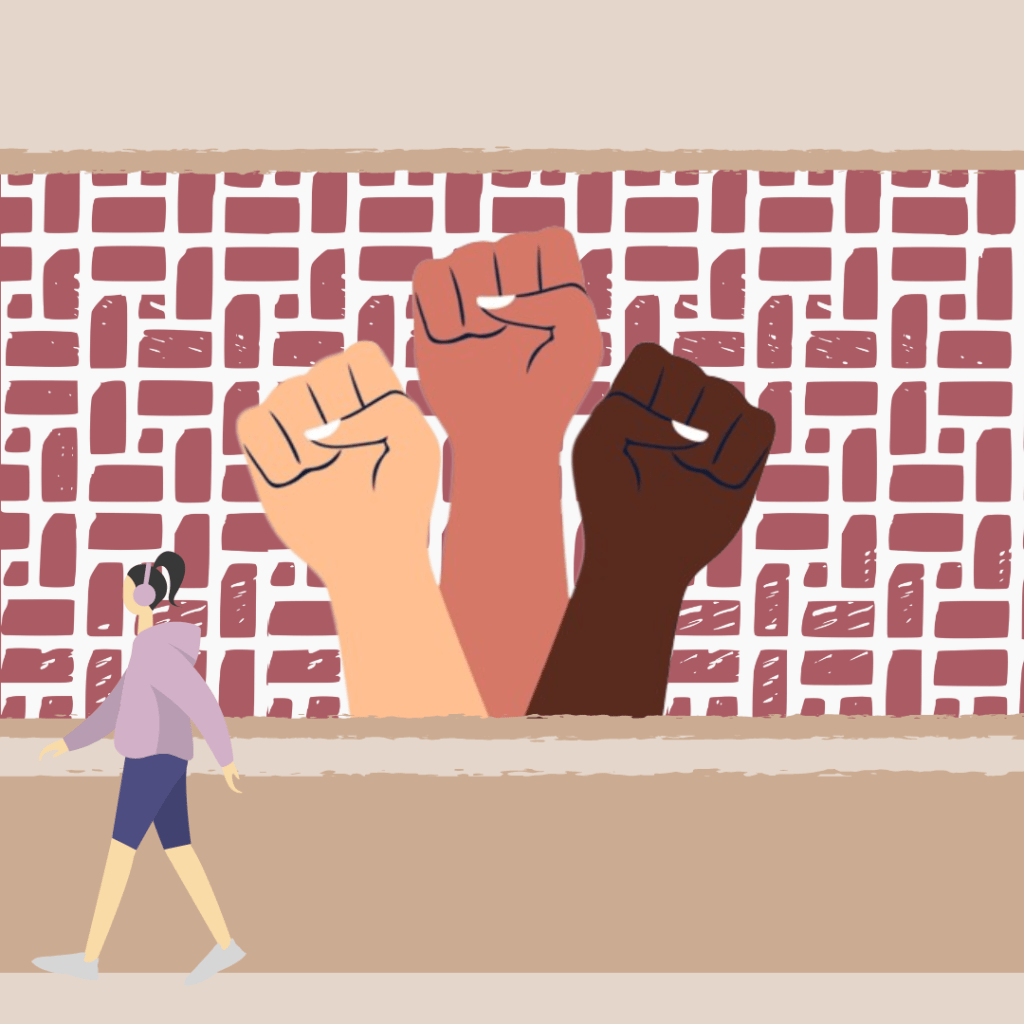
To say that the student body of the Department of Humanities and Social Sciences at IIT Madras is “aggressively apolitical” would not be an understatement by any measure.
The visibility of every discussion by the student body of anything bordering on the political cowers very close to that nice, comfortable margin of unproblematic zero – exactly where its existence as a part of a “politically detached”, “naturalised”, “island-like” technical institute continuously mandates it to live. This very magazine, in fact, has, in its own way (except for flashes in the pan here and there) reflected this reality with next to no self-reflexivity. Perhaps this can even be notched up as an achievement – as a true representation of the Department it sought to portray!
There is definitely a silence that has lived long here, deep in the bowels of a Department whose very existence should have – if it followed faithfully the spirit of the fields it claimed to study, that is – steadfastly prevented its proliferation.
This grand, sweeping assertion of mine must of course be qualified by the position I hold with regards to the limited understanding I have of the department in question. I am of the 2020 Batch, which missed out on a great deal of the course – and, as a consequence, a deeper understanding of the Department – by having a part of it taught online. There is a great deal of context that I may well be missing out on: I only wish to start a conversation amidst what I perceive to be a stifling, deafening silence!
Perhaps a future Opinion piece here will prove me wrong. Maybe this is not even silence at all, but rather all that we can come to expect from the situation that we find ourselves in.
However repellent our unfortunate reality may be to persons of sensibility, the Pandemic Batch of 2020 is now beginning its fourth year in the department. If fourth year isn’t the time to start making grand, melodramatic claims about how your Department annoys you, what year even is, pray tell?
***
The descriptor “aggressively apolitical” was used by a visiting scholar, who described the Department as such after spending two months here interacting with the student body and faculty. This state of affairs has also been noted by several other visitors, and arrivals from other Indian Universities.
This is a descriptor that I completely agree with. It is also a situation that I am entirely complicit in.
I have quite a few reasons to back up this hot take, and several opinions that I’d like to audaciously put forth in a tone that firmly and insensitively sets all that I say in cold, hard stone.
***
It would not be fair to begin this “analysis” without acknowledging the position that the Department of Humanities and Social Sciences finds itself in here at IIT Madras, in the midst of a ravenously technical Institute which doles out student power in much the same manner as they seem to distribute student allowances to their PhD Scholars. Indeed, the place was “meant to be this way” in the first place, wasn’t it?
The students of the scrapped 5-Year M.A. Program – the most “visible” student population of the Department on the Institute’s student activity scene, considering their proximity to the Undergraduates of the Institute – thus find themselves in a sea of mindsets and ways of thinking which (unsurprisingly) tend not to align with the fields that they come to study, and it is a sea which even – at times – actively plays crusading antagoniser to “those preachy, gay, SJW motherfuckers”.
This is the way I see it. Maybe I’m mistaken. I could very well be studying at an Institute where the Sciences and the Humanities have found perfect synthesis and beautiful compatibility – a compatibility which resoundingly reflects itself across the belief systems of both the student populations and those in Administrative positions.
Somehow, I doubt this to be true.
The circumstances I described have, as I see it, resulted in a situation where the average “HS” student’s best strategy is to keep mum about “whatever it is that they study” and just “fit in” silently – that is, if they choose to involve themselves in areas outside of academics at all.
“Shut up and study” is also now a friendly command set down in orientation sessions to incoming batches to the Department. Leave politics out of this Institute, we are not JNU. This is a pure, sanitised haven of immaculate research, and of learning. (A haven that may – only coincidentally – occasionally host the book launch of the serious, “clean” research project that is Snakes on the Ganga, or host such pure, unbiased seekers of the truth as J. Sai Deepak – but let us set that aside.)
“No, no, no child, you don’t understand. Leave your filth at the doorstep! Put your head down and study.”
Study WHAT? What is it that we of the Humanities and Social Sciences ultimately end up studying that exists in this pure vacuum of political divorce?
To seriously study what we do without expressing even a smidgen of political consciousness which at the very LEAST expresses opinion and belief is not only impossible, but actively unconscionable – considering the class, caste and social circumstances of most of the students enrolled in the programme. Even the very minimum of some kind of “performative wokeness” (as it seems to be popularly described by the very serious political scientists who study these sorts of things) among these groups lies still-born in the gutter of this all-pervading silence.
The wide-ranged smattering of disciplines that was such a glorious invite to an enthralling, sexy romance with the Humanities and Social Sciences has become a neutered, fetishised multidisciplinarity. An additional, glitzy certification to the “middle class” attempt to climb the corporate ladder in a manner that apes what the engineering students do – only this time taking advantage of the buzzwords “inclusion” and “multidisciplinarity”. The divide that existed between the Integrated M.A. students and the BTechs has slowly dissolved, as we have begun to think of our course in much the same way as they do: Get done with this hindrance as soon as possible (while making a plethora of extremely original unemployment jokes) and graduate, then milk that IIT tag to death to try your best to get employed right away in the most lucrative corporate position possible, preferably abroad. Screw actively engaging with any of the subjects that are taught to us – all I need is a good grade in a course that I can advertise!
There is no active judgement here – there is no high horse upon which I can sit and lecture those around me. I am subject to all of these forces, and actively reinforce them all through my participation in this system. I myself will follow the incentives that this system of silence peppers enticingly in front of me. And I do.
Most of us are bound by some vague, “middle-class”, unarticulated understanding of the suitableness of an identification on the left side of the spectrum, and the “appropriateness” of holding certain points of view – but that is the extent to which it goes. Why? How? What?
No answers. No public expression of this opinion – at the fear of ridicule, imperfection or (heaven forbid!) the accusation of hypocrisy.
But how and where do we learn about these specifics of the political?
Unsurprisingly, the courses introducing the Political Sciences and the Constitution of India, have of late, also been taught in a manner that the advocates of this brilliant, shining, neutral realm would enthusiastically cheer for. No active engagement with scholarly criticism and papers concerning the thinkers, schools of thought and salient issues under scrutiny in the field, or in the Indian context. Just a Professor who has had every possible “positive” social indicator going for him creating a neutered vacuum of political “understanding” and “insight”, while every now and then speaking contemptuously of student politics and defending eternally some nebulous “process” that he has always been able to access – with no admission of those fundamentally (almost definitionally) left out of its consideration. Caste, and labour politics do not exist. They deserve no mention here.
No acknowledgement of contradiction, no admission of nuance, and the compulsorily schizophrenic complexity of a socio-political existence in a power hierarchy. This privileged space of instruction thus ultimately becomes a platforming of a naturalised status-quo and a preservation of process, without even a firm look at a string of relevant theorists and contradictory viewpoints. The result is a defense of a supposed equilibrium and “process” while barely holding any immediately consequential stake in it – a world which is a stable, self-regulating system which has reached its “natural” settled stage as a meritocracy.
This may well be a valid take on social reality which you can come to comfortably after your own personal reflections.
The tragic issue here is that it is not presented as such a construct, and I argue that it should be acknowledged for what it is – a very particular, ideological take on the world. This sense of complacent, high-handed neutrality thus seeps into the fledgling understanding of a student whose social indicators are already screaming at them to preserve the status quo; thus preventing deeper critical reflection in the study of fields which seek to move beyond precisely that sort of narrow parochialism.
Students graduating from this course will then grandly claim to have “studied political science” in their CVs as they market this “multidisciplinarity” in a country that is now fetishising these buzzwords while simultaneously withdrawing support and liberties to the Arts, the Humanities and the Social Sciences; these fields being the “inconveniences” that they are to the construction of very particular socio-historical narratives.
Stay neutral, let it happen. For this is the new neutral. Get used to it, and shut up already.
Every other Tom, Dick and Harry can organise and shout their opinions about this and that and everything from the rooftops. EXCEPT the people who choose to dedicate years of their lives to studying this, and that and everything.
This is a silence and a “checking of one’s self” that has also bled into the classroom, with Professors complaining loudly and often about the utter lack of opinion and interaction in the classroom setting.
I do not attribute active malice or intent to the way courses like these have been taught. But there does exist a blatant misrecognition of the power that Professors hold in shaping lives and opinions through a proclaimed “neutrality” that is blatantly ideological, and shaped by their own social indicators. Even a mere admission of the existence of this situation would suffice! I am not asking for some “moral crusade”. There ARE Professors who teach this way, with this bare minimum admission, and who aren’t the rabid communists or famous “postmodern neo-marxists” that academia is apparently filled to the brim with.
As students of the Humanities and Social Sciences, we have lost out on so much intellectual and academic development by having our political culture die, and allowing this silence to draw its shroud upon this place of learning. There is no exciting, bubbling place of student interaction where our ideas are allowed to flower or wilt through debate and discussion. Heck, there’s barely even any place to meet anyone in the Department anymore, as common student spaces are actively being shut down. Do your classes here and get out. Don’t linger in any of the classrooms when they’re empty!
Time has changed things for the worse. We have gone from having access to a Department Computer Facility where students could once stay up till 5 AM in the morning (which is now being shut down), to a cramped, twenty-student occupancy Department Library which closes half an hour before classes even end for the day. There is no place for student solidarity to build – for political discussion, or even for the building of simple friendships across batches.
Even a painstakingly constructed, carefully-worded statement released by the Department Student Body in 2021, expressing solidarity with a Professor who alleged caste discrimination from his fellow faculty was faced with anger, and an attempted derecognition of this magazine.
This is not exactly the perfect atmosphere to express opinions of a very certain caliber. But if your politics align to a different spectrum, go ahead. Yell it from the rooftops.
Is it possible to question this silence? I think it’s worth trying, before our extermination as the misplaced, undergraduate vermin that we are is completed with the scrapping of our course.
If you’re reluctant to speak for anyone at the cost of the earth-shattering horrors of perceived imperfection and judgement, at least speak for yourself, and for your opinions on the world – all easily gathered from the various frameworks and perspectives that are shoved down our throats (peeled for inconveniently bitter skins or otherwise) in our classrooms every second of every day that we place our stupid, quivering buttocks on those (I hesitate to call them benches) wooden, semi-comfortable, semi-foldable… chair things.
There is more that we can demand from our experience here, and a higher standard to which we should hold ourselves and our Department!
We are in the death years of this programme. Any eschatology of the 5-Year M.A. Programme must take into account national trends, and acknowledge the complexity of the situation in terms of the various actors involved. It is an eschatology that, in my opinion, is worth reflecting upon at length, and which can provide excellent insight into trends both national and “isolated”.
***
The depoliticised, conveniently neutered reality of a Humanities and Social Sciences Department. The manner in which “alternative” politics is shut down. The power differential between Professors and students in this campus, along with its very particular social make-up. The way in which several courses are taught, to the ultimate detriment of any holistic student understanding. Common student spaces in the department being next to non-existent. The self-imposed, guilt-ridden silence of the Department Student Body. A rapidly narrowing national trend to “acceptable” discourses within the Humanities and Social Sciences.
If you see these as separate, unrelated phenomena, I would say that it is entirely possible to do so, and I roundly applaud your ability to not sink into the marshland of conspiracy theory. But I do think it cannot be denied to those of us of the “tinfoil persuasion” that there is a very specific cumulative effect materialising – the symptoms of which have been brazenly displayed for a while now; the most prominent symptom being the pitifully neutered, depoliticised space that the Department of Humanities and Social Sciences here has allowed itself to become.
The sad, hollow, neutered artificiality of a Department which decks itself out with ostentatious, politically provocative tribal art yet remains “aggressively apolitical” certainly gives us a lens into our times. If the 5-Year Integrated M.A. Programme – this amazingly exciting, unique initiative that planned to introduce students to a whirlwind romance with the Humanities and Social Sciences – did indeed derail into the production of such a soulless, depressing reality, maybe it deserved to die now the pitiful, sudden death that it is about to.
***
 Article 19