About the Speaker – 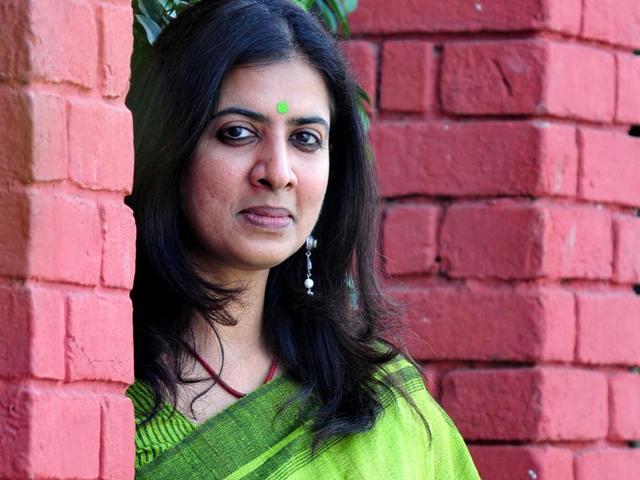
Arundhathi Subramaniam is an award-winning poet and prose writer who has worked over the years as a critic, poetry editor and curator. Winner of the inaugural Khushwant Singh Memorial Prize for Poetry, the Raza Award for Poetry and the International Piero Bigongiari Prize in Italy, she is the author of ten volumes of prose and poetry. Widely translated and anthologized, her recent book of poems, When God is a Traveller (2014) was the Season Choice of the Poetry Society, shortlisted for the TS Eliot Poetry Prize in the UK. As a prose writer, she is the author of The Book of Buddha and the bestselling biography of a contemporary mystic, Sadhguru: More Than a Life. As an editor, her most recent book is the Penguin anthology of sacred verse in English translation, Eating God: A Book of Bhakti Poetry. Translated into several languages, including Hindi, Tamil, Italian, German and Spanish, her other awards and fellowships include the Zee Indian Women’s Award for Literature, the Homi Bhabha Fellowship, the Charles Wallace Fellowship and the Visiting Arts Fellowship. She has been Editor of the India domain of the Poetry International Web since its inception in 2004.
Give me a Home that Isn’t Mine
Ms. Arundhathi began the talk by sharing moments from her life when she felt poetry is what she wanted the most. Her first encounter with poetry was at the age of three. It was the nursery rhymes that left her wondering about the magic of poetry. She feels that prose is more pedestrian whereas poetry is always dancing and the need to connect the dots in poetry is absent. Having grown up as a multilingual, she chose to write in English over other languages as she feels that English marks a real distinction between prose and poetry.
It was while reading The Love Song of J Alfred Prufrock by T. S. Eliot in her grandparents’ house, that she recognised the potential of poetry. To her, poetry is like music. It’s perfectly alright to belong, even if one does not understand. No person crosses the age of sixteen without writing a poem. A love poem perhaps. Everyone can be a writer of poetry. Can everyone be a reader of poetry? Ms. Arundhathi believes that poets should resist readymade language and that is why she always desires to write poems in an engaging fashion.
When asked if there were moments in her life when she felt not at home with poetry, Ms. Arundhathi nods, saying that there are moments when a person feels unfitting even when feeling indulged in doing something he or she loves. ‘Not belonging’ can sometimes be a liberating experience. At such a time, one is standing at the boundary, which gifts us a unique vantage point. Despite poetry being subjective, schools and textbooks take the flair out of a poem by objectification. But when one looks at something for long, it transfigures. Poetry is thus a ‘Dark Art’ to her. It is like a mantra, a distilled understanding of sound and silence. It is an act that embraces the empty space.
Ms. Arundhathi calls herself a secret junkie of spiritual biographies. A poet, in many ways, is a mystic. A poet is always a seeker, not a finder. Engaging questions from the audience, she also spoke about the blurring boundaries of poetry and prose and the use of choice words demanding of a context. Ms. Arundhathi also read out a few poems from her collection. Listening to her talking of poetry in a very poetic manner left the audience spell-bound. The young poets present surely went home with a reaffirmed dedication to poetry and others will definitely reach for an anthology the next time they are in a bookstore.
– Akshay Patil.
 Article 19