
About the Film –
Tirupur aka Dollar City, well known for its thousands of export oriented garment hosiery units and millions of migrant workers, symbolizes a development model where the state machinery, exporters, small and big entrepreneurs, commission agents, trade unionists and workers converge to prioritize export and to earn dollars by ignoring, marginalizing and eventually breaking the laws that protect the environment and workers’ rights.
The film provides an inside view of a successful economic system where there is connivance and consensus between the masters, mediators and the workers, where the ambitions and loyalties collapse, where the rights become a privilege, where duty becomes an opportunity and where one’s desperation is another’s prospect. The fact that there has not been a workers’ strike in Tirupur in the past 20 years, as proudly expressed by an exporter in the film, can be seen as classic example of the Gramscian idea of manufacture of consent.
About the Speaker –
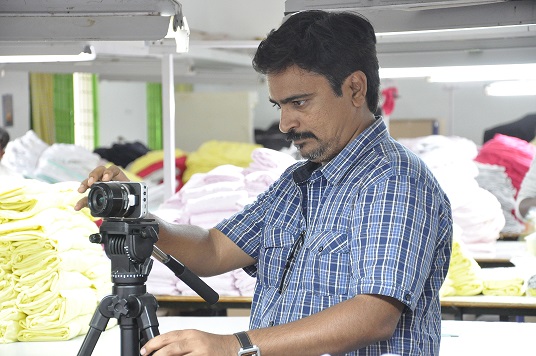
Mr Amudhan R. P. is a documentary film maker and media activist. Along with local youth, he founded ‘Marupakkam’, a media activism group that is involved with making documentaries, organising regular screenings, film festivals and media workshops in and around Madurai. He has been making documentaries since 1997. His prominent films include two trilogies on caste and nuclear radiation. ‘Shit’ has won the best film award at the One Billion Eyes film festival in 2005 and the National Jury Award at the MIFF 2006. Amudhan R.P. founded Madurai International Documentary and Short Film Festival in 1998 and has been organising the festival since then.
Discussion post-screening –
After watching the documentary, the audience was left with many questions and insights. Mr Amudhan initiated the discussion by narrating his experience of directing the film. Some of the main questions that Mr Amudhan aimed to answer through the film were – Why were there no workers’ strikes between 1990 and 2010? Has the system taken sufficient care of the workers? Or is it just that the workers were afraid of losing?
The audience, which included faculty, students and guests, felt that the filming technique of the documentary was very inclusive. Although the interviews were long in duration, they were presented in small pieces, interspersing among various strata viz. the workers, the owners, the supervisors, the providers, etc. The absence of a narrator allowed the viewer to shift perspective in a free an unrestrained manner. The employment of this kind of a sudden reversal of standpoint kept the viewer involved throughout. Some students expressed their shock that there was a Bangladesh closer home. Sociologically speaking, it was surprising to note that the workers seemed completely comfortable with the casteist setup. There seemed less or no resentment at such stereotypical assignment of labour. It was observed that the movie did little to uphold the significance of other factors that influence the workers’ lives and living conditions, i.e. environmental and health concerns such as pollution and sanitation. The effects of globalisation were also visible in the workers lives. The discourse around the workers’ strikes was typical of the Industrial Revolution despite the objectives being different. The inconclusive ending of the film gives rise to a larger global question. If Communists are favoured less and are going out of power, who is the true representative of the workers?
The discussion saw a lot of stimulating and thought-provoking opinions and insights.
- By Akshay Patil

