
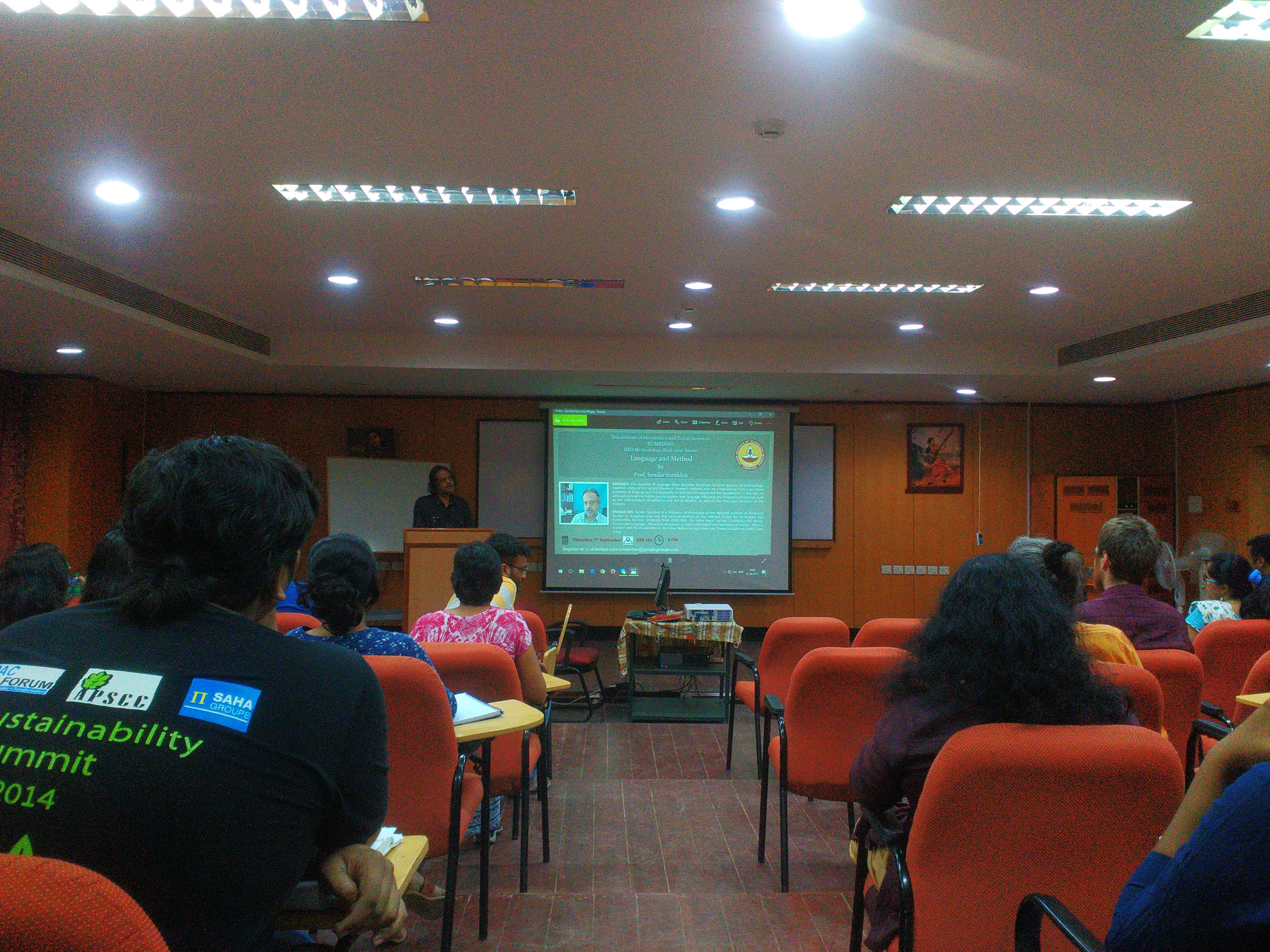
The first lecture of Research and Development (R&D) lecture series for the academic year was delivered by eminent philosopher of science Prof. Sundar Sarukkai on “Languages and Method”. The inaugural event commenced with a welcome note by Dr. Santhosh R (Assistant Professor at the department), a faculty coordinator of the R&D Lecture series. Dr. Santhosh welcomed Prof. Sarukkai and briefly outlined the conceptual plan of the lecture series.
Prof. Sarukkai primarily dealt with the debate surrounding the understanding of mathematics as a language of natural science and its implications on the realm of social science methods. He began by contesting the secondary nature of language as perceived by the natural scientists/social scientists, where language is considered as secondary to the appearance of the world. As a continuation, he extended to the central tension in all science which is the question, “What is the guarantee that language has the capacity to capture the truth?”
Language in a particular field of enquiry is the a certain mode of disciplining it, with a consensus, thereby enabling communication. There is an isolation and bias in every field of enquiry; Newton for example, through his writings renders language nominal in favor of geometry. This, however, is in no way a reductionist exercise. In spite of the bias, he sees the scientific language to be self-aware of itself. Scientific writing which uses various tools such as diagrams and graphs in addition to the written word are attempts to illustrate or speak of the phenomena through various modes; this, for him, is an example of the self awareness in scientific language. In social science research, there is a tendency to adopt the language without self-awareness. Such tendencies in research can be reductionist and one needs to be constantly reflective of the methodology that one engages in.
Keeping this question as a premise, Prof. Sarukkai explored the idea that mathematics as a language does not merely describe the natural world, but also seeks to explain many of its process and predict new objects and phenomena. The language of mathematics which deals with phenomena in abstraction, after ripping off meaning from language, goes on to fill it with meaning. This process according to him is highly enabling, as it opens up possibilities for the language of mathematics to engage with imagination and ambiguity.
He finally commented on the lethargy in research when it comes to addressing the question of language. He said that the question of language is of paramount importance in research, be it natural sciences or social sciences; the interventions of humanities and social sciences in understanding and commenting on the nature of scientific language is important not just for research in social sciences, but also for research in the natural sciences.
Report by Dayal Paleri.
 Article 19