
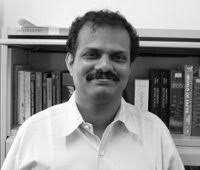
As part of the Research and Development (R&D) Methodology Workshop series, Prof. Bino Paul, Dean of School of Management and Labour Studies at Tata Institute of Social Sciences Mumbai, shared his views on “Shaping of Economics: Reflections on the Making of Ideas”. The session commenced with a welcome address by Dr. Santhosh R (Faculty Coordinator, R&D Lecture Series). Thereafter, Dr. Subhash S., (Associate Professor at the Department of Humanities and Social Sciences), introduced the speaker to the audience as being “an eminent and unconventional economist.” Justifying the tag, Prof. Paul provided multiple possibilities of looking at the evolution of economics, often prompting the audience to air contrary views.
Prof. Paul began the lecture saying, “our conversation is on how economics has been shaping human activity and how noisy it has been throughout”. He stated that learned scholars resort to noisy data to present economics in a tidy fashion. The use of railway passenger traffic as a measure of inter-state migration in the recent issue of Economic Survey of India (2017) was quoted by as a case in point. He continued to cite cases that illustrated the cacophony present in economics since its inception as a discipline of the social sciences. One of the cases showed that the assumption of ‘self-order’ — the built-in capability of economies to self-correct through price and quantity adjustments — breaks off in the context of dignity of labour, irrespective of payment.
Accumulation of capital exploits and alienates labour in any given mode of production, often bifurcating the society into the fortunate capitalists and the hapless working class, resulting in unceasing struggles. The system expected agents to order themselves. This mechanism of self-order holds true for situations that involve no recognition of human behaviours such as emotion, trust and cognition. Economists do not consider the cognitive part of human activity, and the discipline continues to be an artefact. Mainstream economics, which downplays this issue, continues to be articulated as the voice of the larger society and of academia.
The Smithian lineage of labour identified that societal equilibrium may be achieved at the natural price, where the market value of produce is greater than the bare minimum requirement for the survival of labour. This practice was continued in the Ricardian tradition of comparative advantage, considering how cheap the labour was. With the tools of physics and calculus influencing economics, everything was reduced to comparing incremental benefits and costs or, in the case of labour, ‘incremental pleasure (gain) and pain’. When the discipline realized that there were multiple points where incremental gain equaled incremental pain, John Nash introduced the tool of rational bargaining to facilitate self-order. Herbert Simon, seemingly contradicting John Nash, introduced the concept of ‘bounded rationality’, which places limits on the human rationality and emphasises human tendency to succumb to emotions and trust in the process of decision-making. Keynes acknowledged the limits of economies to self-order and proposed an alternative tradition of planning and government intervention.
Different lineages took the discipline of economics to overlapping paths in explaining common issues, giving rise to various methodologies, or ‘world views’. The status of labour, capital, land, and natural resources and their coordinating mechanisms are diverse across different schools of thought. Prof. Paul highlighted the influence of ‘historicism’ in collective bargaining and decision-making in Austria, Germany and the United States. In order to arrive at collectively beneficial solutions, institutions are necessary and institutional thinking has gained prominence, thus giving way to the rise of institutional economics.
The lack of convergence of ideas within economics is what makes the discipline noisy. Numerous methodological issues make the process of filtering voice from noise extremely difficult. If economics continues to be noisy, it will steer towards becoming a discipline of data carpentry rather than a theory-based discipline. He then concluded the lecture with information on how to win the Nobel Prize!
An interactive session followed, in which both students and PhD scholars were active participants. Rather than displaying systems of complex equations, Prof. Paul’s attempt to trace the philosophical origins of economics served to attract non-economic persons as well, thus accounting for a completely filled HSB 356.
Report by Sanjeev Vasudevan.

