
TL;DR: nyc buk. even dumb ppls lyk me cn understnd. nyc speeches anol. made dumb ppls lyk me think. panel discussion vv fun and thot provoking. stories abt writing the buk + thot expts about imprtnce of ideologies in real wrld. i think i am less dumb now.
Prof. Arvind Sivaramakrishnan, beloved of all for his engaging and stimulating classes, and the occasional cricket anecdote showing up in his lectures, launched his book on Thursday, 5 October 2017. The book, titled Introduction to Political Ideologies: Contexts, Ideas, and Practices, is published by SAGE. Intended as an introductory textbook, its accessible writing style and relevant examples were frequently mentioned during the launch.
The event began, as events at HSB 356 usually do, with light refreshments (free food!) outside the hall. As we eventually made our way inside the comfortable air-conditioned room, we spotted some familiar faces, and some not-so-familiar ones. Aside from the publishing team and the usual Department Fixtures, the roving eye could spot Dr Sadanand Menon, Prof. Nalini Rajan and Prof. Probal Dasgupta.
The panel discussion was moderated by the genial Prof R Santhosh, and saw lively engagement by audience members. As students and academicians pondered upon the practical instances which indicated the power of ideas, the overarching theme of the evening was the need, as citizens of society, to engage more with ideologies and their manifestations in the events around us.
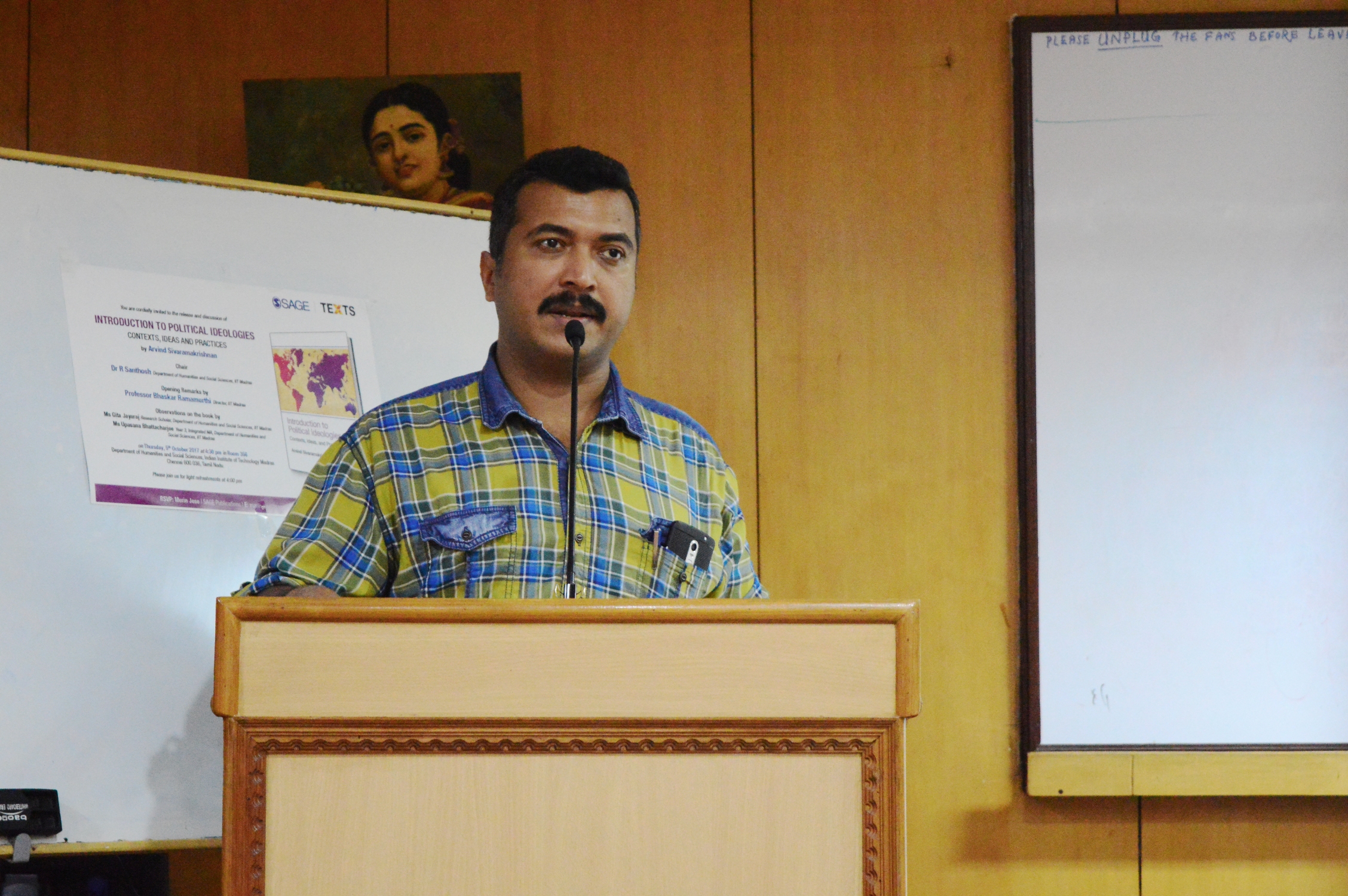
Introductory Remarks (also known as: The Speeching Bit)
Having warmly welcomed the audience, Prof Santhosh opened the speeching bit with the nature of politics and the integral part that ideologies and ideas played in connection with it. He name-dropped the social thinkers (you know—those names you hear in first-year PISS course and sagely nod when they’re brought up in subsequent years- Comte, Durkheim, Weber et al), touching briefly upon their main contributions; presenting a brief history of ideas, as it were. Daniel Bell and the postmodern take on ideologies was also mentioned, and was a recurring theme. Having mentioned that ideas could be emancipatory or oppressive, depending on the way they’re used, he threw light upon the recent resurgence of frightening, inhuman ideologies in ‘neo-’ incarnations. His conclusion was the need to engage more with the ideological narratives operating within society.
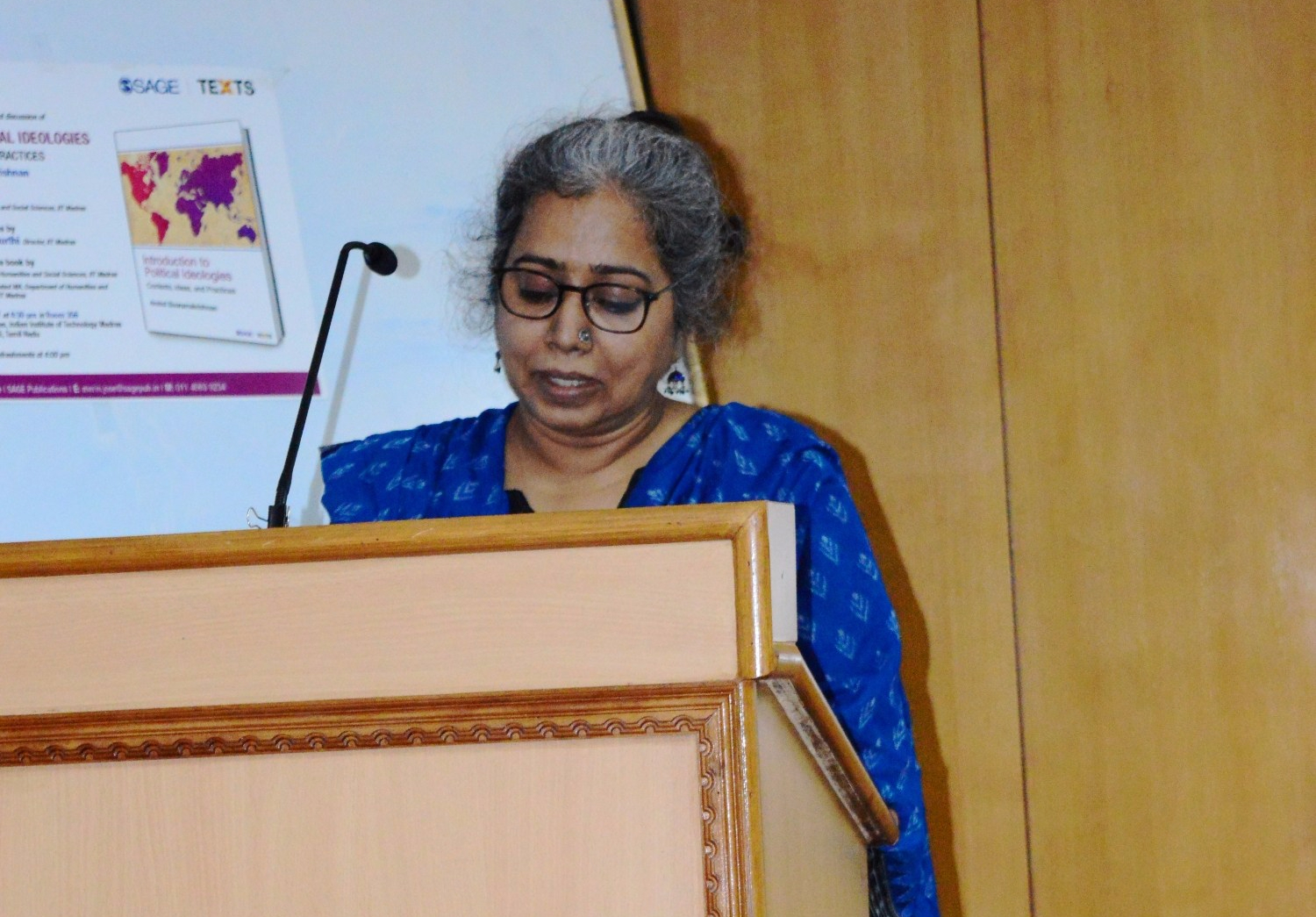
Ms Gita Jayaraj, a research scholar pursuing her PhD in the department, was the second to address the gathering. She, as well as the other student panelist, had taken Prof Sivaramakrishnan’s course on ideologies. Her opening remarks were on the course itself, on its well-organised structure and usefulness, and she extended these properties to the book. She touched upon two chapters of the book. One was the (fourth) chapter on Marx, which focuses on Marx’s own writings. The text, she said, attempted to understand him as a thinker and shaper of economic forces, and not merely as the fountainhead of communism. The other was the (eleventh) chapter on nationalism, whose idea of a nation and of nationalist icons and symbols, she found particularly relevant, considering the times we live in.
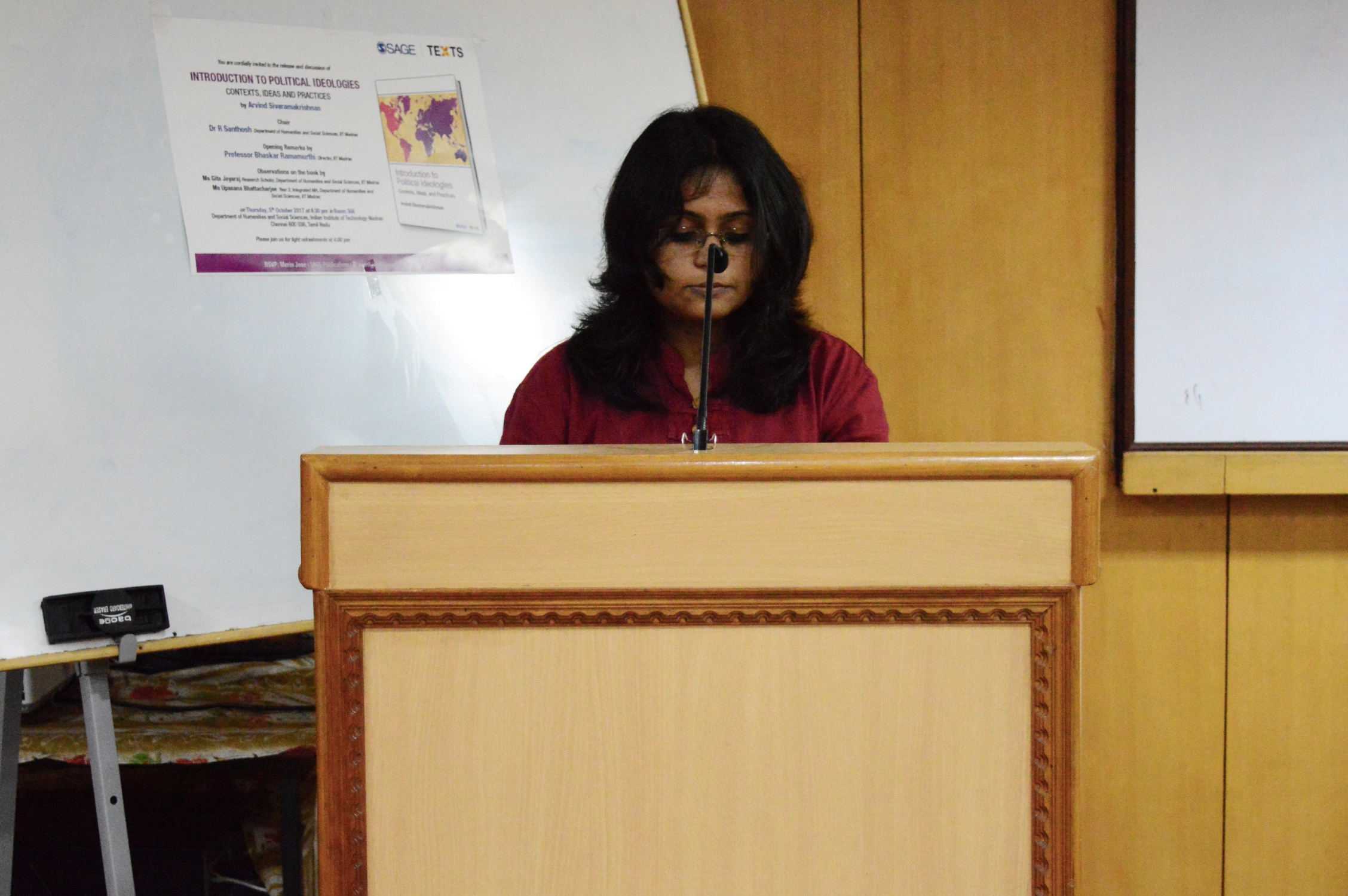
The third speaker was Ms Upasana Bhattacharjee, a third-year MA student. Having opened with her impressions of the book—its lucid, comprehensible writing, with well-chosen and illustrative examples—she elaborated on the reasons she found the book important. Understanding different ideologies, she said, helped us place our assumptions, as well as events around us, in a larger perspective. She put forward the idea that the technological structures that our lifestyles heavily rely on are run by people who have no framework of accountability. Two trends that illustrate this are the spread of fake news and the occurrence of human (gender, race and other) biases in artificial intelligence systems. The solution, she said, is making available training in ethics for the technologically literate people who create and maintain these structures.
Author’s Remarks
When asked about his writing process, Prof Sivaramakrishnan, deadpan as always, had a few interesting anecdotes to share. Having mildly reprimanded Prof Santhosh for reminding him of such awful things, he talked about how Prof. Nalini Rajan (Dean of Studies at Asian College of Journalism) encouraged him to write what would become this book.
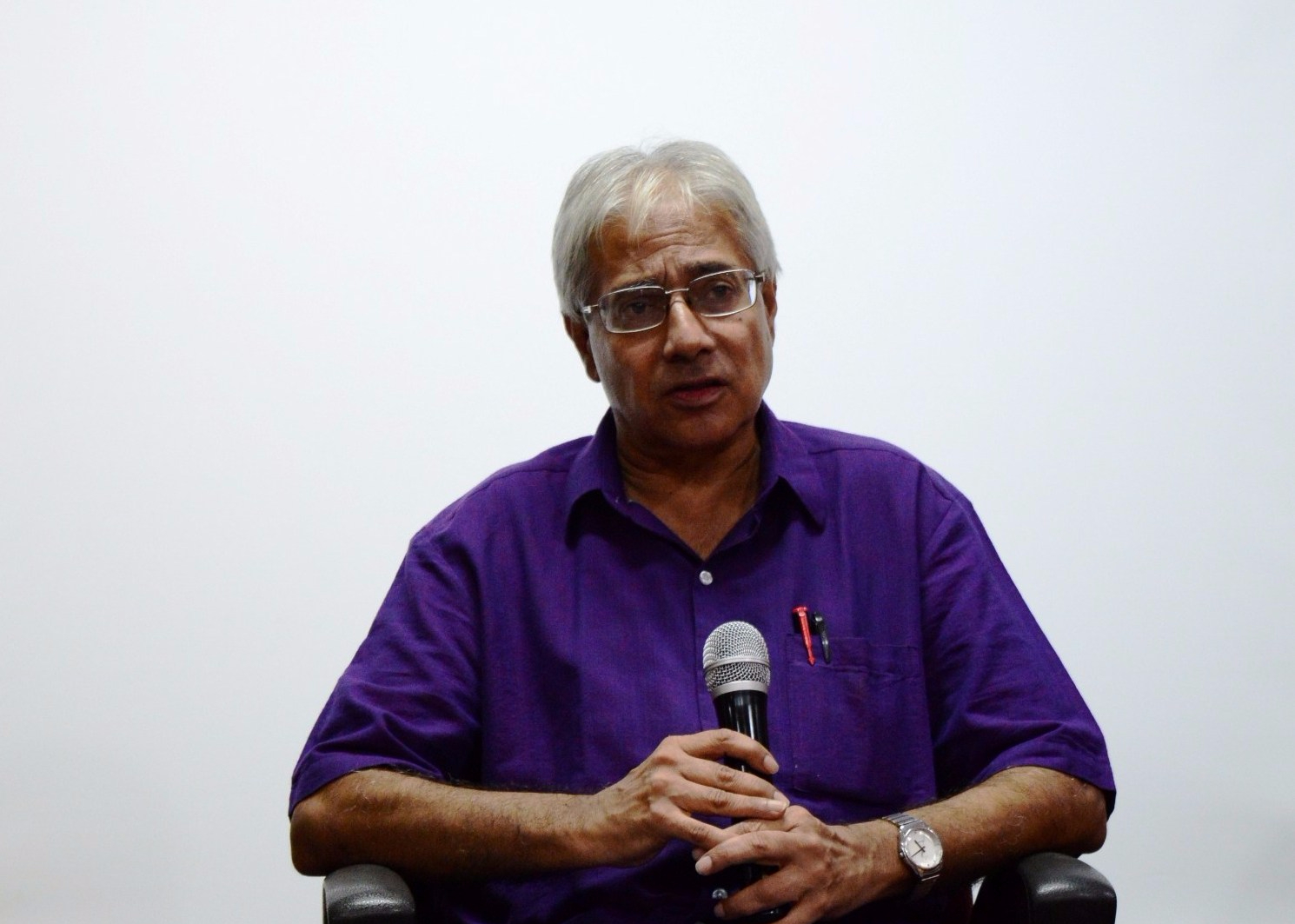
His first draft was entirely by hand, on one-sided sheets left over from his editorship at The Hindu, and took fifteen months—the advantage of doing so, he said, was that he could do it whenever he got a few extra minutes in the day. The examples he used were from all around him, especially from the newspapers, and were quite easy to find. His advice on writing (repeated patiently to his students whenever he assigns a term paper) is to first get a draft down, no matter how horrible it is. Editing it after is always the easier part.
He briefly talked about the hassles he had faced before he could get the book published—the first house he approached boasted of an unprofessional and vicious first reviewer, after which SAGE accepted the book. He mentioned how he was advised by the editors to remove some material commenting on the Hindu far-right, in anticipation of it causing trouble, and how, after initial suspicions of censorship, he eventually complied. He added that material of such nature would not cause problems were it in an academic work, but its presence in a textbook was quite possibly considered problematic.
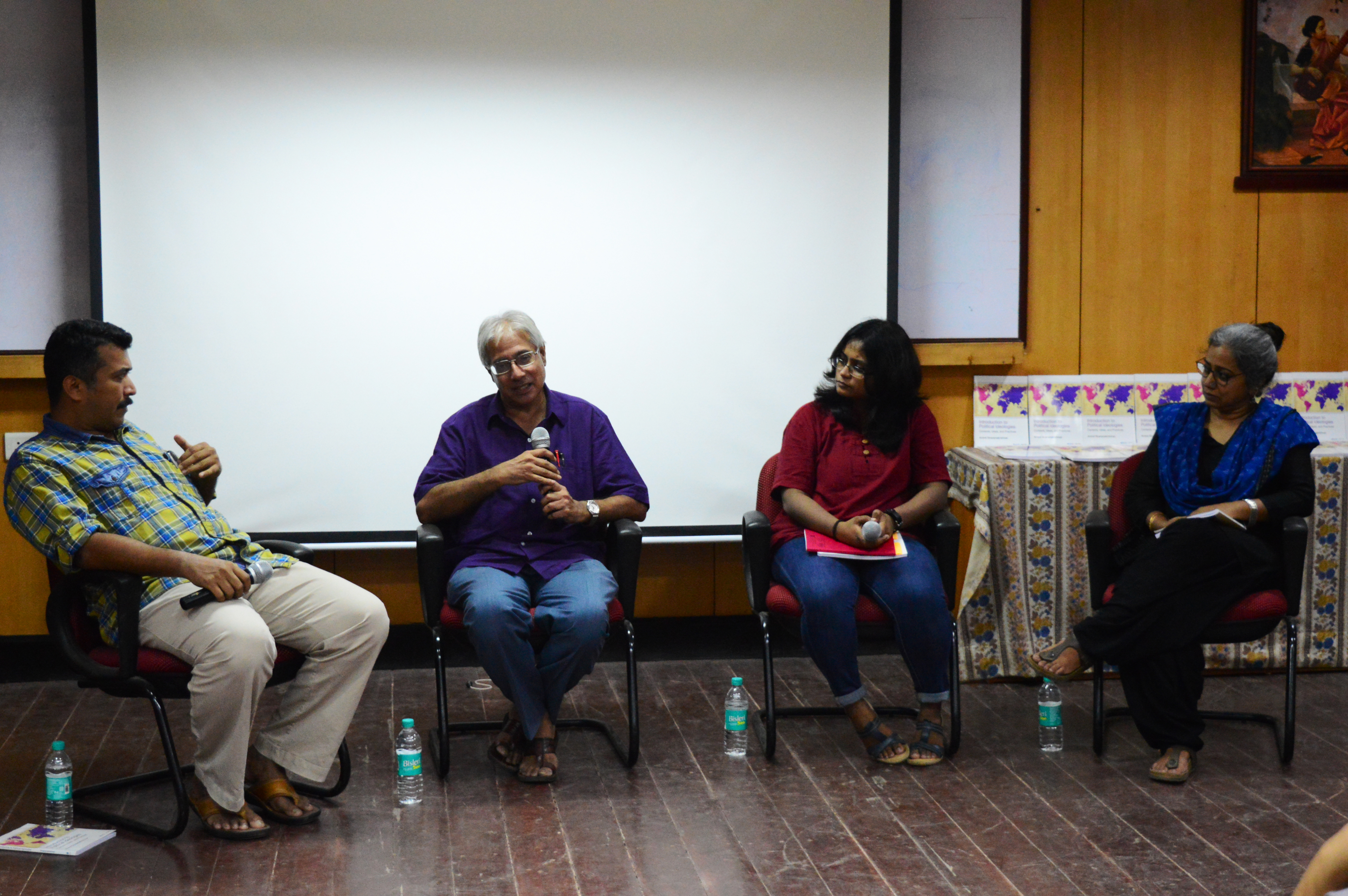
Panel Discussion
The session was then opened to questions from the audience.. Prof. Sivaramakrishnan’s answers were often accompanied by discussions centering around current and historical political events, and the role played by the predominant ideologies of the time. Such events included: possible links between the Hindu far-right and different fascist regimes (Prof S cited an interesting historical article that touched upon this- a paper by Maria Casolari. Bobbing heads were indicative of the students who had taken his course nodding excitedly, glad for once to be able to recognise an academic reference), and the anarchist streak detectable in the recent events in Catalonia.
There were also questions of a more abstract nature: the need for elements of the pedagogical system to present different ideologies in an equitable and fair light; the possibility of material such as the textbook being not just an academic description of an ideology, but a means by which different ways of thinking can be implemented in society; the possibility of similar material being misused; whether there can be political discussion without ideology; and the complete immersion in a particular ideology rendering one’s mind politically numb. One of the many thoughts that emerged was the idea that a reflective, intellectually engaged public is an asset to society, and more of a threat to an authoritarian system than one would think. We were, therefore, encouraged to engage with the events around us.
The book launch came to an end after these and other questions were hashed and rehashed, and left us all with significant food for thought, a powerful zeal to read the book after purchasing it and not just let it languish in room, like souvenirs from other book launches, and slight mental fatigue (at least in this author).
Report by Naomi Karyamsetty
Photographs by Ashraya Maria

