
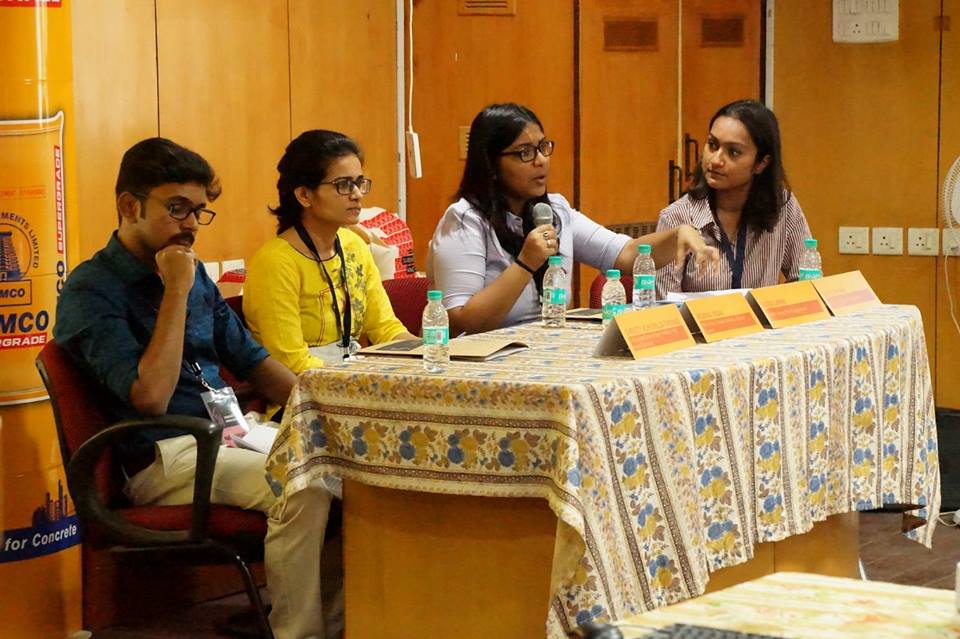
The first day of the DoHSS Annual Conference 2018 saw a very interesting and engaging panel discussion centered on the theme, “Subjugated Knowledges in Music”. The panelists were Christy Kuruvilla Thomas from St. Joseph’s College, Bangalore, Ekata Lahiri and Ishita Sharma from TISS Hyderabad, and Monika Yadav from IIT Bombay. The session was moderated by Prof. Srilata.
The participants first introduced their research papers. Christy’s paper titled “Subjugated Knowledges in Music: The Negro Spiritual” was about the Negro Spiritual experience as a form of critique and resistance. In the United States, when slavery was prevalent, the slaves were forcibly converted to Christianity. This was done to civilize them and to exert greater hegemony over them by co-opting them into the dominant institution of Christianity. However, the slaves who were perceived as ignorant and subservient, were people with their own aspirations and ambitions. Using Christian themes, they created songs that also served as a disguised means of resistance against the White man’s oppression. How they created a discourse of resistance by aligning with the dominant ideology was well explained by Christy, who also referred to Foucault’s concept of hegemonic discourses. These works soon receded into oblivion, and they were misconstrued to be simple hymns.
Ekata and Ishita’s paper titled “Rekhti: Verses that disappeared” studied a form of Urdu poetry that had faded into obsolescence. Rekhti was different from other forms of Urdu poetry, notably the Ghazal, because of the themes of female sexuality that were explored through this genre. Despite being written employing a feminine perspective, Rekhti poets were almost exclusively men. By trying to understand the possible origins of the genre, and how it came under heavy criticism from the patriarchal and religious establishments for its “lewd” depictions of women that did not fit into the patriarchal narrative, the relation between patriarchy and literature was analyzed. The Rekhti is of great literary and cultural significance because it dealt with themes that were far beyond the ambit of conventional discourse back then. It was far ahead of its times.
Monika’s paper titled “Folk Songs, Textual Analysis and Culture Studies” was on Folk Songs in rural Haryana. She did a textual analysis of folk songs sung by Haryanvi women in rural areas. These songs serve as ethnographical narratives detailing the customs and practices prevalent in their society, and how through the institutions of marriage and motherhood, shape their lives and redefine them as symbols of honour. These songs show a glimpse into the inner worlds of these women. The construction and performance of narratives wherein women reclaim control of their lives, gave them agency. These songs are a means of critiquing and resisting the oppression of the patriarchal structure, and also reveal their struggles, beliefs, and aspirations. It is also interesting because, in a way, these songs display both a challenge to patriarchy as well as a reaffirmation of its values.
The presentations were followed by a Question and Answer session, which was brief, yet interesting. The panelists fielded questions from the audience on different aspects of their work. The session was concluded with a remarks from Prof. Srilata, thanking the presenters.
Report by Rahul Jose

