
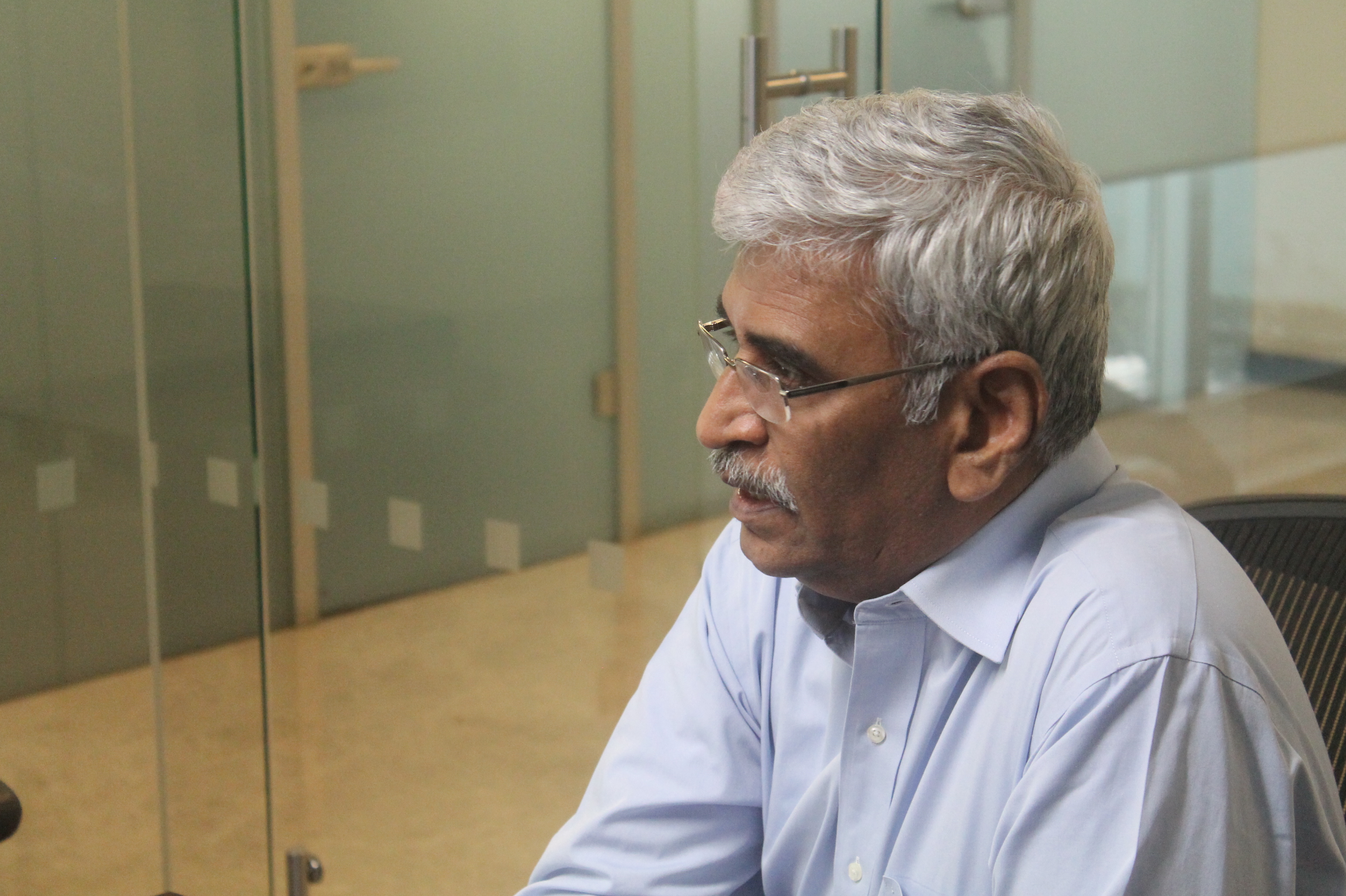
Shweta Venkatesh and Abhinand Shankar in conversation with A.V Dharmakrishnan, CEO of The Ramco Cements.
The man across the table listens to us seriously as we ask him the question every interviewer unfailingly does and smiles a small smile. He hands us a magazine – ‘The CEO Magazine’ – turned open at a leaf titled ‘Cementing Growth: AV Dharmakrishnan, Managing Director & CEO of The Ramco Cements’, and bids us to read it. We read.
AV Dharmakrishnan’s modest response to our question – ‘Tell us something about the company and how you came to be its CEO’ – was no boastful gesture. Instead, it was the action of a man who is not inclined to talk about himself. The article shown to us outlined AVD’s career – his thirty years spent in employment in the company before becoming the CEO, his time as a non-executive director at Rajapalayam Mills, and his involvement with The Ramco Cements at all levels of functioning. His quiet response that he had nothing to add to the content of the said article by way of an answer to us led us to other topics.
He was keen to talk about the company and its growth. Begun in 1961, the company owned a single plant which was the sole provider of their revenue Today, however, the company is one of the largest cement manufacturers in the country.
Their Corporate Social Responsibility (CSR) programmes began in spirit long before the term came into use. Hailing from Rajapalayam, a small town in southern Tamil Nadu, AVD, like his predecessors, ensures that a sizeable portion of the profits contribute towards the setting up of schools in Rajapalayam. The establishment of the P.A.C Ramasamy Raja Polytechnic College by the founder of the company is one that is honoured and maintained by The Ramco Cements. AVD asserts with quiet pride that the college campus is ‘much better than IIT’s’. The Polytechnic College is free of any plastic litter and is maintained so by the people there. This, he says, speaks of the values that one is taught.
‘We are very spiritual here, and value culture,’ he says. ‘ And of course we want to teach young people about our values.’ He recounts an instance when the entire turnover of the company was given to charitable trusts by the founder. Today, he says, the company does a lot by way of implementing the values they hold in high regard. The educational institutions, the Polytechnic college, the training provided to their workers, and the donations made to temples speak in their favour.
The employees of the company are not simply numbers on a sheet of paper, they are, for AVD, human beings who are ‘taken care of’. Not a single moment of manpower has ever been lost, in the company’s fifty-six years of existence, on account of labour unrest. The associates, suppliers, and clients of the company have never expressed dissatisfaction either. ‘The common belief is that companies squeeze their clients for all they’re worth, but that’s not what we do.’ Their intention being that no person, not client, lose money on their account, they also intend for their client to be able to make a good profit from their business dealings.
Loyalty is a virtue that is prized highly by the company. The senior team, comprising the CFO Head, Head of Marketing, Head of Technical, Head of Human Resources- have been with AVD for nigh on twenty-five, some even thirty years now. ‘The first three years are the hardest, that’s when you get to know a person, how they work, what their values and ideas are. But once they’ve been with me for twenty-three years, they’ll be with me forever,’ states AVD with quiet confidence. Admittedly, The Ramco Cements utilises the best and latest technology they can obtain in their factories, but AVD says human beings as people are worth more than any piece of technology could ever be.
The technology used is done so as to ensure that the cement produced by the company is done so with minimal pollution to the environment. Displaying a formidable knowledge of the company’s minimal-polluting stance, AVD mentions ElectroStatic Precipitators (ESPs), and their being the first company in India to use them, ‘back in the 1970s when nobody talked of the environment’. Despite the high prices spent by the company to install ESPs in their plants (given that new technologies are far from inexpensive when first launched in the market), they realised the damage a factory producing fumes and fine particles of cement could do to the neighbouring towns and environ. AVD smilingly confesses that an additional, perhaps more pressing reason could have been that, when seen on a large scale, a sizeable quantity of cement was also being released with the fumes. The ESPs would trap all of that, which could be extracted and used as inferior quality cement. The cement company is the only one in the country to have won the Four Leaves Award for dust-free and clean factory premises.
The company’s interest in other, renewable sources of energy is evinced by the fact that despite the cost and uncertainty, The Ramco Cements are one of the largest owners of private-sector wind farms in India. A considerable amount of research is also being done on producing energy from waste, which serves the double purpose of helping the society as well as lowering the company’s costs for fuel. Their willingness to adopt innovative methods of production that are relatively environment-friendly is a source of satisfaction to AVD.
Perhaps this interest in technology and innovation prompted their interest in the DoHSS conference for the year 2018? AVD denies it not. He also cites the long relationship the institute has had with The Ramco Cements. The institute has, for a considerable number of years, been responsible for analysis of cement grades and quality for the company. Their current project in collaboration with the Ocean Engineering Department involves the construction of a private jetty some thirty kilometres south of Cuddalore. Another ongoing project concerns the recent shift in the classification of Madras as Zone 2 for seismic activity. This means that all buildings must necessarily be studied for structural stability and a certificate of safety granted by certain institutions as listed by the government. This has led The Ramco Cements to collaborate with IIT for a number of analyses and data studies.
AVD’s gentle refusal to dwell upon his personal life, apart from a few general statements left us with smiles. It was easy to see that AVD relied upon his senior team and held them in great respect, a sentiment whose reciprocation was visible to us.
Interview by Shweta Venkatesh
Photograph by Manjith Nair

