
The second panel explored questions surrounding what constitutes subjugated knowledges in art, craft and performance. All the papers looked at the hierarchies implicit in production, at the production of bodies and subjectivities and point towards meanings that cannot quite be contained. A brief introduction by the moderator Dr. Kaamya Sharma was followed by three very interesting paper presentations.
The first paper titled The politics of performance: A case study of changing forms of Lavani and its knowledge production in contemporary Maharashtra was presented by Ms. Sejal Yadav. Drawing upon the ethnographic work carried out by the author as part of her M.Phil thesis at the Jawaharlal Nehru University, the paper provides a comprehensive look at the infrastructures of Lavani performances and audiences and the moral financial economy that coalesces around them. Ms. Yadav introduces the different forms of Lavani, emphasizing the power relations that persist between performers and audiences. In the Diwan khana form of Lavani, which is performed in an intimate setting, audiences decide how long performances lasted and how much dancers would be paid and could walk out in between if they were not satisfied. Fluidic, erotic movements characterize the dance form and most performers are women from the lower castes. In its erotic form, sexual positions, foreplay and manipulation feature in Lavani. These Lavanis are not performed in contemporary times as appropriate audiences, who would not resort to mere commodification of the performance body, but rather understand the nuances involved in performance, are sparse. The influence of Bollywood and Marathi film music and the decrease in young performers are frowned upon by veterans. The author concluded by touching upon the politics behind the banning of Lavani in the 1940s due to its obscene lyrics and movements and upon the efforts of the Tamasha Parishad Samiti to sanitize Lavani and place it within a statist nationalist framework that projects its sanitized form as a cultural art form from Maharashtra.
The second paper titled Art, Craft and the knowledge of a Karigar was presented by Ms. Nikita Kaul, who is pursuing a PhD at the Department of Sociology, Delhi School of Economics. The paper traces the state of the Karigar artisan in the politics of craft revivalism. Like the previous paper, it is rooted in ethnographic work. The paper revolves around the “karkhana” or the workshop, the “ustad” or the master and the “karigar”, the walnut carver. The author begins by recounting an experience where a karigar, Ghulam, opened his karkhana at dawn and drew an ornate design of a vase with deer and floral motifs, which “came to him in a dream”. This experience goes against the dominant discourse of artisans lacking a sense of design, of being too rooted in tradition to innovate. In the state’s attempts to encourage collaborations between artists and designers, there arises a separation between the art and the craft, the head and the hand, the episteme and the techne… The author explores these dichotomies and frowns upon their legitimization as a social fact. The role of designers becomes one of “epistemizing the techne”, of developing a language that has till now remained unspoken. The karigar’s knowledge is rendered indexical, accessible and reproducible. The author concludes by noting that artisans themselves employ this self-degrading narrative for their own benefit.
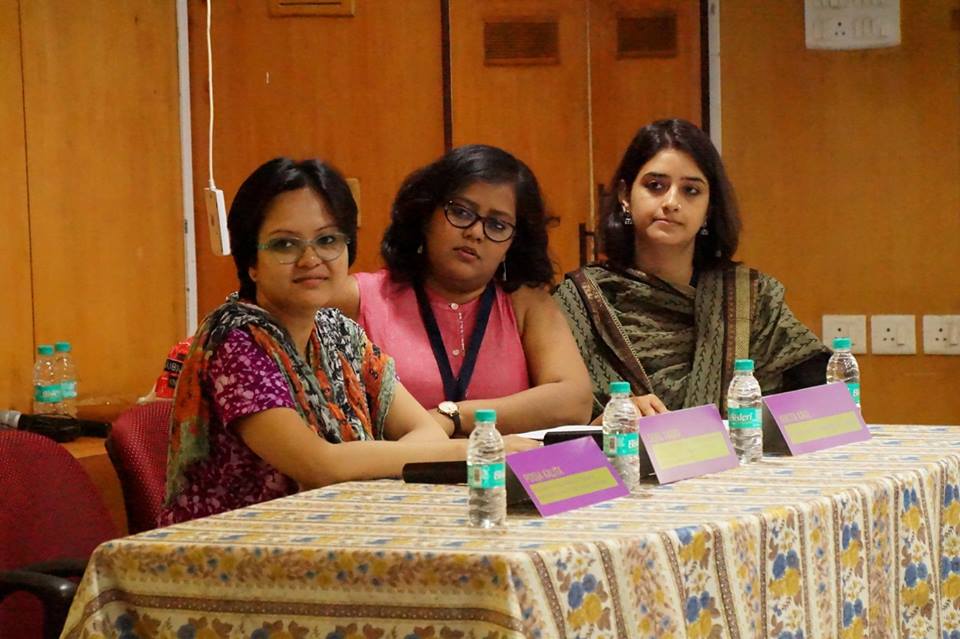
The third paper titled When women narrate through art: Towards an Understanding of South Asian Feminism/ Feminisms was presented by Ms. Pooja Kalita. The paper attempts a deconstruction of art at the etymological, historical and geopolitical level. Unpacking the category of ‘South-Asian’, the author sees art as a medium of power exercised, often in subtle ways, against the patriarchal nation state. Voices otherwise silenced, feature in the artworks by women, which range from quilt making, which is said to challenge both class and patriarchy to contemporary art exhibits in museums. The paper goes on to examine the artworks of Naiza Khan from Pakistan, Anoli Pereira from Sri Lanka and Tayeba Begum Lipi from Bangladesh. Naiza Khan portrays the body as a site of contradictory messages. Anoli Pereira’s series “I Let my Hair Loose” challenges the male gaze and bourgeois feminism. Tayeba Begum Lipi’s “I do not wear this” features a bikini made of razor blades. While the razor blades symbolize women’s entrapment in society, they also act as a shield. These works and many others move beyond simple aesthetics. The author ends by questioning whether only a particular group of artists get seen. The institutions of caste, class, religion and patriarchy play a significant role here.
After the three presentations, Dr. Kaamya summarized the crux of the three papers wonderfully and offered suggestions. Sejal’s work would benefit from a better centring of the performance body, which was subsumed against other claims. A deeper exploration of the history of craft would have enriched Nikita’s paper. Pooja’s paper had deep symbolic potential and a deeper exploration of socio-cultural practices and insights imminent to the artworks themselves would benefit the paper.
The audience posed the question of the state’s involvement in art and craft production to Nikita and Sejal. Nikita responded by saying that the state involves directly, through policy initiatives, but also in more subtle ways, through the creation of discourses on craft and artisans. In tourist brochures of Kashmir, the two recurring images are of beautiful landscapes and of an artisan’s hand working. Sejal remarked upon the state employing its ideology in art. The appropriation of Lavani as a dance form from Maharashtra, the initiative to reserve seats for women in an audience, that is traditionally wholly male are some examples.
Nikita was also asked about the influence of militancy on craft, to which she responded in the affirmative. A new material culture of the man with a gun begins to feature in carvings and sculptures. When Sejal was asked about caste feminism and the Ambedkarite view on Lavani, which pitted itself against the performance of Lavani, Sejal replied that she was pro-performance, to the extent that there was consent and no exploitation. Sejal encouraged students who would be interested in working on similar projects in the future to look at vernacular literature, for therein lies a wealth of material.
Report by Ashraya Maria

