
The first of the post-prandial panels for the day was chaired by the genial Prof. Sudarsan Padmanabhan. Being titled ‘(Un)Covering and (Un)Knowing: The Poetics and Politics of Knowledge Production’, the panel featured three papers presented in a clear, well-thought out and surprisingly accessible fashion.
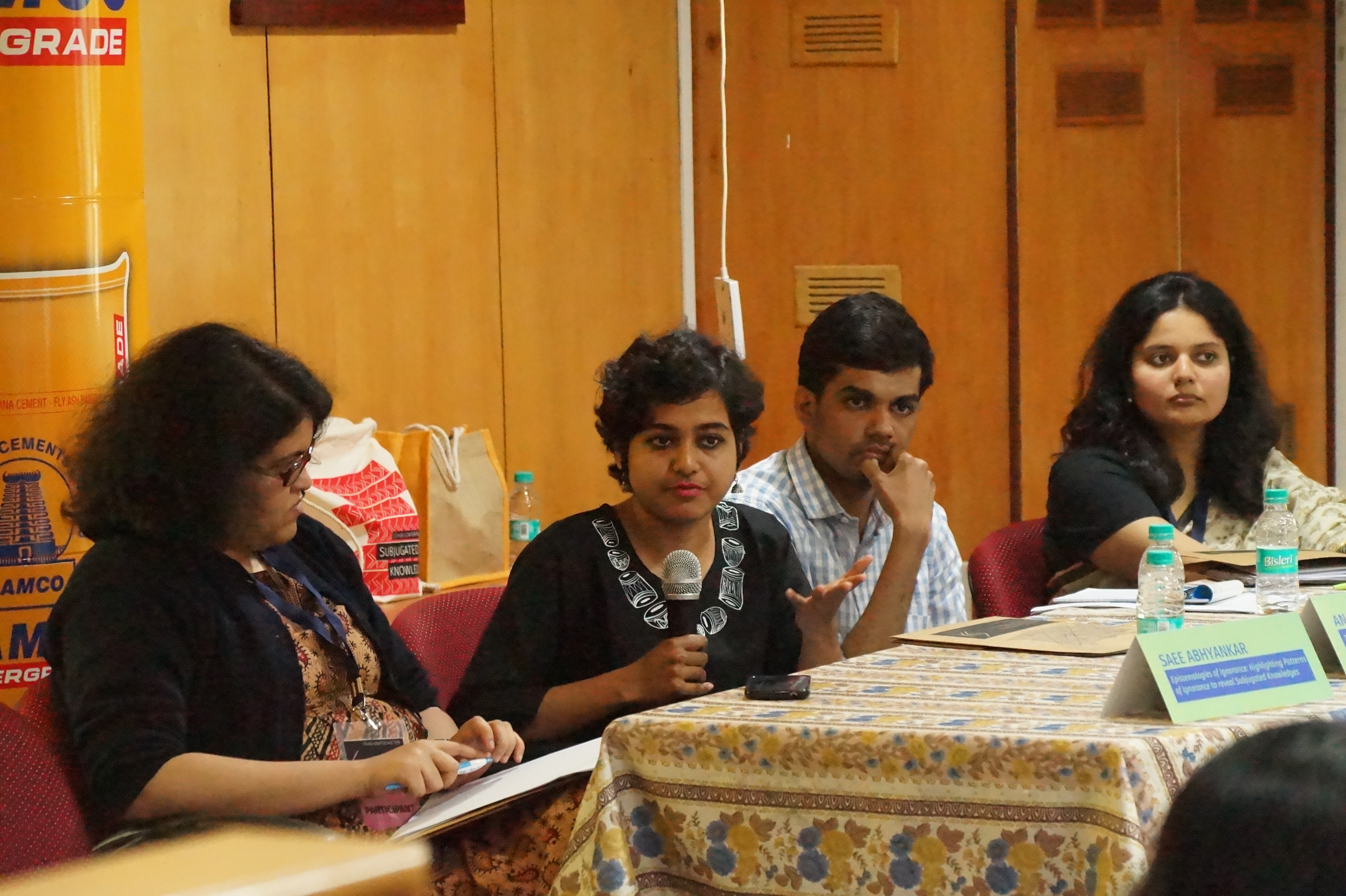
The first presenter was Saee Abhyankar with her paper titled ‘Epistemologies of ignorance: Highlighting Patterns of Ignorance to reveal Subjugated Knowledges‘. The paper presentation began with a reference to Foucault and the manner in which his theorisation had helped to de-centre knowledge-making practices. Following this through, it was argued that in philosophy, subjugated knowledges have been highlighted by patterns similar to the above.
The paper argues that highlighting patterns of ignorance will help in re-configuring knowledge as we know it, and that Epistemologies of Ignorance or EI as an alternative approach to analysing these subjugated knowledges would prove to be useful. Ignorance is not a simple absence of knowledge, its antonym, but is a productive force that produces what we know. Drawing from Charles Mills, the paper goes on to state that non-recognition of ignorance will perpetuate and sustain it, and that the structures that attempt to define and hide ignorance will reveal it and more. The operation of ignorance at an individual and social level and the network created by memory, perception and conception in the production of knowledge and in the creation and sustaining of ignorance were also elaborated upon. Patterns of forgetting, especially at the social level, lead to self-deception across a wide range which fashions the narrative of the social memory in a particular way. Self deception thus becomes an epistemic norm. The paper concluded by stating that the pattern provided by Mills to interrogate ignorance can be used to interrogate the existing frameworks of knowledge. The non-static nature of the patterns of ignorance can be analysed within the changing framework thus provided, as Mills himself acknowledges. EI, therefore, can be used to analyse and critique the processes of knowledge production.
The second paper, ‘The Concept of Aucitya and the Subjugation of Subordinate Knowledge Systems’ was by Sreenath V.S and Anandita Pan. Aucitya, translated into ‘propriety’, was taken to refer to a set of discourses which prescribe a standard way of doing something. The paper argues that aucitya as understood and employed by Sanskrit literary theoreticians was a political tool to subjugate deviant forms of knowledge, to condition the writers and readers of a Sanskrit kavya socially and aesthetically. Instances from various seventeenth and eighteenth century texts were cited that portrayed the injunctions of certain men to others not to challenge aucitya, to follow the rules laid down, and the misfortune a man may meet upon challenging aucitya or deviating from it. The paper then focussed on kavyadoshas, acts that would mar the beauty of the kavya, and how they implicitly referred to aucitya. This was supported by more instances of rules and patterns of writing kavyas and of how they functioned as tools to keep dominant epistemologies in place and uphold the traditions of society.
The paper gave interesting evidence of how certain parts of Hindu epics were re-written so as to hide any trace of ignominy in the hero. Setting aside the fact that one can never know the ‘true’ version of a mythical story, these rewritings are instances of aucitya as functioning through censorship. Stories were written and rewritten to condition people (both the authors and the readers of the texts) to the social propriety of the times. The training of poets – kavisiksa – was compulsory to write poetry, and the paper argues that this was a process of conditioning the author. The kavyasastra therefore, is seen as a process of conditioning, of conditioning the audience to aucitya and in the process, of conditioning the author to forms of knowledge and to rules that were espoused by the dominant power structures. The paper concluded by recognising aucitya to work via soft power, to incite encouragement within one to conform to the propriety of the time. The limited attention being paid to this political aspect of aucitya makes it an unexplored area and hence, a subjugated knowledge.
The last paper of the panel revolved around the identity of an eighteenth century Vedantin poetess, AvudaiAkkal. Titled ‘Reconstructing an Embodiment: The case of AvudaiAkkal’, the paper was presented by Priyam Mathur. The presence of Akkal through the women who sing her songs, but the absence of any mention of Akkal’s works in the canons creates confusion when attempting to establish her identity as a lived body. Akkal was a Brahmin child widow, but saw herself as a realised self, not confined by the position ascribed to her. The self is always seen as a consciousness, a witness, never as a subject.
The patriarchy viewed the position of women to be akin to that of the sudras- total subservience was expected. Akkal was doubly marginalised by her being a widow as well as a woman, a subaltern by virtue of her gender. Her caste, however, meant that she negotiated her realm in a manner different from that of widows of other castes. The paper deems it impossible to locate Akkal’s socio-political identity. Her songs live on, but as a person, she is not remembered in the geographical locale of her origin. She was the pupil of a renowned Bhakti saint despite which her works have been effaced from the sanctioned records of the region. The paper views this as partially the result of the hegemonic patriarchy which has effectively erased traces of AvudaiAkkal as a physical person and partially as the natural consequence of the old tradition of oral remembrance in which the identity was frequently lost or embellished. Akkal, however, is not recreated as an authorial figure, she is quietly forgotten while the oral tradition of her work allows access to her philosophy.
The paper illustrates this to be a problem, not of recreation, but of reduction. Akkal’s death is juxtaposed with the idea of self in Advaitha Vedanta – the self and the body are one and there is no notion of destruction of the body to reach the self. Akkal, therefore, “makes a mark but leaves no trace”. Akkal’s existence and death are brought to the fore by reconstructing her body of work and her individual lived body.
The panel ended with Prof. Sudarsan Padmanabhan wittily lauding the papers and offering suggestions.
Report by Shweta Venkatesh
 Article 19