
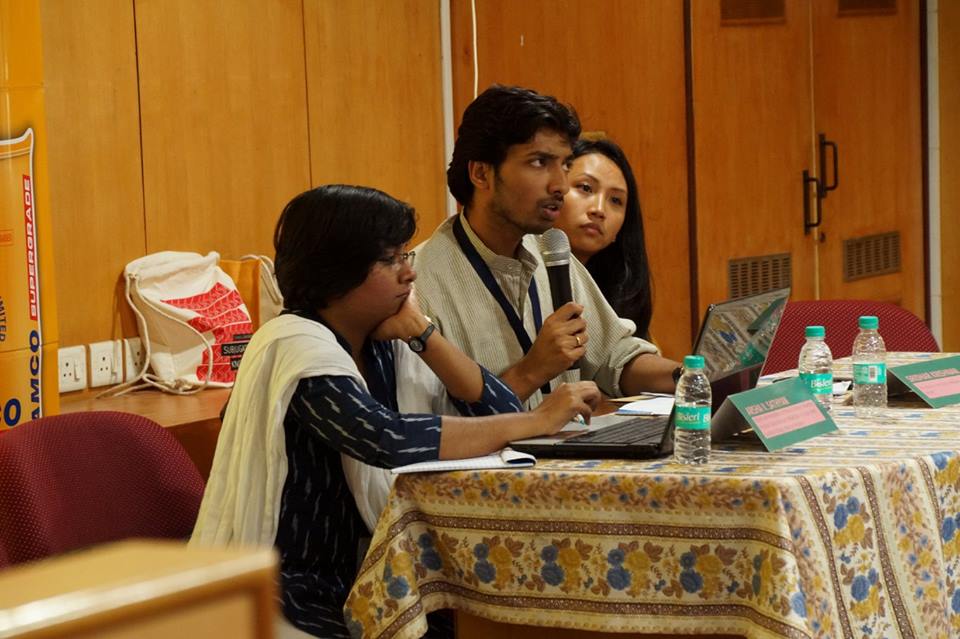
Panel 4 ‘Boundaries and Belonging: The Geographies of Space, Place and Culture’ was moderated by Prof. Merin Simi Raj.
Namrapali Narzary was the first presenter. Her paper titled ‘Boundaries and Belonging: An Analysis of Spatial Governmentality in Assam’ dealt with the ethnic conflicts currently taking place in BTAD – Bodoland Territorial Area Districts. The BTAD has four districts administered by one council. The presence of multiple tribes in a common geographical area, each wanting a part of the said space for their ‘homeland’ is one of the main reasons for the conflicts happening today. The conversion of geographical spaces into political territories enables them to be controlled.
The paper dwelled upon the difficulties that have arisen as a result of the British demarcation and classification of the geography and the people of BTAD. The imaginary lines drawn mercilessly distinguished between the indigenous population and the immigrant population. Autonomous councils formed for the purposes of local governance can be found throughout the BTAD. The politics of the region, however, has resulted in protective labels being applied to groups of people, which grants a label of ‘de facto ethnic homeland’ to the contested places.
Ethnic conflicts have been theorised upon widely, and the paper presented two major theories used. The first was primordialism, which sees blood relations as basis of solidarity. The second is constructivism, which sees ethnicity as a false consciousness and as a strategy to achieve economic and political goods. The appropriation of the phenomenon of ethnicity, not of language or of religion, by the elites has led to the formation of the idea of a homogenous ethnicity that is different from the rest of the country and has subsumed the numerous conflicts being fought by minor ethnic groups. Employing Foucault’s definition of the term governmentality, which is drawn from the terms government and rationality, the paper deems these conflicts to be the result of spatial governmentality, which creates a structure or a space where one begins to govern oneself.
The paper concluded by stating that ethnoterritoriality was a colonial framework. While it did not dismiss entirely the claim that ethnicity and territory are interlinked, it did state that the mixing of the two created problems. The concepts of ethnicity and identity are not static, they undergo constant change. It would be a mistake to regard them as fixed categories. An analysis using spatial governmentality would help to understand the positions of indigenous people, immigrants and the geographical spaces that are being fiercely contested today.
The second paper – ‘Rights and Resistance in Political Action: Asserting Political Space Through MGNREGA’ was presented by Arsha V. Sathyan. The paper was the outcome of an action research programme conducted in the tribal village of Dudhera in Madhya Pradesh. The village comprised 279 houses divided into four castes. Arsha spent 8 months as her first period of immersion in the village. She described the village, its main occupation (farming), and how it was directly dependent on the rains. Despite the existence of the MGNREGA (Mahatma Gandhi National Rural Employment Guarantee Act), the wages provided by it rarely reached the people. The villagers were unaware of the minimum wage they were entitled to, of the working hours and conditions that the act stipulated. Given that Madhya Pradesh is widely recognised as having successfully implemented MGNREGA, this was startling. People were aware of the existence of policies but not what the exact provisions were. Applications to MGNREGA were based on the Panchayat’s convenience and not on the workers’ choice of employment. There were also cases of official records showing people to have enrolled in MGNREGA and having received work, but when interviewed, the people denied having ever applied.
Having outlined the state of affairs thus, the paper proceeded to describe how the people of Dudhera utilised MGNREGA as a tool of action. After discussions, the people decided to claim their rights under MGNREGA which records showed them to be in possession of. The lackadaisical implementation of the scheme by the state government meant that the rights were granted to people in a perfunctory manner.
The paper then described the process of people filing RTIs, acquiring their rights, the money they were owed and various other aspects of the scheme they finally gained access to. MGNREGA was made active by the people demanding work under the supposedly-active scheme. The paper analysed this space as a political space for positive collective action and viewed the transformation of the villagers as a movement from passive citizens to politically-aware ones. Through the framework of MGNREGA, the new space for peoples’ re-politicisation can be viewed. The space thus created provides for the emergence of alternative discourses and knowledges.
The last paper of the panel was titled ‘An Inquiry into the Condition of Postcoloniality in Nepal’ and was presented by Sridhar Krishnan. The paper began by dwelling upon the narrative of Nepal as a ‘Hindu’ state, uncorrupted by Muslims or by the British. Nepal’s non-coloniality is highlighted, it has never been subjugated by a colonial power in its history. There is no reference to them in their histories and in their museums.
The shifting borders of Nepal and India baffled the British who desired clean lines to serve as boundaries between the two states. The imposition of boundaries on a state and a people unfamiliar with the idea of regarding them as fixed is a project in colonialism itself, given that Nepal eventually accepted these boundaries. Nepal, located between Tibet and India, served as an interface between the two.
Secondly, the paper pointed out that the nation was far from being isolated from colonial influence. A British Resident was stationed in Nepal and archival records show letters being written by the Resident to other Englishmen in India and abroad. This points to a clear influence of British power within the state of Nepal, both in domestic and international affairs. Nepal, therefore, was doubly colonised – by being the neighbour of a British colony and by aligning its economy with that of British India’s. To further decimate the non-colonial narrative, Britain was the first country to recognise Nepal as an independent country in 1963. Nepal then depended upon British recognition for its sovereignty and independence.
The expunging of colonial evidence from the country’s history could, posited the paper, be on account of the fact that Nepal had to build a nation out of inherited states after the fall of the Rana autocracy. The institutionalisation of the ‘Nepali’ language, when in reality a number of languages existed out of which Nepali was fashioned, and of the idea of ‘Nepal’ were demanding projects that could not afford an external impulse of colonialism to damage an already fragile narrative. Nevertheless, postcolonial Nepal is a reality, and one that has its problems.
Prof. Merin thanked the participants for sharing their work at the conference and expertly situated the major areas of focus of the three papers – contested identities, geographical places, and postcoloniality – as by-products of modernity at various levels. She also recognised them as ceasing to bring the people the promised empowerment and instead becoming tools of suppression. She commended the papers for using dominant forms of knowledge to enter subjugated forms of knowing, thanked the participants once more, and closed the panel.
Report by Shweta Venkatesh.

