
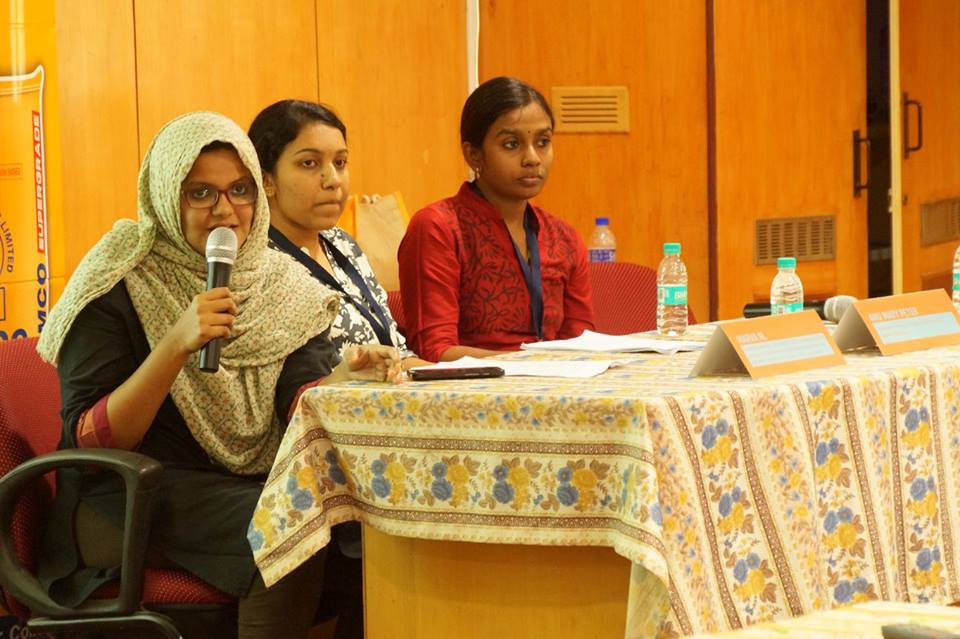
The fifth panel began after a touching address by keynote speaker Dr. Carlo Caduff. Moderator Prof. V. R. Muraleedharan introduced the panel by once again bringing to the table the problem of disclosure in medical practice.
The first paper titled “(New) Old Wives Tales of Ossathis and Eattummas: Gender, Caste, Religion and Medicine” was presented by Marva M., a final year Masters student at the department. Her work drew from her MAP research surrounding postnatal care among the Mappila Muslims in the Malappuram district of Kerala. Ossathis, Vannathis, Eattummas and home nurses were identified to be the post-natal care givers, and their various roles were highlighted. The Ossathis belonged to an Islamic barber caste and were hereditarily midwives. During the forty day period of rest, they would massage and bathe the mother. The Vannathis, who were of the Hindu washerwomen caste, bathed the baby and washed soiled clothes. Eattummas, on the other hand, are non-hereditary carers, for whom postnatal care is a means of livelihood. They are often from the lower castes and cannot financially depend upon their husbands. The tradition of post-natal care involved the grinding of kashayams and herbal medicines and powders. This knowledge was shared among rural women. These shared assumptions are not often encoded in language. There is also a spiritual element to postnatal care as well; the rhythm of certain Islamic prayers help the women forget the pain of childbirth. Historical carers belong to particular castes. There is a stigma to such labour that can be traced from Islamic notions of purity and pollution. Though caste consciousness is theologically contrary to Islamic practice, it remains prevalent. The Ossathis are said to massage differently from the Eattummas; they are said to possess “magical hands”. The knowledge of the Ossathis are not being passed on to future generations and the division of labour between the Ossathis and Vannathis is breaking down. The dimensions of care labour are changing. The preference for a muslim carer is about the body. These knowledges are invalidated and termed “inauthentic” ayurveda, though the distance between canonized Ayurveda and folk knowledge is narrow. Marva ends by noting that the revival of ayurveda has had nationalist undertones and that the male bourgeois citizen subsumed women and their knowledge.
The second paper titled “Towards a Theory of Health Humanities and Graphic Medicine” was authored by Anu Mary Peter and Raghavi R. K. of NIT Trichy. Anu began by noting the distinction between disease, which is an objective biomedical term, and illness, which is more subjective and denotes the experience of a disease. In medical discourses on the disease, the voices of caregivers and patients are subordinated to the empirical knowledge of the doctors. The possibilities of narrative medicine and health humanities were explored and examples from pop culture were cited. The authors then attempted to define comics, highlighting their strength in combining the verbal and the visual. Graphic medicine was identified to be a sub-genre of comics which can speak of the traumatic experience of illness. It can be situated in the interstice between the known and the unknown realms of medical conditions. Drawing from the principles of narrative medicine, it expresses the lived experience of suffering and exposes the limitations of bio-medicine. Four works, Aliceheimer, My Degeneration, I had a Black Dog and Tangles, were illustrated to explain the possibilities of graphic medicine. These possibilities included the creation of new realities, education, the forging of emotional communities and therapy. Graphic medicine thus creates safe narrative spaces and espouses experiential as well as empirical truths.
After the presentations, Prof. V. R. Muraleedharan posited the question of how hopeful one can be of improvements in holistic care, given today’s reality of the rampant commercialization in medicine. This was followed by a question and answer session.
Marva was asked where the line between traditional practices and modern medicine is drawn in natural births. Marva responded by saying that though the regulatory environment was unfavourable to home births, some women preferred home births as they did not feel in control of their bodies in hospitals. Anti-biomedicine sentiments are at sway in Malappuram, and there is an impression that hospitals unnecessarily prescribe C-sections. Marva was also asked if the scientificity of the Eattummas were being questioned, given a public healthcare system is in place. Marva responded by saying that post-natal care was not provided for in public healthcare systems. The women wanted more than occasional check-ups by ASHA workers. One of the gynaecologists interviewed remarked that there was no postnatal care in allopathy and thus, there is little conflict among systems of healing. Another question posed to Marva was regarding the status of caregivers in Islamic societies outside the sub-continent, where caste does not prevail. Marva responded by saying that race politics in Arabia is similar to caste discrimination, and that historically, barbers doubled as surgeons as well. The last question posed was on the language of the eattummas; on which codes they used to describe the vagina and contractions. Marva responded that the vagina was not named, but referred to as “it”.
Anu and Raghavi were asked about the potential of educational tools such as Dr.Mims and Dr. Aster, who feature on television. Raghavi noted that the comic figure is a safe portrayal. It tells the truth, but does not frighten. She also noted that graphic medicine normalizes the image of the doctor as a human being rather than a god-like figure. When asked about the feminization of medical knowledge in comics, Raghavi noted that the masculine/feminine distinction between biomedicine and graphic medicine did exist, but was not highlighted upon in the paper as the authors believed both the discourses equally potent and integral to a better healing process. When asked about the reluctance of doctors to listen to the patient, Anu recounted an experience where a doctor had told the patient that she was trained to listen, not to the patient, but to the patient’s body. Raghavi said that there is a positive effect when physicians use graphic texts.
Report by Ashraya Maria.

