
The second day of the Department of Humanities and Social Science annual academic conference housed the panel ‘Making and knowing the body’. It was the 6th panel of the conference, and was chaired by the conference convener Dr. Mathangi Krishnamurthy. The session began with Dr. Krishnamurthy outlining the direction of the panel and the question it would attempt to discuss and deliberate upon. The panel, she said, would address questions of the body and of excess. She went on to quote Michel Foucault and briefly bring into the discussion his discourse on the body as a site of resistance and power.
The first panelist, Sweetha Saji presented her paper entitled ‘Biostatistics and Experiential Reality: Graphic Pathography as a Site of Subjugated Knowledge’. She explained how graphic pathography translated lived experiences of patients into autobiographical form through the medium of comics. The narrative created in this process is an alternative to the hegemonic discourse of biostatistics that doctors often refer to. The texts she used to support her argument were ‘Janet and me: An Illustrated Story of Love and Loss’, ‘Mom’s Cancer’ and ‘Broken Egg’. Her central argument was that the discourse of biostatistics had quickly created problematic categories of normalcy-abnormality and majority-minority. It compressed the lived experience of a patient into a statistical aggregate and reduced the patient to a mere diseased body, specimens in a long process of trial and error, often exploited by the doctors for monetary gain. Graphic pathography on the other hand captures the lived experience of the patient and critiques the dependence of biomedicine on statistical data.
The second panelist, Mehak Sawhney presented her paper ‘Vocal Affections: Sensory Infrastructures and Print Disability in India’. She began by tracing technological development and its links to disability in the 19th century. Her paper focused on four important technologies: reading, OCR (Optical Character Recognition), TTS (Text to Speech) and ASR (Automatic Speech Recognition) engines, and Braille. Her paper explored the idea of technology beyond the binary of analog and digital; it tried to understand the body as a site posited against the sensory. She explored, through her examples and her field research, the various ways in which disability actually led to the creation of technology that was then adapted to a wider framework, instead of existing technologies being adapted to suit the disabled. She also touched upon ways in which the former has been subjugated as a site of knowledge and meaning making.
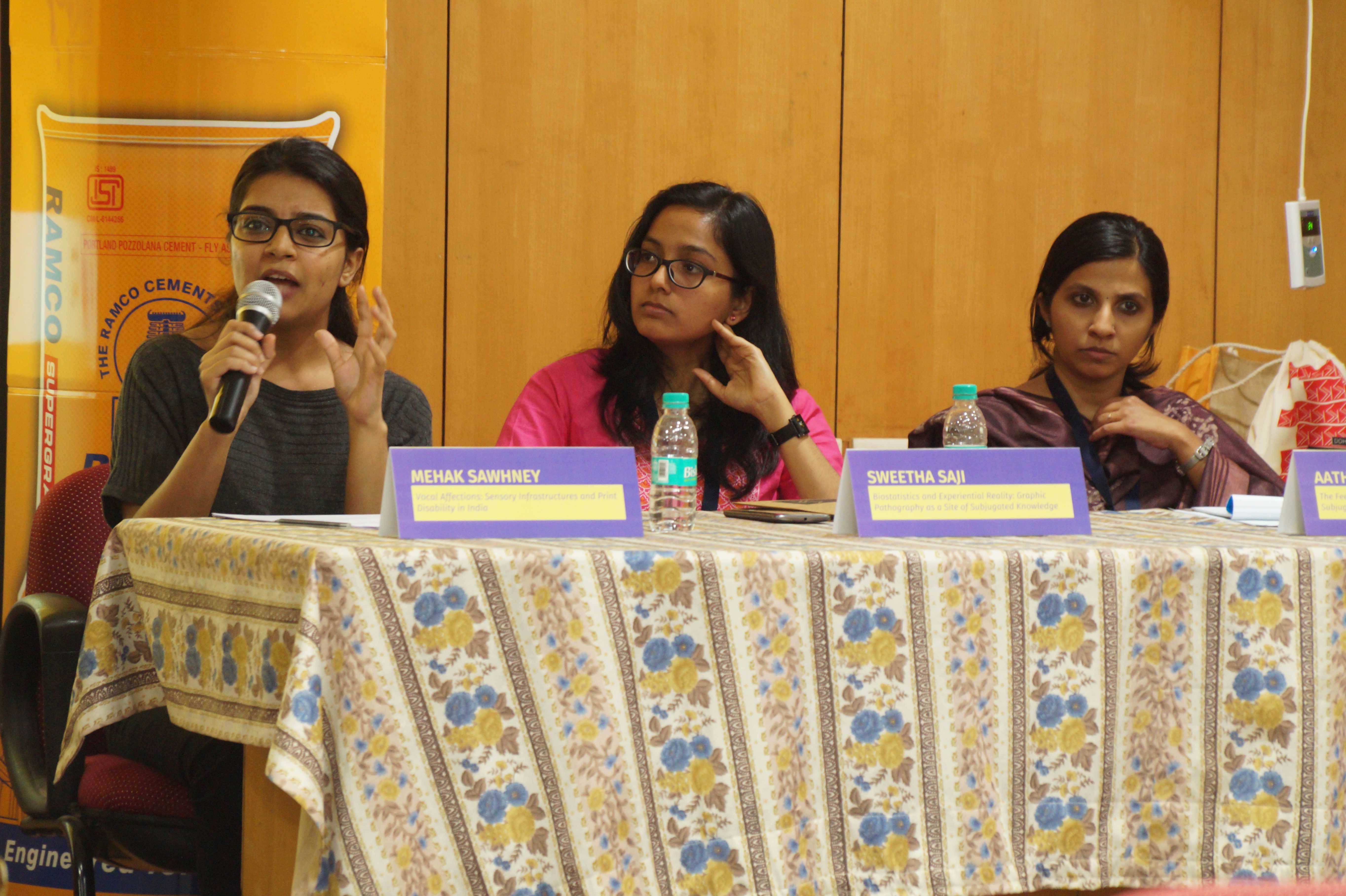
The third panelist, Aathira A., presented ‘The Feeble Historical Bodies: Reading the Subjugated ‘Body’ in James Joyce’s Ulysses’. She began by drawing attention to the term ‘vibrant’ as explained by Jane Bennet and used it in her analysis of the everyday body found in Ulysses. She examines the everyday ‘feeble’ body as a site of knowledge, and a way to reclaim ‘low-ranking’, ‘unqualified’ knowledge. She sees bio-history as a culmination of everyday acts of bodily preservation. She examined the body as a site of pleasure as well as affliction.
This was followed by Dr. Krishnamurthy providing some interesting insights and summarising the discussion before opening the panel to receive questions from the audience. The questions of the audience probed deeper into the research questions of each paper. Some of the most interesting questions revolved around construction of the patient’s afflicted body and lived experience of the caregiver in Ms. Saji’s paper and the binarisation of the digital and analog in Ms. Sawhney’s paper. The question of body as a site of power and resistance was also brought up in the discussion.
The panel beautifully rounded up a discussion on construction of the body, examining it as a site of subjugated knowledge, the overarching theme for this year’s edition of the annual conference.
Report by Sunaina Bose
 Article 19