
The seventh and final panel of the DoHSS Academic Conference, on the topic of indigenous identities, was moderated by Prof Santhosh Raghavan. It featured three panelists presenting their papers on various forms of subjugated traditional knowledge systems, followed by discussions and questions.
The first paper by Panchali Bhattacharya was titled “Revival of Indigenous Naga Knowledge in Easterine Kire’s When the River Sleeps”. In the presentation, she talked about traditional knowledge in the North-East, especially in Nagaland, and noted how the writer Easterine Kire brings it to the forefront through her book When the River Sleeps. She began with explaining what she meant by “indigenous people”. The term refers to the original inhabitants of a land, as opposed to those who arrived later, either through peaceful migration or violent conquests. Traditional indigenous knowledge refers to the body of knowledge and beliefs which has been culturally transmitted over generations through folklore, legends et cetera. It speaks about the indigenous way of life and how people interact with their natural/cultural environments. However, with the advent of scientific modernity, such systems were downgraded to a lower position in the knowledge hierarchy. This was because they were considered to be subjective, prejudiced ways of thinking, as opposed to “objective” scientific knowledge. The North Eastern part of India has a rich repository of such bodies of knowledge, as it is a hotspot of various ethnolinguistic groups. A reverence towards indigenous knowledge, though not overtly displayed, is embedded in the collective unconscious of these groups. In contemporary times, fiction plays a major role in carrying forward this legacy, and Kire’s book provides valuable insights into the same. Through the book, she has succeeded in bringing such subjugated knowledge systems into the mainstream.
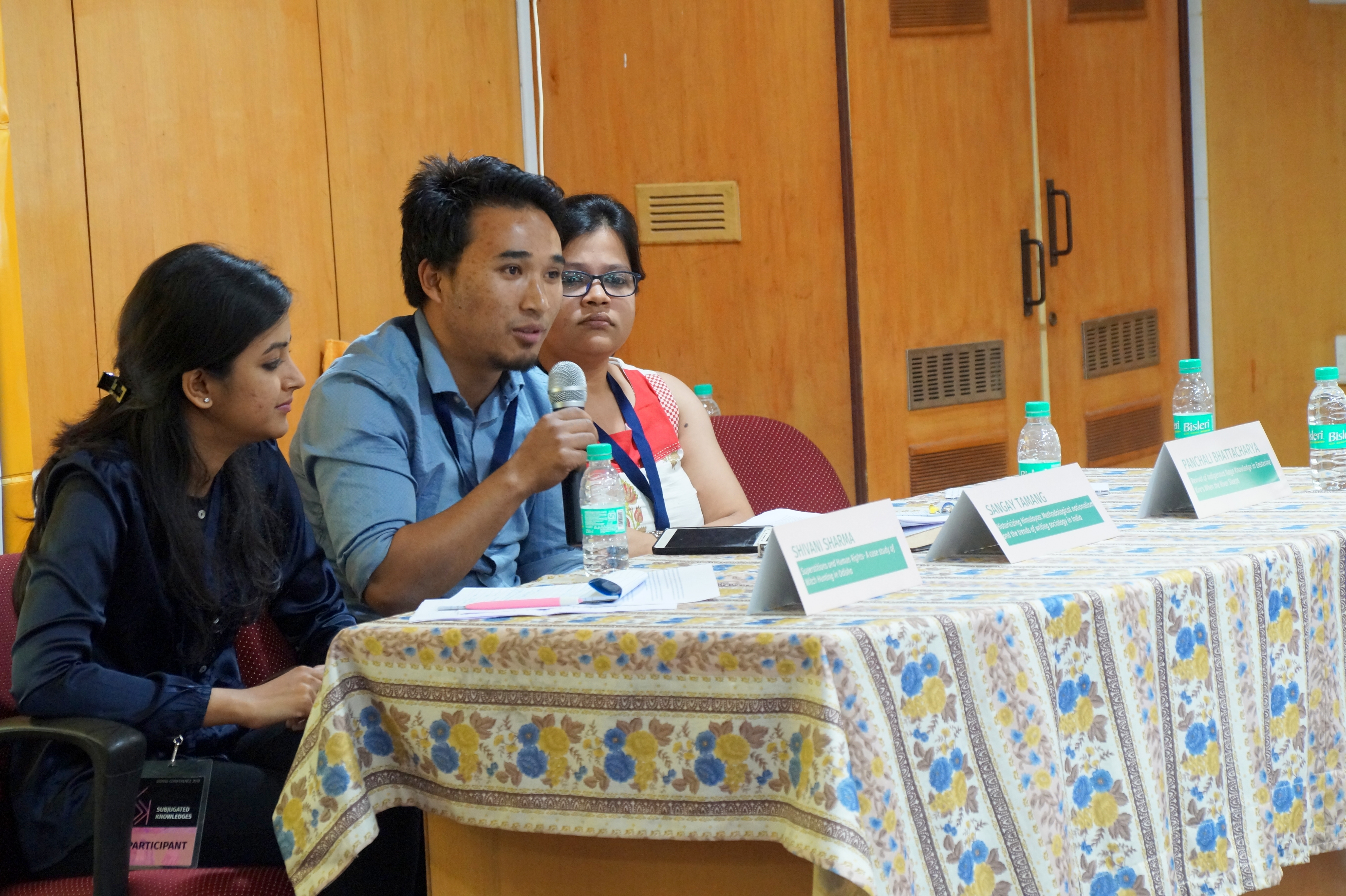
The second paper, titled “Historicizing Himalayas: Methodological nationalism and the trends of writing” was a critique of the conventional methods of writing Indian sociology. Sangay Tamang, the panelist denounced “methodological nationalism”, a method of sociological inquiry that takes the nation-state as the primary unit of analysis. Indian sociology, he said, was obsessed with the nationalist project and hence failed to incorporate experiences of those outside “mainland India”. Sociologists had internalised colonial categories and hence saw the nation through the binaries of castes and tribes, mainland Indians and hill people and so on. Such divisions, whose foundations were laid through colonial-era laws, were cemented by generations of Indian sociologists post-independence. Indian sociology evolved as a sociology of plains. Tamang quoted a few examples, such as G. S. Ghurye’s portrayal of a unique timeless Indian culture, which was equated with Hindu culture, and M. N. Srinivas’ functionalism, which inspired subsequent sociologists who focussed only on caste and the village. Over time, sociology evolved as the study of the caste system, while studying “tribal people”, who were deemed primitive, was left to anthropologists. This approach might also have been informed by colonial mindsets, which saw the Himalayas as a space of exoticism, isolation, and adventure as opposed to the chaotic mainland. Tamang then called for alternative approaches which would conceive the history of the Himalayas with that of the nation. This can throw new light on Indian sociology too.
The final panelist, Shivani Sharma, in her paper “Superstitions and Human Rights- A case study of Witch Hunting in Odisha” spoke on superstitions and how they violate human rights, with special reference to witch-hunting in Odisha. Superstition, which she believed is the biggest social evil since time immemorial, operates on the fear of the unknown. Certain ritualistic practices constitute attacks on individual dignity. Historically, assertive and rebellious women have been the target of such witch-hunts. These were also tools in the hands of the powerful and privileged to convince the poor that oppression was not due to them but because of spirits and ghosts. Also, in recent times, women have been branded as witches in order to snatch away property which is rightfully theirs. Sharma then highlighted some initiatives by certain individuals to dispel myths and superstition surrounding witches. She concluded by asserting the need for education, which has the potential to make people more rational.
Prof Santhosh then made a few remarks, followed by an engaging question-answer session. There were a few questions to the first panelist on what she meant by modernity and how Easterine Kire had portrayed the tensions between tradition and modernity within her own community. In response to a question from Prof Mathangi, Sanjay Tamang asserted that Indian sociology viewed hills as homogenous, while they are actually spaces of contested identities. With regards to the final paper, Prof Santhosh felt that modern conceptions were being superimposed on the phenomenon and that it would be too simplistic to look at it as a law and order problem. Another member of the audience also said that pitting superstition against science ignores the problems of the scientific method itself and does not take into consideration philosophical inquiry into science.
Report by Avinaash R.
 Article 19