
Department Soapbox on 12th March, 2018.
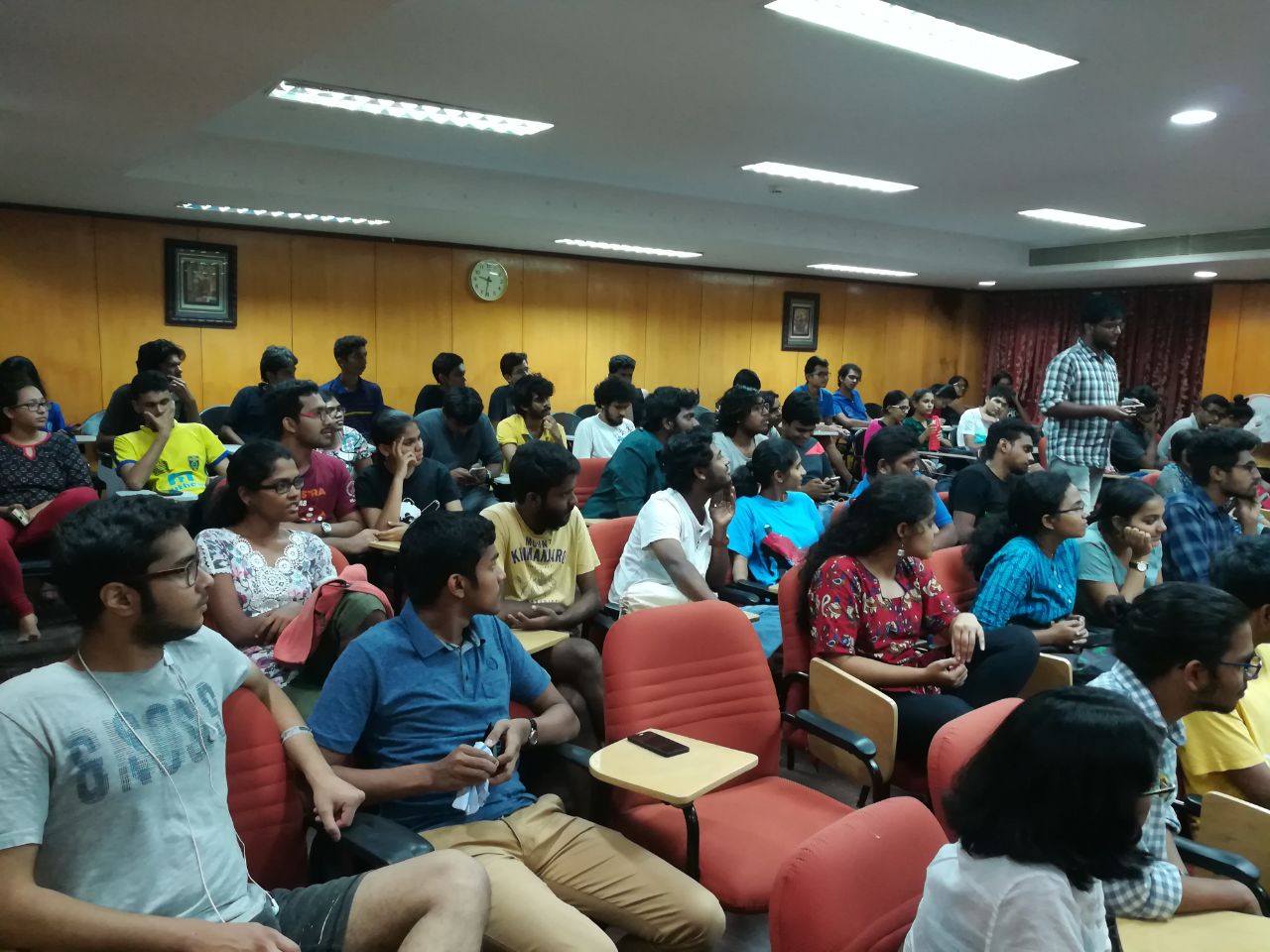
On Monday, the 12th of March, two candidates faced-off in what was ‘the first ever HS elections’ for the post of Branch Councillor. Parthiv Kidangoor and Yogesh Kumaran, both second-year candidates, presented their manifestos to a sizeable portion of the DSB (possibly the largest gathering of the DSB for a soapbox ever in the Department).
Find the manifestos, feasibility reports and statements of purpose of both candidates in this folder.
Manifesto presentations:
Following Melwin’s welcome, Parthiv began his presentation. His initiatives focussed mainly on re-starting the Department Journal (Wissen), on extending the timings of the MML, making the third year quant courses exclusive to DS students (although, perhaps he meant HS students?), implementing a formal timeline for the MAP, and introducing a new course every semester as per popular demand, among other things.


Yogesh began by speaking about the possibility of a debate forum operating under the aegis of a faculty advisor. His other initiatives included a civil studies study circle along the same lines, workshops on higher studies that will be conducted in collaboration with I&AR and the Career Development Cell, and publicising the conference via theatre performances by student groups from different colleges across the city.
Cross-Questions:
Yogesh to Parthiv
Q: On the feasibility of introducing of new courses?
A: Plan of action: Approach professors → pitch the idea → approach the DSB and ensure that at least 20 people want the course → then propose it to the Senate
Q: On the exclusivity of quantitative courses for DS (HS?) students
A: A talk with the HoD has revealed that the Math department offers these courses, Therefore, if required, we can ensure that the quantitative courses offered by our department are exclusively for our students.
Parthiv to Yogesh
Q: On the involvement of the BC in arranging for publicising the conference via theatre groups. Has the candidate talked to the events team about this?
A: This initiative will not occur during the even semester, along with the conference, but will happen in the odd semester. Student groups will be invited to perform, either on campus or outside, in and around the city. Videos of these performances, when posted online, will generate publicity for the conference. Cash rewards will also be offered.
The candidate clarified that he has not spoken to the events team.
Follow up comment: Most of the aforementioned publicity initiatives are not working for Shaastra and Saarang. Please justify your attempt at a similar strategy for the DoHSS Conference.
Q: On the role of outreach committee- how different is it from the Alumni Affairs team?
A: Via the outreach committee, the alumni will be required to publicise the MA programme in their matriculation schools. The initiative also hopes to reduce the number of dropouts from the programme and increase the number of students attempting the HSEE paper.
Note: At this point, the two candidates slipped into banter about the willingness of their fellow classmates to drop out of the course in their first year.
Q: On the running of the Civil Services Study Group
A: The reasons why this group fizzled out in the past years were political. This group will be run by final year students who will be paid stipends for this work. The group will also invite people from the branches of the administrative service to give talks and act as mentors. Apart from discussions, the group will also conduct lectures by the same.

Melwin’s questions:The next twenty minutes saw the current BC, Melwin, pose three questions to the candidates. The first question addressed their proposed visions for the Department Council. Parthiv responded that the Council is functioning smoothly as it is but that he would like to see an increase in the number of their meetings. He also said that a reporting of all department PoRs to the Department Secretary or BC. Yogesh, on the other hand, suggested incentivising the Department Council meetings for the freshies.
The second question was about the balance the incoming BC would have to strike between the Career Development Cell and the Department Placement Team in negotiating placements, internships, and visibility. How would the BC achieve this without compromising the department’s identity? Yogesh stressed upon the need for collaboration, saying that it was a necessity if we are to improve our placement record. Parthiv began by acknowledging the existence of a unique identity for the department and did not wish for it to be compromised, but also recognised the underrepresentation of the department in the I&AR team. He mentioned that a collaboration does not necessarily mean a compromise and that the I&AR team was necessary for funding initiatives (for instance, alumni talks). Parthiv concluded by stating that the department would not be entirely excluded from the process as students would always remain as points of contact.
The next question requires the candidates to recount the most important SLC meeting that they’d attended this year. Parthiv mentioned the meeting that banned the letting off of firecrackers in hostel zones, while Yogesh related the meeting which involved a discussion of incentivising work at Jagriti.
In his final question, Melwin asked the candidates to list their preferences for standing committees (for example, CMGFS, CCASH).Both Parthiv and Yogesh were quick to reply that their first preferences were the Social Equity Committee (SEC). Yogesh reasoned that the impact of the SEC was greater than the other standing committees. The proposed initiatives to bring people from different backgrounds onto the same plane were, he said, more effective. Parthiv said that apart from aligning from his own personal interests, the SEC provided disability access and audits and brought palpable change and impact.
Questions from members of the Department Council:
Q1: On intention to ensure that the department Journal is ‘duly recognised’
Y: ‘Duly recognised’- referring to the ‘due procedures’ necessary for a journal to receive due recognition.
P: Lack of publicity led to the attempt failing. There is a need to accept graduate and undergraduate entries with a cap on both. A country-wide approach for better outreach needs to be adopted. A team comprising PhD scholars, 5th year students and faculty advisors would be adopted instead of a double-blind peer review system for accepting papers. A domain number (already procured) and an index number (to be procured) are essential for ‘due’ recognition of the journal.
Q2: On the HS specific initiative mentioned in the Institute Academic Affairs Secretary’s manifesto
Neither candidate was able to provide a satisfactory answer.
Note: Neither Department Secretary nor the Conference Head had any queries.
Questions from DSB:
Note: These questions concern issues that are recurring ‘problems’ in the department. Their being asked to the candidates served to highlight the problems that the incoming BC is likely to encounter, with no immediate solution at hand.
Q3: On the incentive for a team to curate the department journal, aside from it being a mere resume credential.
Q4: On the space crunch faced by the students in the department- issues of the library, the DCF and the MML were discussed.
Q5: On presenting a unified front as a department to the SLC (reference: ratification of the current T5E Head Editor, wherein the Department BC and the Research Councillor held different views).
Q6: On ‘inclusivity’ not only in cultural clubs, but also in light-hearted department events, and how they intended to implement this as a policy measure (SLC is a legislative body, and not a body that implements resolutions).
The final question, the answer to life, the universe and everything (in department speak: how to increase participation in GBMs), of course, is one that is timeless and has no answer…yet (no, not even 42).
Report by Shweta Venkatesh and Ranjani Srinivasan
 Article 19