
On the 5th of March, 2018, the Department of Humanities organised a session on Prof Peter deSouza’s recent book In the Hall of Mirrors: Reflections on Indian Democracy. This was followed by a R & D Lecture on Scientific Temper.
The session began with Prof Sudhir Chella Rajan offering his comments on the book. Prof Chella mentioned that he had read some chapters of the book earlier too, as they had appeared as columns in The Hindu. According to him, in this book, Prof deSouza had donned the hat of a public intellectual, attempting to answer that question which is at the heart of all political science enquiry, the question of how we can all get along. After this a PhD Scholar, Kongkona Dutta, and a fifth-year MA student, Piyush Kumar, spoke about the book as well.
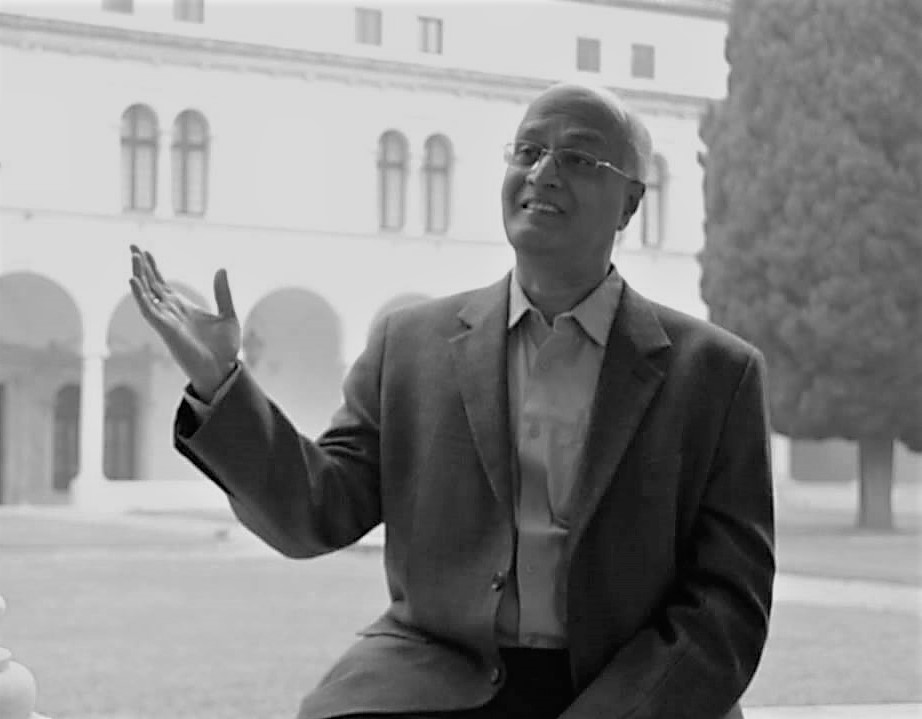
Prof deSouza said that he was moved by the commentaries of all three of them. Even though the articles compiled in his work were disparate, he felt that they were together coherent enough to be read as a book. Following that, he dwelt upon the naming of the book. Conventional frameworks in academia were inadequate to explain India, as they overstated and overclaimed what they represented. They ignore ambivalences and contradictions, instead choosing to cherry-pick facts in order to suit a narrative. In that sense, the phrase “Hall of Mirrors” is a epistemic statement, as a hall would give a richer view than a single one.
The book attempts to answer two questions: what democracy is doing to India and what India is doing to democracy. While there has been much scholarship on how democracy is aiding the social transformation of India in a more egalitarian direction, the question of how India has changed the conceptual landscape of the idea of democracy itself has not been given the attention it deserves.
Essay as a form is intended for the lay reader, as there is no need for a bibliography or positioning the commentary in literature. Prof deSouza said he was gratified by responses from professionals as varied as doctors and lawyers to some of his essays. Responding to Piyush’s question on why he chose to retain a piece by Aung San Suu Kyi in his book despite her stance on the Rohingya crisis, Prof deSouza said he struggled with the decision and ended up not removing it because he felt Suu Kyi was a different person then. He ended with thanking his friend Prof Hemachandran Karah for initiating the first public discussion on his book
After this, Prof deSouza began his talk titled Scientific Temper 2.0. While presenting the Economic Survey 2018, India’s Chief Economic Adviser mentioned that we needed scientific temper. This, and some instances under the current regime, such as a minister’s comment on evolution and the presentation of papers on Vedic “scientific achievements” in the reputed Indian Science Congress, have revived an idea that was debated 40 years ago and then consigned to the historical dustbin. For Jawaharlal Nehru, a firm believer in the promise of the Enlightenment, the promotion of science would create a scientific temper, which would combat superstition, ritual and obscurantism and bring India to the modern age. There is a danger of taking the modern Indian scientific landscape, a product of such a lofty ideal, for granted. Institutions such as the IITs and IISc were the outcomes of the vision of Nehru and the scientists of that period, who shared his idea regarding the place of science in independent India.
However, the project has not achieved as much success as it was intended to. There have been critiques of the Nehruvian idea not only from nativisits, but also critics of developmentalism, and postmodernists, who are skeptical of the Enlightenment itself as it promotes western hegemony under the guise of a false universalism. In 1984, the scientist Pushpa Bhargava gave out a public statement lamenting a “retreat from reason”, something that would undo the gains made by Nehru. Prof deSouza, even while acknowledging some criticism, still believes that Nehru is relevant to contemporary India. According to him, like the national movement, we need a second Renaissance, one that will engage with critical reason.
Prof Hemachandran Karah, commenting on the lecture, felt that Scientific Temper 2.0 should handle contradictions and not portray a black-and-white vision of the world, which the original idea was guilty of doing. It must also make space for alternative knowledge systems.
This was followed by a question and answer session.
Report by Avinaash R.
 Article 19