

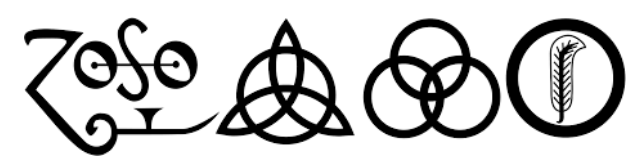
(The four symbols representing the four members of Led Zeppelin taken from their fourth album – “Led Zeppelin IV”. From left to right – Jimmy Page, John Paul Jones, John Bonham and Robert Plant.)
I will be honest with you here, I am a Led Zeppelin fanatic, hence there are hardly any songs of theirs that I am not thrilled about. However, if I had to pick some bad songs, they would be from their penultimate album – “In Through the Out Door”, which was released in 1979. However, their previous album – Presence – had already started to give out hints of this decline in 1976, with most of their songs failing to meet the high standards set by their first 6 albums. It is therefore a surprise to discover a hidden gem, which is “Achilles’ Last Stand” in this album.
Video: Achilles Last Stand - Performed at LA Forum, 1977
Achilles’ Last Stand isn’t one of Led Zeppelin’s more famous works. That honour inevitably goes to “Stairway to Heaven”, and to the more enlightened- “Dazed and Confused” and “Kashmir”, both superior songs in my opinion. But it is one of their best without doubt.
The title of the song refers to the injury Achilles suffered to his vulnerable area at the back of his foot which caused him to die. Also alluded to are the events of singer Robert Plant suffering a car crash in 1975 in Greece and a broken ankle in 1976, the second incident much like Achilles himself.
The lyrics have Flamenco influence and were written while Plant was in Morocco, hence the line – “the mighty arms of Atlas hold the heavens from the earth”… which refers to the Atlas Mountains in North Africa. It has a second meaning too, which refers to the mythological Greek hero Atlas carrying the earth on his shoulders.
Jimmy Page’s guitar work is mesmerizing in this song. It is six guitar tracks overdubbed, and thus it was a heck of a feat to pull off in concert. Soulful, the influences of both rock and blues can be clearly seen. It features one of his best solos and is probably his last great song with Led Zeppelin. Page himself says that this was his favourite song to perform during his LZ days.
The music makes you feel as if it is from a world far far away. It has a hauntingly beautiful intro and outro, which starts to suck you into a world of mysticism. The entire atmosphere seems cosmic and magical in some ways and it transports you away on a journey.
Before long, a thumping, foot stomping drum beat kicks in. Many argue that John Bonham deserves his Hammer of the Gods title for “Immigrant Song” from “Led Zeppelin III”, the title is reaffirmed in this song. It is a drummer’s sprint which is unrelenting, punishing and immensely rewarding all at the same time. His drum fills are innovative and add to the character of the tone. And of course, Bonham follows the guitar more closely than the bass in many parts which gives an extra edge to the rhythm. It is fast and furious, and the groove is extraordinary. While Page was sometimes inconsistent in Zeppelin’s twilight years from 1975-80, Bonham held it all together with amazing energy, inventive fills and some of the hardest drumming possible. The New Wave Of British Heavy Metal (NWOBHM) was undoubtedly inspired by this groove and heaviness of the music, and it is justified as to why Led Zeppelin are known as one of the first two heavy metal bands (the other is Black Sabbath).
John Paul Jones completes the rhythm section on his peerless bass, which can be best described as tight and precise. Jones only improved with age, and it is seen here too. In addition, his skills as a keyboardist don’t hurt either. He operated the bass with foot pedals, a measure of how good he was.
Although the lyrics speak about love, it is different from other Led Zeppelin songs such as “Whole Lotta Love”, “How Many More Times” or “Communication Breakdown”, which talk more about sex between couples. This one talks of a journey of a couple seeking a certain place. “Oh, to sail away to sandy lands and other days, Dancing as they fought the crowds, below the streets that steam and hiss”, “to touch the dream”, “to ride the wind”, “the birds have flown” and “to tread the air above the din”…
All of this seems to be about Plant and his wife’s trip to Greece and Morocco. The constant travelling and soul searching for a new place to discover seems to indicate a spiritual journey, which in my opinion is confirmed by these words:
“To seek the man whose pointing hand
The giant step unfolds
With guidance from the curving path
That churns up into stone”
The man with the pointing hand could be either a Guru or God himself.
The search eventually ends, essentially stopping the journey, having reached some sort of conclusion, perhaps? I don’t know for sure – ambiguity is a device used by musicians to create doubt in the listener’s mind and to allow them to apply a personal and unique meaning to the lyrics.
Although the search seems to have stopped, Plant asserts that he does know the way, and so seems assured of reaching his goal.
It was played on their last three tours before Bonham’s untimely death in 1980: their 1977 US tour, the 1979 Knebworth concerts and their 1980 Europe tour.
When played live, this song can be described as Led Zeppelin’s take-off point. After this was played, the concert and the band seemed to be elevated to another level. Due to very few bootlegs available, most of the evidence is based on reports. However, the two versions below performed in 1977 and 1979 confirm the high level of their performances.
As a final note, this song symbolizes Zeppelin at their best, even in their twilight years, and is a terrific introduction to the band. Trust me, even a passing interest in rock and roll will get you hooked, and it deserves more than a single hearing. One of their top ten songs, in my book.
https://www.youtube.com/watch?v=YWOuzYvksRw – Performed at Knebworth, 1979
Article by Simha Y.N.
Poster by Sanjana Acharya.

