
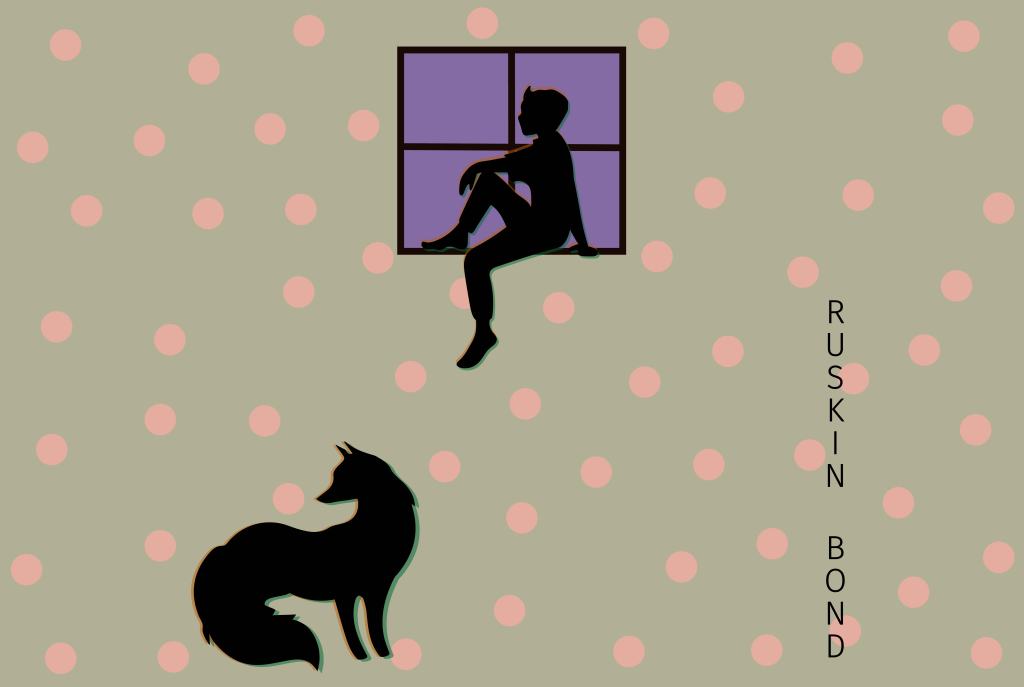
As I walked home last night
I saw a lone fox dancing
In the cold moonlight.
I stood and watched. Then
Took the low road, knowing
The night was his by right.
Sometimes, when words ring true,
I’m like a lone fox dancing
In the morning dew.
My favorite poem by Ruskin Bond has now become immemorial as the title of his autobiography. Thus I found it fitting to pen my tryst with the man whose words have been my companions for many years now.
Being an only child of two working parents, it doesn’t come as a surprise that I took to reading for pleasure quite early. Every few weeks, my mother used to take me to the Crossword store and I could get any one book I liked. I must have been around 10 when I first chanced upon Ruskin Bond’s books. I picked ‘The Room on the Roof’ and brought it to my mother. She looked at it and smiled. Years later, I stumbled upon a well thumbed copy of the same book, her name scribbled inside. It was her favorite too.
I finished reading that book that night itself. In Rusty, I found the most perfect friend. He too was an only child. He too liked staring out the window, watching the squirrels in the trees and the people in the street. His life in Dehra, though far from the crowded Calcutta I lived in, resonated with a lonely child living in a massive British bungalow now owned by the Indian government. I too was surrounded by hoity government officials for neighbours and yearned for company my age. I followed Rusty’s life closely. His rebelliousness, his love for words, his need for the peace of the hills called out to me. As a child of a government servant, frequent transfers were the norm. Rusty felt this anguish of rootlessness too. After losing his father at a very young age, he lived with his mother and stepfather for a while and then packed off to a boarding school. From then on, he ambled along, like a flowing brook, going where life took him. When I left Calcutta, not long after, I knew that at least I’d always have Rusty. Rusty wrote of his teenage years, his years at the boarding school, the friends he made and the plans to run away. I loved his style of lucid prose that made for a riveting read of tasks we consider mundane, be it the portrayal of the early morning tea ritual of a Punjabi joint family or the sedulous description of the Indian summer, replete with playing children and the lazing buffaloes. My personal favorite though, was the description in one of the stories of a chaat wala. The comparison of the chaat wala to a deity, hidden behind a curtain of smoke and sizzle, bestowing upon us the gift of spicy aloo tikkies and tangy golguppas makes my mouth water every time I revisit that passage.
As Rusty grew up, so did I. Rusty often kept a reassuring hand on my shoulder as I navigated my teenage years, as I drew respite from his tales of adventures and misadventures. The tales of running away turned to those of coming home. Many relationships were made; some friends were lost along the way and stories poured. Bond free-lanced from Delhi and Dehra, supporting himself with his writing, finally settling down with his first love, the hills. He still lives in Ivy Cottage at Landour, near Mussoorie. He has seen perhaps the most tumultuous time in Indian history, the political instability of the post partition era, but his works were steadfastly focused on the stories he wanted to tell; those of the people around him. He told us of the lives we deem too insignificant to write about, pushing into the imagination the beauty of the ordinary. Bond wrote of the hills and the simple life, and the dusty roads leading home, of the lonely women we meet as mere faces in the crowd and of the tigers being hunted down.
Every time I go back to the world of Rusty, it is like taking a long walk in the hills, amongst the trees which whisper the many stories of his life with the river meandering by my side.
By Divyanjana Prashansa
Illustration by Sanjana Acharya
 Article 19