
The first pre-conference event, the Theme Release Event, kicked off a series of events that will culminate in the 8th edition of the Annual Academic Conference of the DoHSS, from 31 January to 2nd February, 2019. The Theme Release event, which entailed a Panel Discussion, was to begin at 6 pm, on the 27th of September, 2018 in HSB 356. The students settled down soon after the refreshments. All the three panellists entered and took their positions on the dais. Upasana Bhattacharjee, the Conference Secretary, welcomed the gathering and introduced the theme of this year’s Conference – ‘Identity and Citizenship’. She spoke about the continuously evolving and complex nature of both the concepts in the theme and hoped that the event would set a good precedent for the upcoming pre-conference events. Then, she introduced the panellists of the day: Suhrith Parthasarathy, an advocate at the Madras High Court, Vanessa Peter, a policy researcher at the Information and Resource Centre for the Deprived Urban Communities and former programme manager at ActionAid, and finally Adjunct Professor at DoHSS, Arvind Sivaramakrishnan, who was also the moderator of the panel.
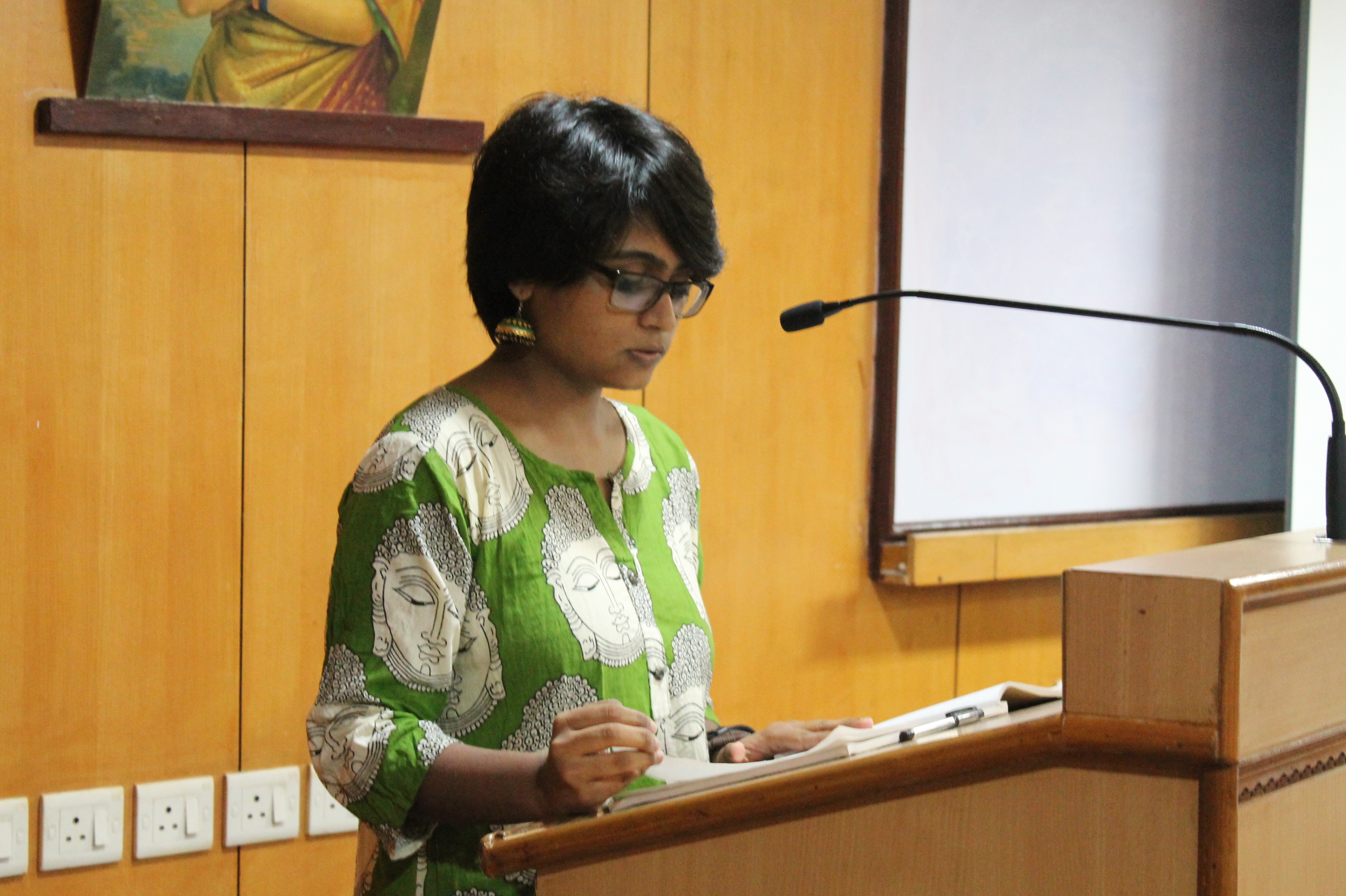
Mr. Suhrith started off with the current debates and controversies related to the Unique Identification Authority of India (UIDAI), more popularly known as Aadhaar, in the context of the recent judgement of the Supreme Court upholding the constitutional validity of the Aadhaar scheme and laying down a specific set of purposes for which it could be made mandatory. He began with a detailed narrative of the scheme since it was first mooted by the UPA government and the various legal and social challenges that were encountered in the various stages of its formulation and implementation. He discussed the proclaimed objectives of the scheme and the legal and constitutional provisions that concerned with and came into conflict with its implementation. Initially, Aadhaar as a mandatory identity scheme, got into the way of one’s access to the benefits of public welfare schemes. Since it was hastily introduced through an executive notification by the current NDA government, it escaped the usual course that a legislation would have taken in the Parliament, he said. Later, when it was brought to the Parliament, it was introduced as a Money Bill in the Lok Sabha, which further restricted the space for democratic negotiations required before its actual implementation. Mr. Suhrith concluded his talk by discussing the SC judgement’s consequences on the issues of identity and citizenship. He listed out some of the major flaws that surfaced with the initial roll out of Aadhaar, such as the exclusion of a significant section of the population from welfare schemes, posing of a potential threat on the idea of ‘welfare as a right’ and the scheme’s incompatibility with the right to privacy within the fundamental right to life and personal liberty.

Ms. Vanessa Peter then took to the stage, to offer her views on the matter. She offered to share her profound and eye-opening field level experiences of engaging with communities, especially the urban homeless in Tamil Nadu. She spoke about her struggles as an activist, working to procure identity certificates for the urban poor residing in slums and other informal settlements, from the government authorities. She reminded us how crucial it is for the marginalised and the shelterless to be recognised as the ‘marginalised’. Whether they receive the benefits of welfare schemes, including access to ration shops is dependent on their ownership of ration cards. More than half of them do not own electoral ID cards. Even after assertion and recognition of one’s identity is complete, accessibility to entitlements still remains a problem. She remembered the hardships her team went through over a period of five to six years, as they worked to procure ration cards for 100 homeless people in the city. Identity proof like Aadhaar still remain a luxury for them.
She also pointed out an inherent defect in the nature of the vocabulary employed in laws, policies and government documents while referring to the slum dwellers and the shelterless. Most of the definitions of slums, she said, are extra-judicial. She condemned the massive evictions that were recently undertaken in Chennai. The evicted were resettled in ill-equipped buildings around 50 km away from their initial settlements. She also complained that the authorities often do not follow due processes during eviction. She expressed her concern over the scenario of dwindling democratic spaces due to the rise of powerful parastatal agencies which often end up taking decisions on the behalf of people.
The talks were followed by a discussion and a Q & A session for the audience, moderated by Prof. Arvind Sivaramakrishnan. The session witnessed robust discussions on a wide range of issues ranging from the role of civil society movements, accessibility of legal justice systems, the need to provide government rules and notifications in vernacular languages, to challenges in achieving equality in access to information; especially in today’s digital world where technologies like e-governance are making a headway.
Report by Aswathy Venugopal
Photographs by Ashraya Maria
 Article 19