
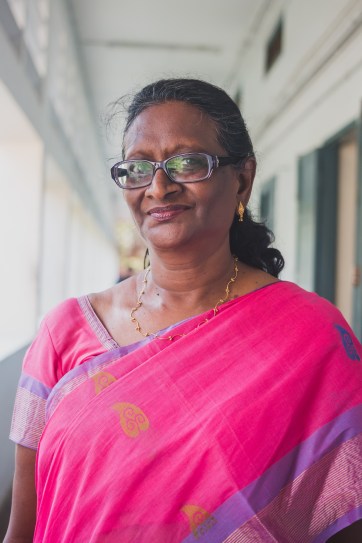
In honour of Prof Evangeline Manickam’s retirement, colloquium lectures were organised at the department on the 1st of November.
Prof Manickam has been a Professor of English at the department from 1982 till her retirement last year. She holds a PhD in American Literature (Southern Fiction) from the University of Madras and has been a two-time Fulbright awardee. Among her research interests are South Asian Diaspora Literature, specifically Punjabi Diaspora Writing. Most recently, Orient BlackSwan Publishers had published a critical edition of F. Scott Fitzgerald’s The Great Gatsby, with annotations by her.
Prof Sreekumar Nellickapilly inaugurated the programme and welcomed the speakers.

Tale of a Palm-Leaf Manuscript, Prof Manakkal Nagarajan
The first speaker was Prof Manakkal Nagarajan, retired Professor of English at the University of Madras. The topic of his lecture was Tale of a Palm-Leaf Manuscript.
He began by narrating his involvement with the Institute of Asian Studies, Chennai during his post-retirement phase. As someone trained in Sanskrit and Tamil, his assignments included translating palm-leaf manuscripts. The original manuscripts were written with stylus on palm leaves, which could not last more than 200 years. Those who copied these often did not know the intricacies of the language of the manuscript, thus corrupting them.
Thousands of such manuscripts are preserved in libraries across India and abroad, including in the Government Oriental Manuscript Library in Triplicane (the speaker wryly remarked on its anonymity) and the Theosophical Society Library in Adyar. One peculiar manuscript that the speaker came across was the subject of the lecture.
This manuscript, containing forty-four pages, was written in 1937 (yes!) by Arumuga Perumal Nadar. The manuscript mentions that it is a copy of Purushadevi Kathai, written by Thyagaraja Nadar of Thiruvalai in the 1730s (There is a discrepancy as to the date of the original text as there is also a reference to a wedding that occurred in 1616). It narrates the tale of Pennarasi, ruler of a matrilineal queendom. She is impregnated by the southern winds and gives birth to Purushadevi, her heir. A grown-up Purushadevi is herself impregnated by the southern winds. While she is expecting, a nearby ruler, Chemban, wins a war against the queendom, which leads to the suicide of Pennarasi and Purushadevi. The wrath of the two women leads Chemban to suicide. The dead characters all become gods; Pennarassi becomes Isakki, who is to date worshipped as a kaaval deivam (village deity) across Tamil Nadu.
Purushadevi Kathai, probably sung as a ballad, lays no claim to being a Sangam classic or an epic. Its author had no Miltonic ambitions, the speaker states. The text and the goddess Isakki can be seen as part of the Little Tradition in the traditions of worship of the Hindu pantheon. While the Big Tradition involves regular worship in well-established temples, the deities of the Little Tradition are worshipped in small local shrines.
The real question, though, is this: Why did Arumuga Perumal Nadar reproduce the manuscript in palm leaves, in 1937? There can be multiple answers to this. The first, rather naive, possibility is that Nadar was poor. For the second, the speaker refers to Michel Foucault’s Archaeology of Knowledge on how certain kinds of knowledge are made sacred so that they can be preserved and made available only to a select few. The third possibility is that Nadar was a fraud who manufactured an ‘ancient’ text that never existed.
Such are the issues that arise when you try to historicise a text, which had tried to textualise history.
Embarkation and Disembarkation: Journeys of Women Labourers from Tamil Nadu, Prof Padma Venkatraman
The second speaker was Prof Padma Venkataraman, or Mangai, retired professor of English, artist and activist. Mangai has been active in theatre for decades, with work centered on gender. Her lecture was titled Embarkation and Disembarkation: Journeys of Women Labourers from Tamil Nadu, referring to her work on the gender aspect of diaspora studies.
Much of the literature on Indian indentured labourers is from the other side of the shore: the point of disembarkation. There has been an abundance of both fiction and non-fiction from The Caribbean Islands, Fiji, and several states of Africa and South America about their lives. There is often a tendency to lump the narratives from from all these countries together, which glosses over the differences in the background and experience of labourers who went to different countries.
Such literature is also mediated, says the speaker. While not undermining their truth value, it is important to acknowledge that mediation has happened because the works are from Anglophone or Francophone literatures, an ocean apart from the original homeland of the migrants. It is thus important to look at this phenomena from this side, the point of embarkation. It becomes an act of destabilizing the existing narrative from a post-colonial perspective. This brings us to the question of the reasons behind migration. In most literature, a singular narrative is provided: colonialism forcing them to migrate to replace African slaves after the abolition. Connected to this is the idealized view of the motherland as a happy place which the migrants did not want to leave. In this way, agency is denied to the migrants. This was often not the case, the speaker asserts. For instance, groups of migrants termed kangalis came back to the homeland to recruit new labourers. Kangalis are not part of the usual terminology in which the experience of indentured labourers from Tamil Nadu is framed.
The voices of women are also mostly silent. The speaker concluded by screening parts of an evocative play Kalki, which looks into the personal lives and agency of female indentured labourers in Malaya.
Syncretising Academic/Disciplinary Borders, Prof Ganesh Krishnamoorthy
The third speaker, Prof Ganesh Krishnamoorthy, focused on the diasporic literature of the displaced tribals of Tamil Nadu in his talk Syncretising Academic/Disciplinary Borders. The migrant experience here is forced on the tribals as they are displaced from their forests, often due to large developmental projects. The obvious first question raised here is: for whose development? The tribals have a notion of development that is different from the mainstream; one that involves the symbiotic relationship between themselves and their forests. This is ignored and tribals are constructed as ‘savage’ and ‘uncivilized’.
All knowledge exists somewhere in a system of hierarchy. Tribal knowledge systems find place in the lowest rungs of this hierarchy, where it is often made ‘non-knowledge’. Their languages are forgotten; their younger generation is educated, not in their tongues, but in the dominant language of the area they migrated to. Tribal life experiences, for which words may not exist in these dominant languages, are forgotten because, as Wittgenstein puts it, the limits of one’s language are the limits of one’s world.
All this contributes to the creation of a Fourth world, a world of people marginalised further by Third world countries. Here, literature of the tribal diaspora becomes literature of protest; protest against their displacement and marginalisation. Such literatures have the power to subvert the dominant narrative, the speaker contends.
Migration and Memory in some Jewish Fairy Tales, Prof Padma Mckertich
The final speaker Prof Padma Mckertich’s lecture was titled Migration and Memory in some Jewish Fairy Tales. It was centered on her insights trying to historicise Jewish fairy tales from clues in these texts regarding their time and place of origin.
Fairy tales play an influential role in the socialisation of children. The portrayal of the prince as the saviour and the princess as the damsel in distress convey the gendered values considered desirable in girls and boys. Fairy tales also contain other insights that come to light when we put them in their context.
In the Jewish case, they contain memories of a group oppressed throughout history. Their lives as a community take centre stage in these fairy tales, as opposed to the life of, say, a prince and a princess. In fact, royalty feature only on the fringes of these tales (with exceptions, such as King Solomon). Synagogues and rabbis are more important. Here too, a hero is sent on the archetypal quest; however, the gain or loss is not his, it is his community’s. Some tales refer to the anti-Semitism rooted in the societies the Jews lived in; there are tales where they contribute significantly to these societies but are still banished from there.
Creating these tales may have functioned as relief to an oppressed group of people. The Jewish Talmud speaks of Luz, a city of immortal residents; a utopia of sorts. Fairy tales might have been for them another city of Luz.
Finally, as all good things come to an end, so did this colloquium, but not without a truly heartfelt sharing of stories from the staff. Prof. Manickam was fondly remembered by many of her long time colleagues as a person to whom you could confide in. She was a bulwark of support for many of her colleagues especially on their recruitment days. She calmed their fears and heard out their apprehensions. This was attested to by Sreekumar, Swarnalatha, Srilata, and Jyotirmaya Tripathy. In addition, several former office staff had made the trip just so that they could meet their dear friend one more time. All around, memories were revisited and happy/sad incidents were narrated. It was probably the best tribute of them all. No doubt, Ms. Manickam was very moved by it all. She graciously thanked everyone and took her final bow. The department has a huge hole, which will no doubt take a long time to fill.
Report by Swathi CS, with inputs from Simha YN

