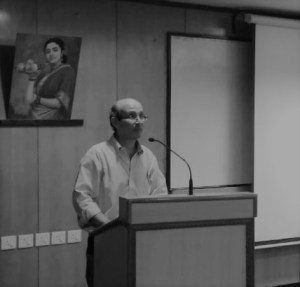
 A lecture on “Universal Access to Human Knowledge” by public domain advocate Carl Malamud was organised on October 15th at the department. Malamud is the founder of Public.Resource.org, a non-profit that digitizes public domain documents in order to make them accessible. An author of eight books, Malamud is also founder of the Internet Multicasting Service, a nonprofit that started the first radio station on the Internet and was responsible for making the SEC EDGAR database available. He is a recipient of the Berkman Award from Harvard University, the Pioneer Award from the Electronic Frontier Foundation, and the Bill Farr Award from the First Amendment Coalition.
With Public.Resource.org, he identifies public information that is not available online and makes it available on the web. He also takes up cases where a public agency has licensed its data to a private company which charges an access fee. Then, he buys the data and makes it publicly accessible while openly declaring that he has done so. He then tries to get the original holder of the data to cooperate and take over the job. This tactic, he says, is like the satyagraha of Gandhiji.
He began be narrating his experience with the Internet in the early years of its development. He then moved on to his activism for the public domain. He began with US Building Codes. Building Codes in the US, like other laws, are not supposed to be under copyright. However, the California Building Code and Fire Code were not publically accessible. He published the codes online, for which he was sued in 2013. Here he mentions that litigation costs for these cases were very high; he would not have been able to cover them without pro bono representation by law firms. His work was also recognised and supported by a Google grant “for ideas to change the world.”
He then revealed that he now works most of the time in India. A meeting with Aneesh Chopra, former Chief Technology Officer of the United States, led him to be introduced to Sam Pitroda, who was then championing the telecommunications revolution in India. He began by making the National Building Code of India publically accessible. He then moved on to making books by freedom fighters available online. This included the complete works of Mahatma Gandhi, Nehru and Dr Ambedkar.
Universal access to knowledge is the promise of our generation, he says. This is the promise of the internet. Sure, there are bigger problems to be tackled; however, widening the public domain is important since any democracy is based on an informed citizenry. If the government is to tackle the bigger problems, citizens should be informed. Restricting access to knowledge is a new form of colonialism. Like the freedom struggle, India should take leadership in fighting this colonialism. It should use technology as a medium to challenge established inequalities in access to knowledge.
As his final remark, he says, “And don’t forget, you can question authority.”
Report and Photographs by Swathi C Suman
 Article 19