
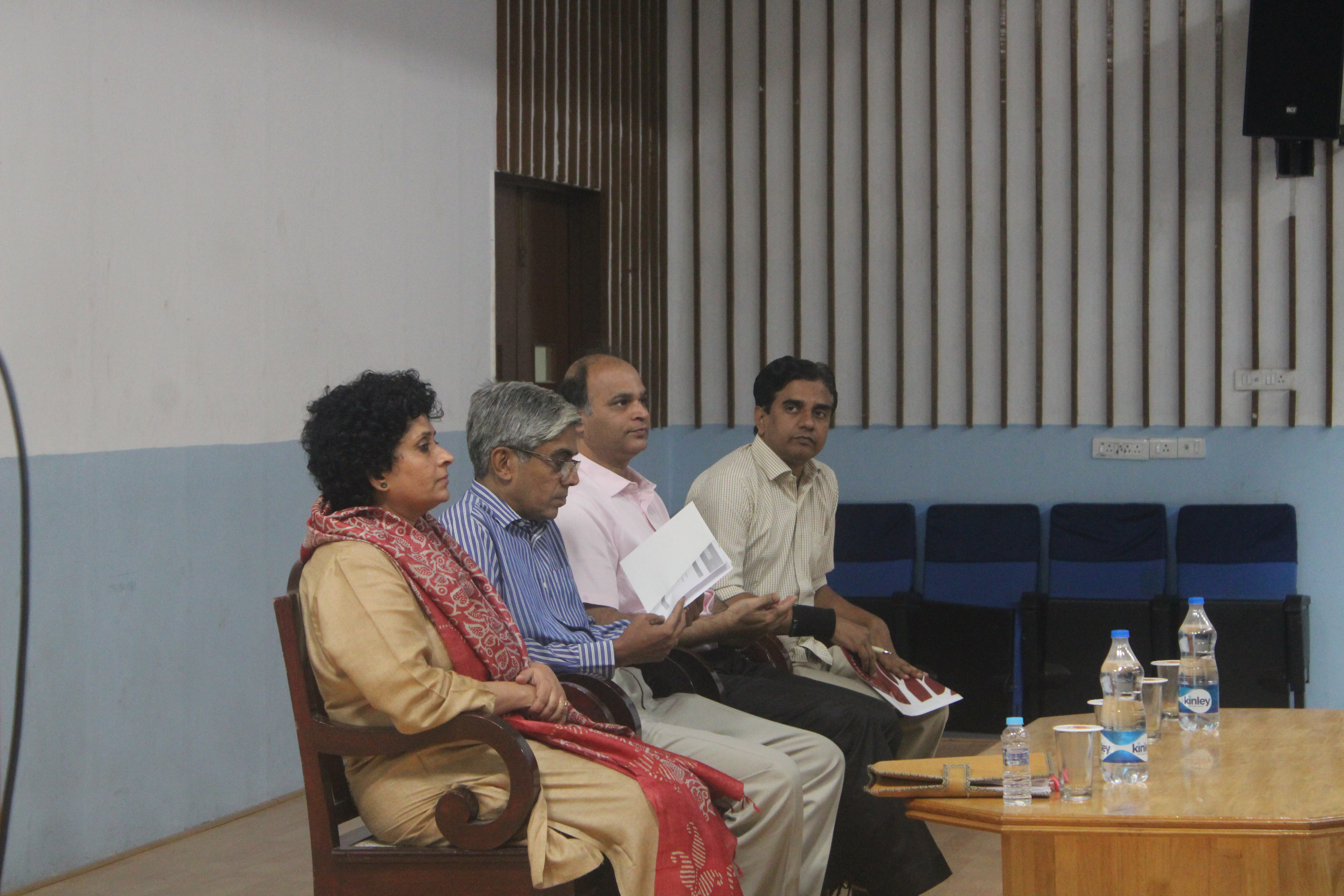
The inaugural ceremony of the 8th Academic Conference organized by the Department, was held on the 31st of January, 2019. The event commenced with the welcome address delivered by Prof. Umakant Dash who welcomed the audience which comprised the faculty, students and participants from various institutes across the country. He took note of the topical nature of the theme of the conference and mentioned the notable speakers who had been part of the conference in its past editions, such as Martha Nussbaum, Gopalkrishna Gandhi and Lata Mani among others. Following Prof. Dash, Prof. Rajesh, the faculty advisor of the Conference, delivered the concept note of this year’s theme ‘Identity and Citizenship’. He highlighted the multidisciplinary nature of the theme and the complexity of the concept of identity, which can be perceived as a process of being and becoming. Citizenship is contested based on the filters of identity, such as race, gender, caste, etc. Prof. Rajesh ended his speech with an excerpt from the epic ‘Rashmirathi’, by the Hindi poet Dinkar. The Director of IIT Madras, Prof. Bhaskar Ramamurthi commended the department for the significant presence of undergraduates in the audience. Following the Director’s speech, Dr. Anupama Roy, Professor of Political Science, Jawaharlal Nehru University, delivered the keynote lecture titled ‘Transformative Citizenship of Scales, Sites and Encumbrances’.

In her lecture, Dr. Roy focused on citizenship as a legal category in India and traced the trajectory of the changes in the understanding of citizenship through various legal acts such as the 1955 Citizenship Act to the 2016 Citizenship (Amendment) Bill. She interspersed her argument with thought-provoking stories, anecdotes, popular legal cases and debates. Dr. Roy spoke about civic citizenship wherein citizenship is understood as the loyalty to the law of the land, and not based on a shared cultural past. She spoke about how the state and its agents invoke the life in law, creating categories in its execution. Dr. Roy then proceeded to highlight the important provisions and changes brought in by different amendments to the Citizenship Act. She extensively discussed the movement in Assam and the struggle for preserving “Assamese identity”, which began in 1966. The amendment introduced graded citizenship in Assam, in an attempt to preserve their identity from foreigners. Subsequently, Dr. Roy discussed the deterritorialization of citizenship with the introduction of overseas citizenship in the 2003 amendment, and the limited rights that it grants vis-à-vis dual citizenship. Following this, she spoke about the new turn in citizenship with the 2016 Bill, which exempts all Indian religions and Christianity from the category of illegal migrant from Afghanistan, Bangladesh, and Pakistan due to ‘religious persecution’. Dr. Roy argued that this new provision presented a bounded view of citizenship and stands in contradiction to the principle of secularism. She concluded her lecture by noting that the 2016 Citizenship Bill, NRC and other practices conjoined with existing discourse to create a conservative idea of citizenship.
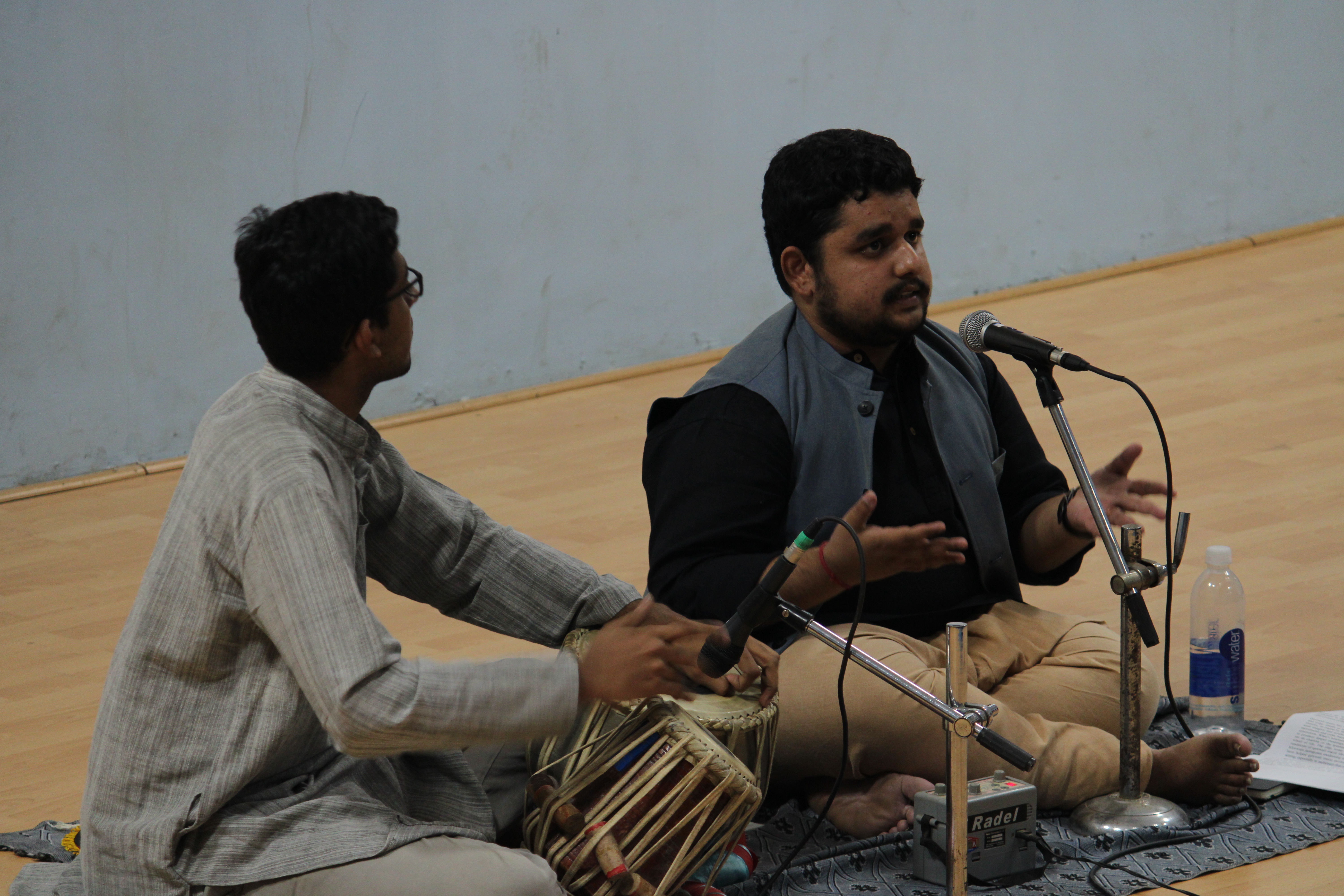
Following the question and answer session with Dr. Roy, Abhinand Shankar, a fifth year Development Studies student presented a lecture-demonstration titled ‘Lighting Up the Classical Scene’. His presentation focused on the rigid boundaries between classical and non-classical music, which leads to many art forms being left out. He spoke about a citizen artist, who is someone who understands the boundaries of classical music and reshuffles the artform within it. Abhinand traced 4 different artforms that are considered non-classical, providing a theoretical argument and performing pieces from the same. First, he brought attention to Tamil music which was always left in the margins of the concert circles in Chennai, which focused predominantly on Sanskrit and Telugu songs. As an example of the same, Abhinand presented a powerful performance of Bharatidasan’s ‘Vaana Mazhai Neeye’. Subsequently, he discussed Qawwali, the semi-classical music of the Sufi tradition. He spoke about its characteristics and its popular usage in Bollywood. He presented another piece ‘Damadam Mast Kalandar’, popularized in Bollywood movie. Following that, Abhinand discussed pre-revolutionary Iran’s music scene, with the singer Googoosh at its center. His argument about how her music represented life before the Islamic Revolution in Iran, was beautifully complemented with a musical piece ‘Man Amadeam’. Abhinand also touched upon the Rajasthani rural artform of Thumri. He stated that by being woman-centric, the artform challenged the masculine-feminine binary and allowed for the subversion of patriarchy, despite most of its songs being set around the woman pining for the love of the man. Abhinand concluded his lecture-demonstration with his rendition of a Kabir Bhajan, and spoke about Kabir’s philosophy that identity and citizenship started with one’s own self. The inaugural ceremony came to an end with Ms. Upasana Bhattacharjee, the Conference Secretary for 2019, warmly delivering the vote of thanks.
The inauguration ceremony of the Conference presented different aspects of its theme and struck a perfect balance between the theoretical and practical, academic and artistic. It therefore set the stage for the audience to ponder and engage with the theme through the forthcoming panels and lectures.
Report by Meenakshi Viswananthan
Photographs by Sathya Priya

