
The second panel of Day 2 titled “Negotiating Gender” was moderated by Prof. Binitha Thampi. She began by making a few introductory remarks on intersectionality and the absence of a distinct category called “women”, and how political mobilization around such a category could be seen as problematic. The first paper was titled “Blazing Fire in the Womb”: Identity, Equality and the Discourse of (Queer) Citizenship, presented by Amanjeet Brar, M.A, Akal University. It spoke of the history of the Supreme Court judgment on article 377, contextualized through representations of same sex desire in two novels from colonial and postcolonial India – A Life Misspent (translated from Hindi, Kulli Bhaat 1939) written by Suryakant Tripathi Nirala, and Mohanaswamy by Vasudhendra (2016). The issues of the exclusion, mockery and even violence that is inflicted on the characters in these books was seen as a response by society due to its highly heteronormative nature. The speaker spoke of Judith Butler’s theory of a Heterosexual Matrix, and pointed out that marginalization occurs on the basis of socially defined roles. She concluded by stressing the concept of gender neutrality, and how babies are blank slates on whom gender identities are described, and called for a democratic politics that would bring the LGBTQ into the mainstream.
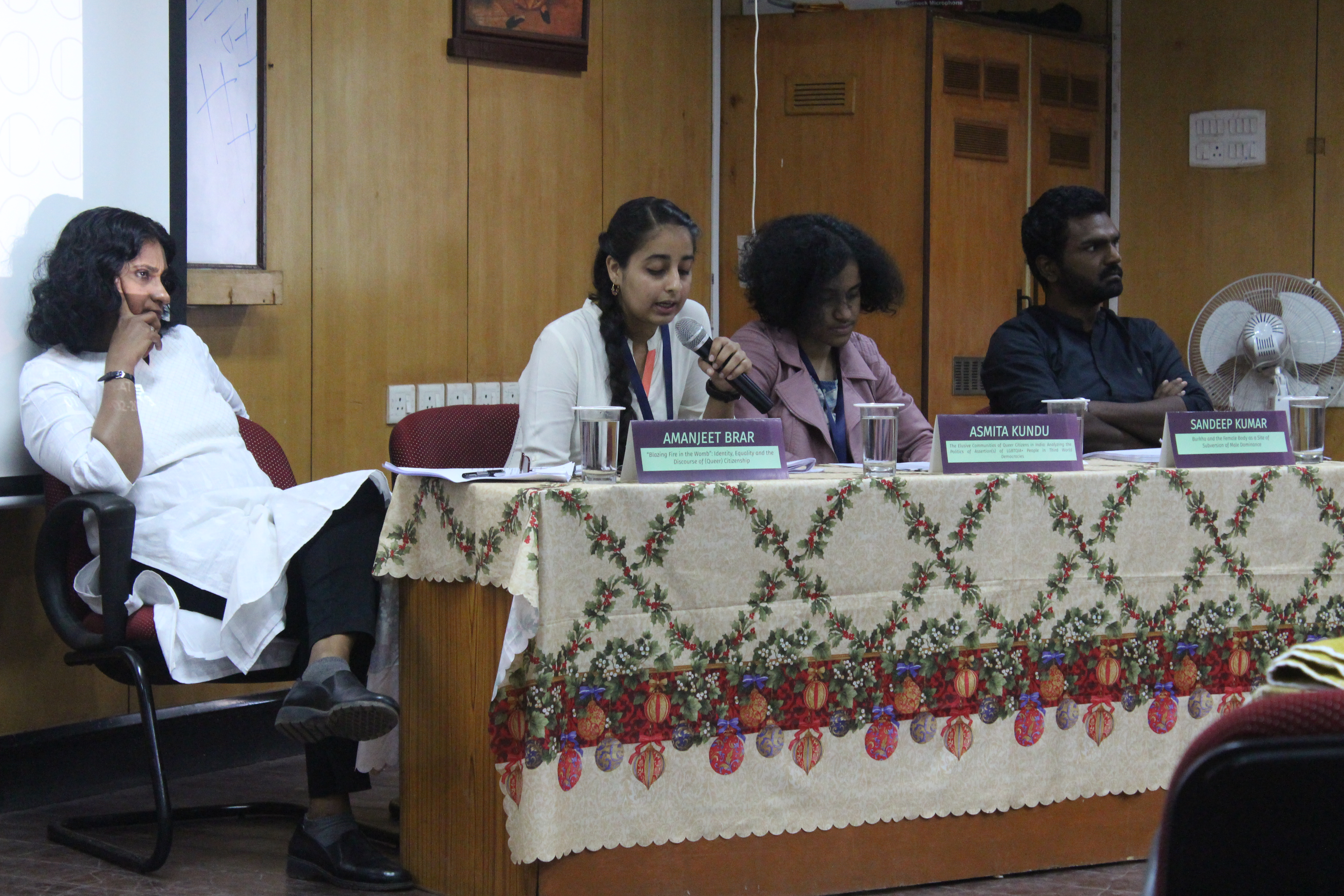
The second paper was titled “Burkha and the Female Body as a Site of Subversion of Male Dominance”, presented by Sandeep Kumar from IIT Madras. It examined the trajectory of how the Tawaifs, or courtesans of Lucknow, went from being considered the custodians of high culture and privileged members of society to the current perception of them as mere sex workers or “Nautch girls”. They had a complicated hierarchical structure that placed men at the bottom of the Tawaif household, to the point where the birth of a boy child was considered a sad event whereas a girl child’s birth was celebrated. The men performed domestic tasks, and it was the women who were inheritors of wealth. The Tawaifs were well versed in the arts, and an invitation to their evening soirees was seen as an honour and a matter of pride. People from high society often sent their children to learn high culture and etiquette from these women. Tawaifs consisted of several women who sought asylum and had run away from controlling fathers or husbands, and were able to exercise a degree of agency – it was they who selected their patrons, not the other way round. They also subverted the patriarchal order in different ways, one of which was through the Burkha, and in the process synthesised a counterculture that went against patriarchal norms. Burkhas were expected to be worn by women to protect themselves from the male gaze as a form of ownership, but the Tawaifs wore the Burkha voluntarily as a way to be seen only on their terms; as a way of saying that their bodies were only accessible to those who paid for it. Another way in which they subverted patriarchal norms was through their homosexuality, since they saw their male patrons merely as a means to earn a living, but actually found love and pleasure only in the company of other women.
However, with the advent of British colonialism, their patronage began to cease, and they were displaced and stationed in military barracks to provide sexual pleasure. Here, they were subjected to venereal diseases and reduced incomes. Thus, the were stripped of their cultural identity and reduced to mere flesh trade, and faced a brutal character assassination by colonialism. Their vast contributions to classical arts such as Kathak and Hindustani music are also overlooked and sometimes not even acknowledged, unlike the Devadasi tradition in the South.
The final paper was titled “The Elusive Communities of Queer Citizens in India: Analyzing the Politics of Assertion(s) of LGBTQIA+ People in Third World Democracies”, by Asmita Kundu, Ph.D, JNU and IIT Bombay. The speaker spoke of how currently in India LGBTQIA+ people are legally tolerated since they are seen as a benign minority or are medically sanctioned as anomalies, resulting only in a temporary facade of acceptance. The dominant understanding seems to focus on individuality, as evident even in the Supreme Court’s judgment, but the marginalized can contest for political rights only by forming communities. Thus, speaking of a queer community becomes difficult since belonging does not make itself evident at birth, especially since desire is an indefinable human characteristic and self-identification is achieved after alienation and introspection. Therefore, such a community is voluntarily fostered and illusive, since it is made up of diverse individuals who do not share a unified experience. The speaker also spoke of how individual representations in the media are well received and accepted by liberal Indians, but it is important for the community as a whole to also gain this acceptance. The concept of a model citizen is one who contributes to the economy through the heteronormative institution of marriage and childbearing, so what can currently be seen is merely an assimilation of queer assertions into heteronormative frameworks as a tolerable minority, which is to be kept in mind while thinking of community rights and the cultural politics of identity.
A lively question and answer session wrapped up the panel.
Report by Shravya Chavali
Photograph by Aditya Parameswaran

