
The Day 2 of the Conference had its second keynote lecture in stock for the audience. It was titled ‘Vanishing Identity, Linguistic Human rights and Linguistic Citizenship’. Prof. S. Imtiaz Hasnain, Professor of Sociolinguistics from Aligarh Muslim University, shared his insights and observations from his recent studies on the Chinali language, an unclassified (not listed in any government records or census) language spoken in the Himachal region, its status as a vanishing language as well as a vanishing identity and his approach to this crisis of the language speaking community, as a sociolinguist.
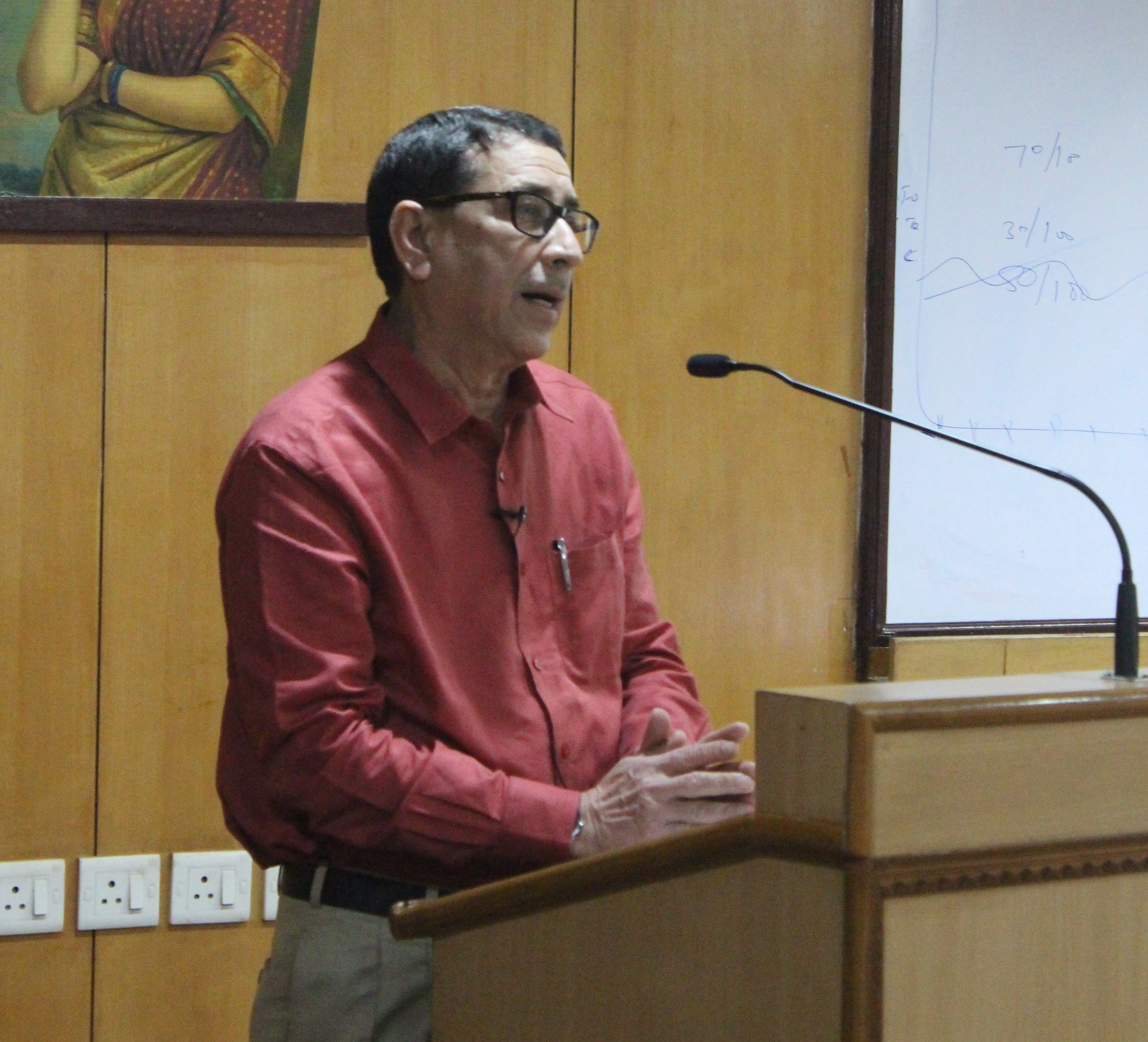
His studies were based on an understanding of language as a medium for enacting and performing citizenship. The relation between linguistic identity and citizenship comes to the fore when marginalised groups, their ‘voices’ and their language(s) get excluded from institutionalised, state sanctioned political discourses. Having worked extensively in the field of minority languages, he spoke about how crucial language practices and articulations are in a democratic participatory state, especially for marginalised communities, linguistic and others. According to Prof. Imtiaz, non-mainstream groups articulate their identity through their “everyday practice of language”. Besides, language is also a tool to wrest power and recognition from the state. The politics of exclusion and inclusion of languages in ideological state apparatuses like Census is often directly related to a sense of legitimacy and the state’s recognition of minority language speakers and their culture. He discussed the problematic categorisation of language in census operations and administrative records. For example, the census classifies only those languages with a minimum of 10,000 speakers. This leaves a significant linguistic wealth of the country into oblivion. He also pointed out the irregularities in the way language classification is done for the purpose of census operations. Mutual intelligibility and language relatedness often is an erroneous criteria for classifying languages. For example, subsuming several languages as ‘varieties of Hindi’ is inherently faulty because many of those speakers do not even comprehend Hindi.
Chinali is a language with only oral heritage since it does not have a script. This also turned out to be the reason why the danger of extinction is lingering around the language. Today, since many Chinali speakers use Hindi more often in their daily lives, Chinali seems to have been losing its visibility. As a sociolinguist, posed with a challenge of deciding on the measures to increase the visibility of the language, Prof. Imtiaz pondered over developing a script for them so that the language could be documented. However, script is never a neutral entity. “It carries strong political and ideological content within it”, he says. The Chinali speakers were suspicious of Hindi and its Devnagari script’s ability to imbibe the nuances of Chinali. Besides, there arose the risks of miscommunication and misrecognition as well. Sounds unique to a language are indexical to identity formation of the linguistic community as they provide “social meaning of existence and recognition”.
The community was named ‘Chinal’ by a British gazetteer and the term means ‘uncivilised’. He points out that he encountered a complex situation in which the speakers themselves didn’t want to use it to refer to themselves. Linguistic groups, especially marginalised ones, tend to articulate their sense of assertion (of linguistic identity) and pride in their semiotic processes.
He further elaborates that Chinal, as a referential language was a building block for a mere political act and that it was different from providing the status of citizenship. The function of linguistic citizenship is to delineate and make visible socio linguistic complexities of language issues and to make way for participation of minority speakers in governance. Participation in governance is one of the most effective methods to improve visibility of linguistic minorities but currently finds no place in the linguistic human rights discourse. Also, in the human rights paradigm, inadequate attention is given to the socio-economic fabric of language issues and interconnections between language, state, market and civil society.
Towards the end of his lecture, he pointed out that the need of the hour is to assuage the sense of inferiority marginalised groups experience due to the absence of state recognition of their linguistic identities. He also lamented over the fact that the notion of multilingualism is no longer a norm in the Indian context due to the alarming rate at which languages and consequently, linguistic identities are vanishing. He also used 2011 Census data on languages to substantiate some of his observations. He concluded by reiterating the need for linguistically marginalised communities to participate in governance and perceive their linguistic identity as a powerful tool to claim social and political rights for the community.
Report by Aswathy Venugopal
Photographs by Aditya Parameswaran

