
Professor Amaresh Dubey, Professor of Economics at the Centre for Regional Development, Jawaharlal Nehru University, delivered a keynote lecture, Identity and Durable Inequalities, on how identity interacts with various macroeconomic factors and outcomes. The lecture took place at HSB 356 on Friday 1 February 2019, the second day of the eighth annual DoHSS conference on identity and citizenship.
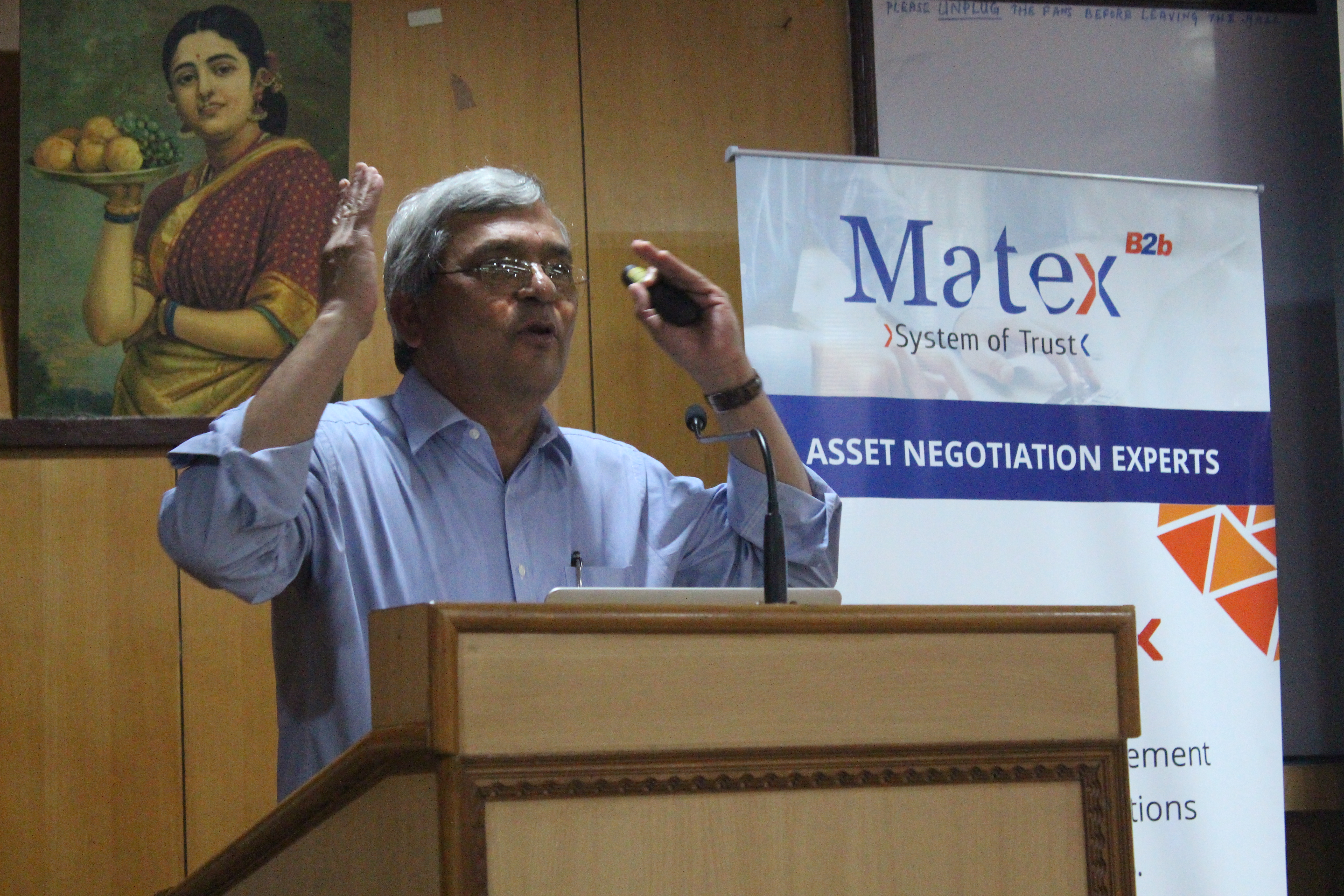
Starting a little after 5.50pm, Prof. Dubey’s jovial opening remarks put the audience at their ease. He briefly recounted how he had been asked to speak at the conference. He complimented the informal nature of the academic conference, and remarked that this would improve the quality of discourse and discussion. Mentioning that this was his first visit to the campus, he aridly remarked that it smelled the same as IIT Bombay did. He also mentioned the fact that he had shared a doctoral supervisor with department professor Subash S—he had been the said guide’s first student, while Prof. Subash had been his last. Lastly, he quipped that the last speaker’s slot was one of his favourites, as it allowed him to get away with talking about anything.
Prof. Dubey then began the lecture with a brief discussion on the definition of identity. He then talked about development, mentioning various events in history that influenced the trajectory of Indian development. He then explained the nature of the relationship between identity and development, with the example of inequalities in economic growth, which need to be reduced.
On identity
Prof. Dubey began by explaining the concept of identity. He defined it as a socially and historically constructed concept. The inherent link between one’s identity and societal structures of power and control was also mentioned. As observed in experimental economics studies, the social identity of a particular group affects how other groups interact with it—additionally so when the other groups have their own identities. This form of identity-based discrimination often persists in spite of legally-specified preventions. Once the influence of identity is accounted for in economic models, analysts would gain better insights into issues that had not been previously understood.
On development
Drawing from the writing of Jared Diamond in Guns, Germs and Steel, Prof. Dubey described the food cycle as the most revolutionary technology in the history of Homo sapiens. This process of domesticating plants and animals for food and work succeeded in changing the hunter-gatherer organisation of human society. It gave rise to a surplus population, which did not directly produce the food it required to sustain itself, and took up other occupations. This was a starting point for the differentiation of society, and the resultant formation of different identities.
Prof. Dubey then discussed the historical context that gave rise to the concept of development. For over two thousand years, India and China together had the largest share in the geographical distribution of the world’s wealth. The 60% share that it formed fell to around 10% around the start of the nineteenth century. This was due to the widespread effects that the Industrial Revolution had on the processes of production. Agriculture-based goods and services, that had traditionally held high utility, were replaced by the manufacturing sector and its products. It was in this context that the concept of development emerged.
The constitutive features of development are still being debated. However, it broadly refers to the gradual process of a society becoming more complex in the way it organises its people and resources. Its characteristic features commonly include economic advancement and increase in living standards. Dudley Seers argued for the inclusion of social indicators, such as reducing poverty, inequality and unemployment. Amartya Sen expanded this definition, positing a more romantic version: true economic development provides people with a set of linked societal freedoms, both economic and otherwise.
India’s history as a British colony shaped the unique perspective in development that it bears. Dadabhai Naoroji (who criticised the British drain of Indian economic resources and was instrumental in forming the Indian National Congress) investigated the high levels of widespread poverty and hunger that India was experiencing. He compared the average food consumption of Indian households with the food amounts allocated for inmates in Indian jails. He observed that around 70% of households consumed lower levels than the amounts allocated in jails.
In the postcolonial era, theories of development began to discuss the possible future of regions whose economies ‘lagged behind’ (with respect to industrialised Western European nations). Endogenous growth theory posited that these ‘underdeveloped’ countries lacked capital, which was the engine of growth for developed nations. Investment could augment the economic growth of underdeveloped countries, enabling them to improve their comparative standing in the world economy.
As Indian policy adopted this standpoint, widespread poverty continued to plague the country, extending into the 1980s and 90s. Attempts to mitigate the situation included the formation of the National Development Council in 1952. Economic growth was understood as a necessary precondition for tackling mass poverty.
How identity matters in the context of development
Prof. Dubey then briefly traced India’s economic development after its independence. He mentioned India’s incremental growth rate, which saw considerable increase after the 1980s. In connection with this, he cited I.G. Patel’s book, Glimpses of Indian Economic Policy.
At this point in the lecture, Prof. Dubey examined the horizontal inequalities observed in various social groups during India’s growth. To illustrate this, he used a dataset with information on growth in per capita expenditure from 2004-05 to 2011-12, and highlighted the widely varying rates experienced by sections of society such as the Scheduled Castes, Scheduled Tribes, and the Other Backward Classes. He also observed the difference in growth patterns that were observed in rural and urban areas.
He finally observed that despite traditionally vulnerable households (such as Dalits, Adivasis and Muslims) witnessing significant gains in status, identity-based disparities continued to persist. There is evidence of rising inequality, and on-ground levels are much higher than are commonly argued.
Concluding observations and the way forward
Here, Prof. Dubey mentioned the historical prevention of Scheduled Caste category individuals from owning land, and how it contributed to their inequal participation in the economy. However, according to him, redistribution of land to these sections of society was not an ideal solution. In an economy progressing away from agriculture-based production and towards manufacturing and the service sector, forcing people to remain bound to the land would be detrimental. Prof. Dubey was of the opinion that these historically oppressed sections would be better off if they had access to education, through which they could participate in the Indian labour force and contribute to economic growth.

Questions
Prof. Dubey’s speech was followed by questions from the audience. One of the questions was on the bill for reserving 10% of jobs and educational opportunities for economically weak general-category people. When asked for his opinion on this, Prof. Dubey again said that it was impractical from an economic point of view. Firstly, he averred that it was difficult to identify economically backward individuals, with household income data being the only available information. Secondly, the specified income cutoff (8 lakhs per annum) was too high, and would qualify 97% of the population for reservation, leading to negligible overall impact. He considered continual division based on reservation ‘bad economics’.
The last question referred to a comparison of two differing policies, that of land redistribution and education, in improving the situation of India’s Scheduled Tribe population. According to Prof. Dubey, STs were not gravely deprived of land, and had a landholding pattern similar to that of the forward castes. Redistribution of land would trap them into agriculture-sector activities, in a climate where the share of this sector is steadily decreasing. Therefore, this policy did not recommend itself to him.
Report by Naomi Karyamsetty
Photographs by Aditya Parameswaran

