
The third panel of the Department Conference titled “Cityscape” was moderated by Prof. Solomon Benjamin. Two papers were presented at the panel – “Politics of Slum Redevelopment” by Ms. Bhuvaneswari Subramanian, of Ambedkar University, Delhi and “No Home for Homelessness: The status in itself is a crime” by Ms. Swati Singh and Mr. Amol Bhalerao, of the Tata Institute of Social Sciences, Mumbai.
The panel commenced with introductory comments by Prof. Benjamin. He urged young researchers to frame their work in their own categories and terms, rather than inherit existing categories. Cities problematize categories of identity and citizenship.
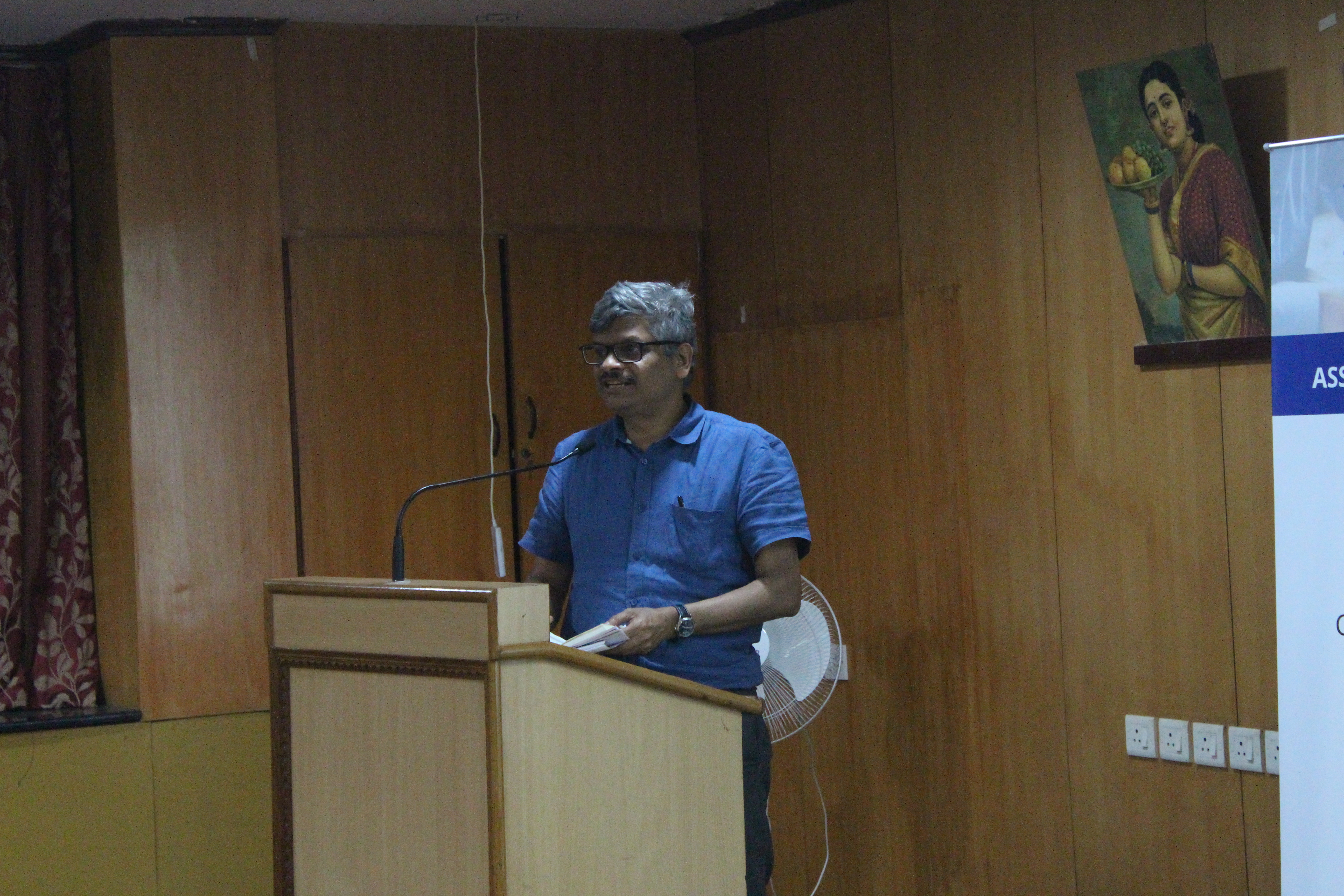
Ms. Subramanian began her presentation by providing a historical overview of the Dharavi region and tracing the lineage of Dharavi Redevelopment Project (DRP), which planned to transform slum settlements into a modern integrated township. Before the DRP was advocated for and approved, the residents financed the upgradation of their houses in groups, with support from the government. As of 2014, only one building had been constructed by the MHADA in Dharavi (which was now divided into sectors). Ms. Subramanian conducted her fieldwork in this building.
Upon speaking to the residents, she realized that many of them were not even aware of the DRP and only knew that they were moving into buildings. There was a lack of communication between the government, the people and administrators. The division of Dharavi into five sectors and the eligibility conditions for acquiring a flat in the new building did not seem to make sense. The slum dwellers do want redevelopment, and must be included in the planning process.
The second paper was presented by Ms. Singh and Mr. Bhalerao. The paper was based on fieldwork conducted at the Chatrapathi Shivaji Terminus (CST). It traces how policies criminalize homelessness. Much of this depends on how the homeless are perceived. The Bombay Prevention of Beggary Act 1959 labelled homeless persons as beggars. The tone of the act is punitive and unconstitutional. In addition to such legislation, the homeless struggle immensely to get ID cards. Their belongings are often confiscated and burnt by corporation workers. Conventional state language focuses on the materiality of citizenship. The narratives of the homeless are not documented. This gives rise to the question: who qualifies for citizenship?

The presentations were followed by a question and answer session. One of the questions raised was whether the discipline of urban studies was always anti-state and anti-planning. Prof. Milind Brahme remarked that the panel reminded him of the illustrious novel by Rohinton Mistry titled A Fine Balance.
In his closing comments, Prof. Benjamin remarked that the papers revealed the state as a set of disaggregated entities, through their nuanced ethnographies. One seeks identity from a place. The Dharavi paper explored how between 1990-1995 there was a change in who controls space. Despite having opened Dharavi for private real estate investment, the fact that big developers are not coming in, attests the presence of adequate political clout which could keep them away. There are ways of thinking about the city without the hegemony of the plan.
Report by Ashraya Maria M.P
Photographs by Aditya Parameswaran

