
Dr. Satish Deshpande, an all too familiar and respected figure among the students and faculty of the department, was the last keynote speaker of the eighth edition of the HSS Conference. Participants, students and faculty gathered together in the Central Lecture Theatre at 3:00 pm on Saturday, the 2nd of February 2019, to listen to Professor Deshpande’s lecture titled ‘Four Moments in the Career of Caste’.
The event commenced with the Conference Secretary Ms. Upasana Bhattacharjee bringing to the audience’s notice the recent and rather unconstitutional arrest of the well-known Dalit scholar Dr. Anand Teltumbde. Professor Deshpande then began his lecture by expressing his strong disapproval of Professor Teltumbde’s arrest, and appreciating its mention in the Conference.
In a time where mere access to information is conflated with wisdom, Prof. Deshpande noted that teachers are being forced to recall their vocation and act as ‘real’ teachers. To act thus – as a real teacher – he proposed to suggest to the audience a way of seeing or putting together information. He began by drawing attention to the inevitable tension and co-implication between the two concepts of identity and citizenship. While the idea of citizenship has a universal quality to it in that it is tied to the state and juridical notions of rights, the idea of identity is more particularistic, and appears to be something of an excess in comparison. The troubled meeting point of the discourses on identity and citizenship, Prof. Deshpande noted, culminate in the concept of the nation-state. The idea of the nation-state, as we know it, is the heir simultaneously to a very dry, juridical tradition of Roman Law on one hand and a passionate tradition of nationalism on the other. Two models of citizenship were drawn to the attention of the audience here – firstly, the liberal model, which assigns a ‘status’ to the citizen as a rights-bearing individual, which is at odds with the republican model that assigns a ‘role’ to the citizen as one who actively participates in governance.
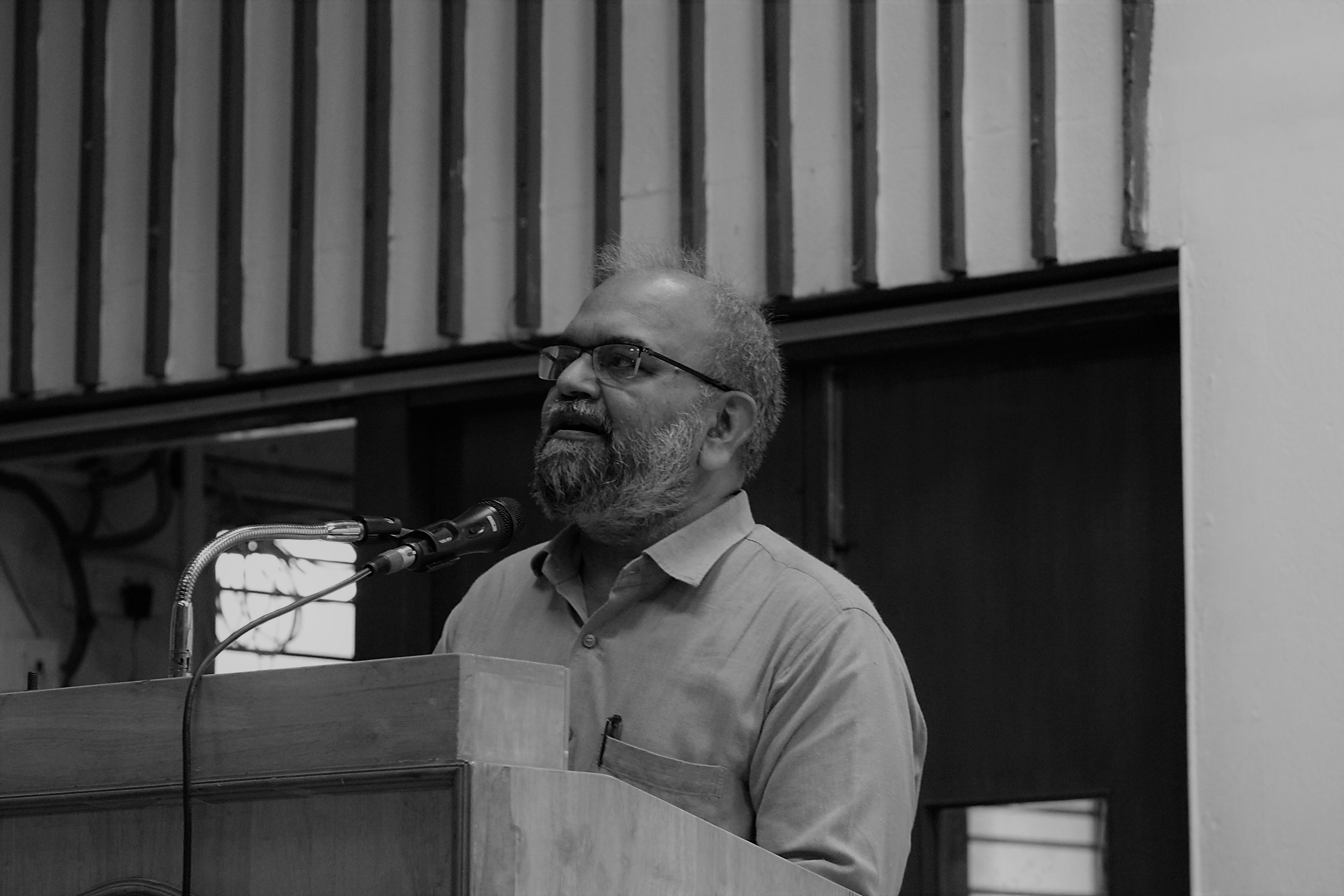
Having set the context thus, Prof. Deshpande set out to explore the ‘career’ of caste in India in the last century in an attempt to identify the points of inflection in the trajectory it has taken. To succeed in this endeavour, he emphasised that one must think of caste as a processual, relational entity, rather than a singular entity. He then pointed out that it has roughly been a century since the earliest movements to reform caste in India emerged, be it the first public mixed dining – ‘mishra bhojanam’ – that happened in Kerala in 1917, Sri Narayana Guru’s famous movement ‘nammaku jaati illa’ in 1916 or the first resolution against caste made by the Indian National Congress in 1917.
Prof. Deshpande therefore placed the first moment in the career of caste at the 1930s, when reform movements such as these were beginning to solidify and take effect. He referred to three broad agendas with regard to caste that were being pursued at this time:
- The agenda of annihilation, as conceived by Dr. B.R Ambedkar;
- The agenda of reform, as advocated by M.K Gandhi, which was staunchly against untouchability, but believed in the varnashrama, or the division of labour based on caste;
- The anti-caste agenda of Vinayak Damodar Savarkar, which proposed a vehement and unmerciful fight against caste, on the condition that everyone agrees that there is only one caste – the Hindu.
What was agreed upon by this time was that caste could not be left alone, which Professor Deshpande believes was a sentiment that stemmed from the Poona Pact of 1931. The demands for independence had solidified by then, and caste began to be perceived as an inordinate embarrassment to India as it was against the fundamental principle of equality that an emerging modern nation-state like India must embody. The Poona Pact, therefore, appeared to settle the caste question by countering mandatory exclusion with mandatory inclusion manifested through caste reservations. However, the underlying implication to be noted is that these reservations placed the upper castes in the positions of power and made them the ‘givers’ of reservations.
Prof. Deshpande then moved on to identify the second moment in the career of caste as the 1950s, in the context of the Constituent Assembly debates. This period saw the rise of the language of ‘backwardness’, which trumped the language of ‘difference’. Following the period of tumult that India had just faced, there emerged strong calls of unity that aimed to brush aside difference and inequality (even of caste) within the country. The arrival of the concept of the ‘unmarked citizen’ paved the way for meritocracy establishing itself as the default standard. Reservation began to be looked at as an unfortunate and regrettable exception made to the concept of meritocracy. In fact, the first amendment made to the Constitution after the State of Madras v. Smt. Champakam Dorairajan case effectively brought about a model of reservations that put the lower castes on the wrong side of morality. This resulted in the hyper-visibility of the lower castes, who were projected as people lobbying for undue advantages, and the invisibility of the higher castes, who sincerely believed that caste had nothing to do with their lives and carried on as though centuries of privilege did not affect their social standing, because it was only merit that mattered. Caste is essentially relational, as we are urged to remember; but that relational aspect was being erased during this period in a rather underhand manner.
The third moment, Prof. Deshpande noted, was the Mandal Revolution of the 1990s, which emphatically uncovered the open secret that caste was indeed still wielding its power in Indian society. Over 50% of jobs in all sectors were revealed to be confined to a tiny and privileged 15% of the population that comprised the upper castes and this made it incontestable that the so-called ‘General Category’ was but a myth. The period also marked the rise of both neoliberalism and the return of right-wing Hindu politics. In a sense, it was the end of one set of developments in the trajectory of caste and simplistic caste politics could no longer stake any claim to authority.
The fourth moment is the time we live in today – the period post-2014, which Professor Deshpande characterised as being one of uncertainty, ambiguity and saturation, where simple explanations no longer work. High degrees of economic and social differentiation among castes has led to the non-existence of homogenous caste groups. The neoliberal agenda – the agenda of globalisation – is being contested and there is a sense of pervasive disillusionment with the concept of neoliberalism. This is also the time of the rather misleading concept of intersectionality, which is characterised by a collegiality of concepts. To understand caste, one needs to know more than caste. Elections cannot be fought on single caste basis anymore – they involve much more complicated alliances. There are complicated processes of disaggregation and tentative efforts at reaggregation that are occuring in the country – the best example of which, Professor Deshpande observed, would be the 2014 general election. Flying under the single flag of caste therefore, can no longer yield the same results as it would have done earlier.
Professor Deshpande then concluded by grimly pointing out that the story that began 60 years ago with Champakam Dorairajan in Chennai has come full circle today, with the 10% reservations being granted very recently for the General Category in India. Smt. Champakam had then, back in 1951, opposed her exclusion from reservation on the grounds that she was a citizen of India; today, the new reservation bill has responded by giving her her ‘fair share’ in the reservations.
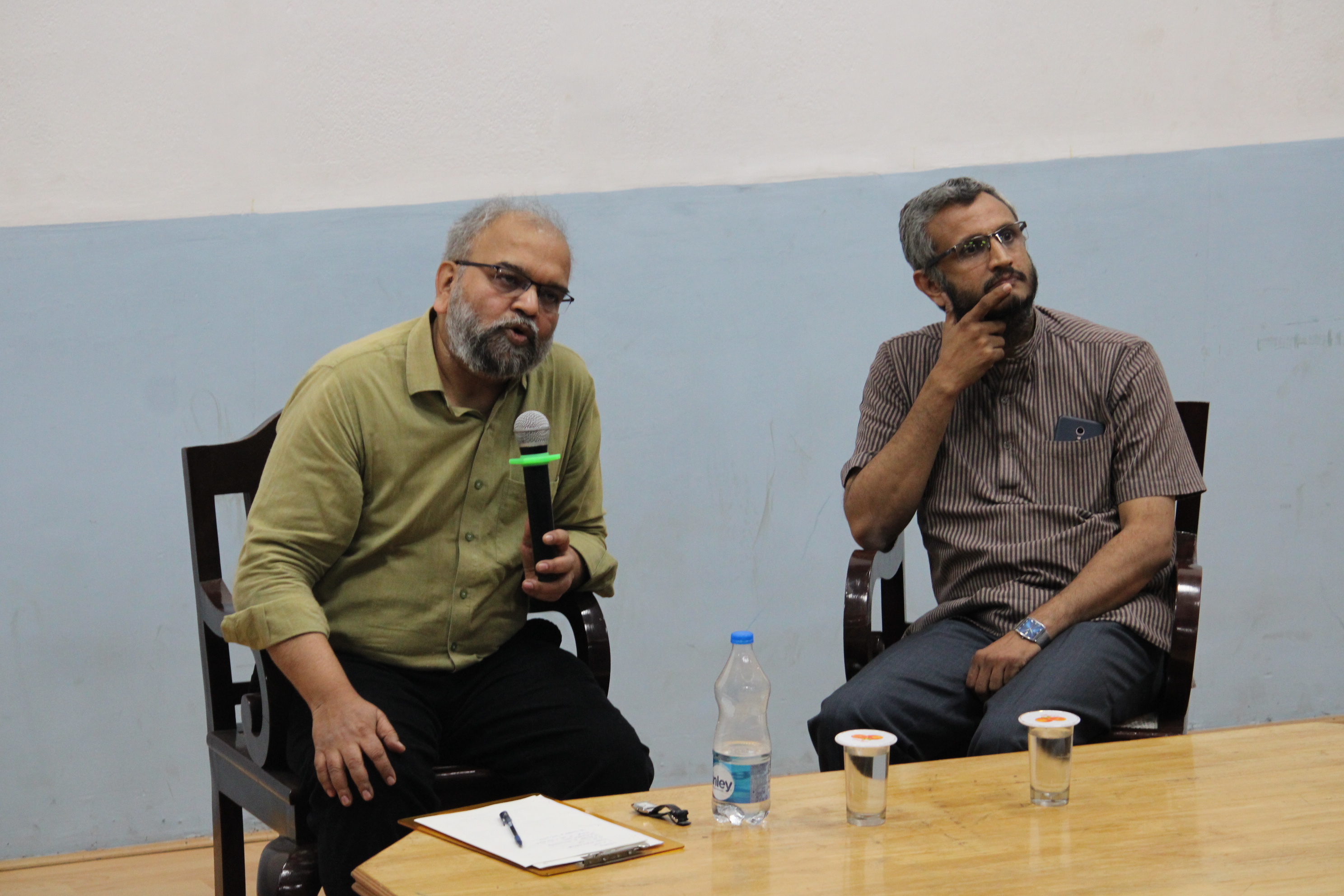
A question and answer session followed Professor Deshpande’s crisp yet profoundly insightful lecture, with many pertinent questions being raised. Most notably, when Professor Deshpande was asked when India would see the end of reservations, he responded that it would happen only when a whole month goes by, without a single caste atrocity occurring in the country. Professor Suresh Babu then delivered a few concluding remarks, after which the audience moved back to HSB 356, and panel presentations scheduled for Day 3 were recommenced.
Report by Sruthi Ranjani
Photographs by Aditya Parameswaran

