
It was Day 3 of the Department Annual Academic Conference and the fifth panel titled ‘Fostered Citizenship’ began at 12 pm sharp. Prof. Arvind Sivaramakrishnan was the moderator for the session.
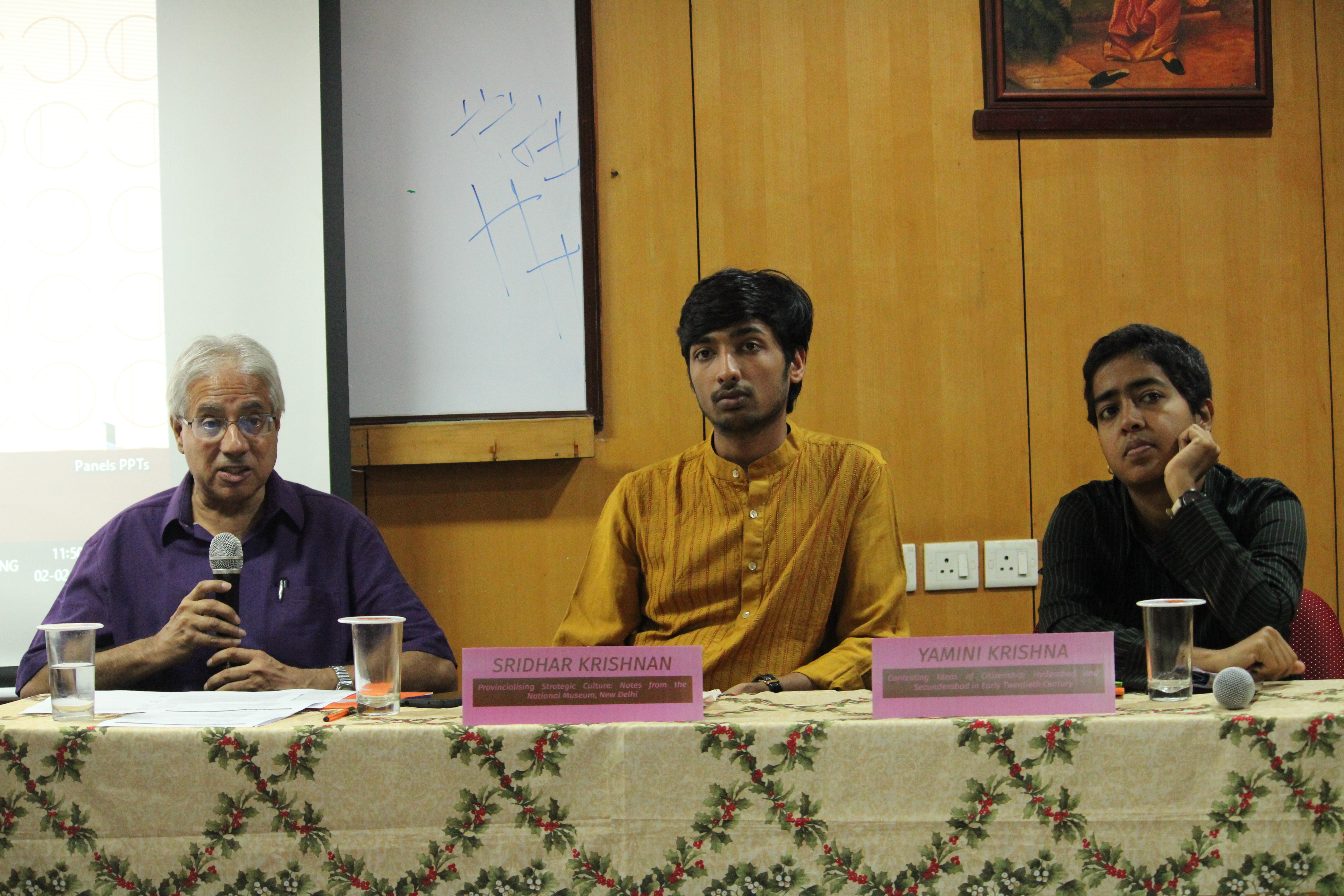
The first panellist was a Ph.D. scholar from English and Foreign Languages University (EFLU), Hyderabad, Yamini Krishna, who presented her paper titled ‘Contesting Ideas of Citizenship: Hyderabad and Secunderabad in the Early 20th Century’. Her paper intended to historicise the idea of citizenship, the way it was constructed in the colonial cities of Hyderabad and Secunderabad which belonged to very distinct paradigms, which resulted in the rise of two different and contesting modes of being a citizen. Yamini accounts for this difference by pointing to the distinct political and economic contexts in which these cities thrived. Hyderabad was a patrimonial modern city while Secunderabad operated in a colonial capitalist mode. An understanding of India’s notions of identity and citizenship would be incoherent without tracing them to its colonial past. This is where Yamini’s paper draws its relevance from. Secunderabad was a military cantonment, administered entirely by the British. Nizam had leased it out to the British under the condition that it would be used solely for military purposes, in the 1930s. Hyderabad, under the Asafjahi dynasty, was the capital city of the dynasty. The identity of Hyderabad as a ‘princely state’, she said, has not been given due attention in the discourse of nationalist history. Later, a contention arose once Nizam noticed that the land of Secunderabad was not being used for military purposes and therefore demanded portions of the land to be returned. She explained the term ‘patrimonialism’ using Max Weber’s categorisation of three types of traditional authority. A patrimonial state is characterised by a network of personal relations and rules that find their expression in the cultural values. It also involves the cultivation of etiquette among the nobles and the administrative staff. Since Hyderabad imbibed the values of patrimonial modernity, the notion of citizenship was based on the knowledge of the common patrimony and loyalty to the sovereign and not on the basis of law or by birth. She reminds us that the categories of patrimonialism and citizenship were not necessarily contradictory. Emphasis was diligently placed on ‘cultivating the practices of citizenship’. On the other hand, Secunderabad developed as a commercial town around the military cantonment with due concern for the law or rules as the basis of its political and economic set up. Yamini also mentioned the nature of political, economic and identity based concerns the citizens of both the cities held in the wake of the transition of power over Secunderabad from the British into the hands of the Nizam – for example, the identity of being a Muslim or a non-Muslim under a Nizam, imposition of Urdu language, affiliation to Universities, running of businesses etc. She concluded by stating the two different definitions of citizenship that emerged from these contesting paradigms – one, that declares “I am a native, therefore I am a citizen” and the other that declares “I am an electoral representative of the state, legitimised by law and therefore I am a citizen”.
The second panelist was Sridhar Krishnan, a Research Scholar from the South Asian University, New Delhi. His paper was titled ‘Provincialising Strategic Culture: Notes from the National Museum, New Delhi’. His paper was centred on an understanding of public spaces like museums as spaces used by the state for propaganda by tacitly imposing and institutionalising state mandated narratives or histories. He argued that our collective understanding of India as essentially ‘a peace-loving state’ is such an example of the postcolonial state’s attempt to propagate such notions about the strategic identity of the state. This is done through a carefully structured and coordinated viewing experience, well charted out paths and a clear indication of dos and don’ts systematically arranged for the visitors to the museum, to the extent that these tools collectively streamline their thought process itself. His presentation was interspersed with examples from recent politics of India. He argues that strategic culture ardently interacts with the common citizens and is not just an elite run business. Similarly, foreign policy is not entirely divorced from the common citizen, as is the common conception. He elucidates these arguments using the study he conducted in the National Museum, New Delhi. He questions the notion of museum as a neutral educational space or an open text for the viewers to read and interpret from. The experience, according to him, is constructed. The artefacts on display in the museum – the statues, robes, royal relics and rarities, weapons and other war equipment convey only the state approved narratives. He also alluded to the contesting definitions of geographical boundaries of what we understand as ‘India’ today, contributing to this ‘constructed’ness. He refers to this as a ‘misappropriation of legacy’ – a distortion of the idea of India that gets formed in the viewers’ psyche.
He also referred to Chola imperialism as another example refuting the ‘innate peacefulness’ of Indian subcontinent. He believes that it was a colonial construct; a deliberately constructed myth in an attempt to appease the nations’ need to possess ‘legitimate histories’.
The panel concluded with a Q & A session moderated by Prof Arvind Sivaramakrishnan. Concepts such as ‘mulki’ or ‘local native’ identity were elaborated by Yamini in the session. Sridhar responded to questions related to his argument around museums as means of propaganda, after which the session was concluded by Professor Sivaramakrishnan.
Report by Aswathy Venugopal
Photographs by Sathya Priya

