
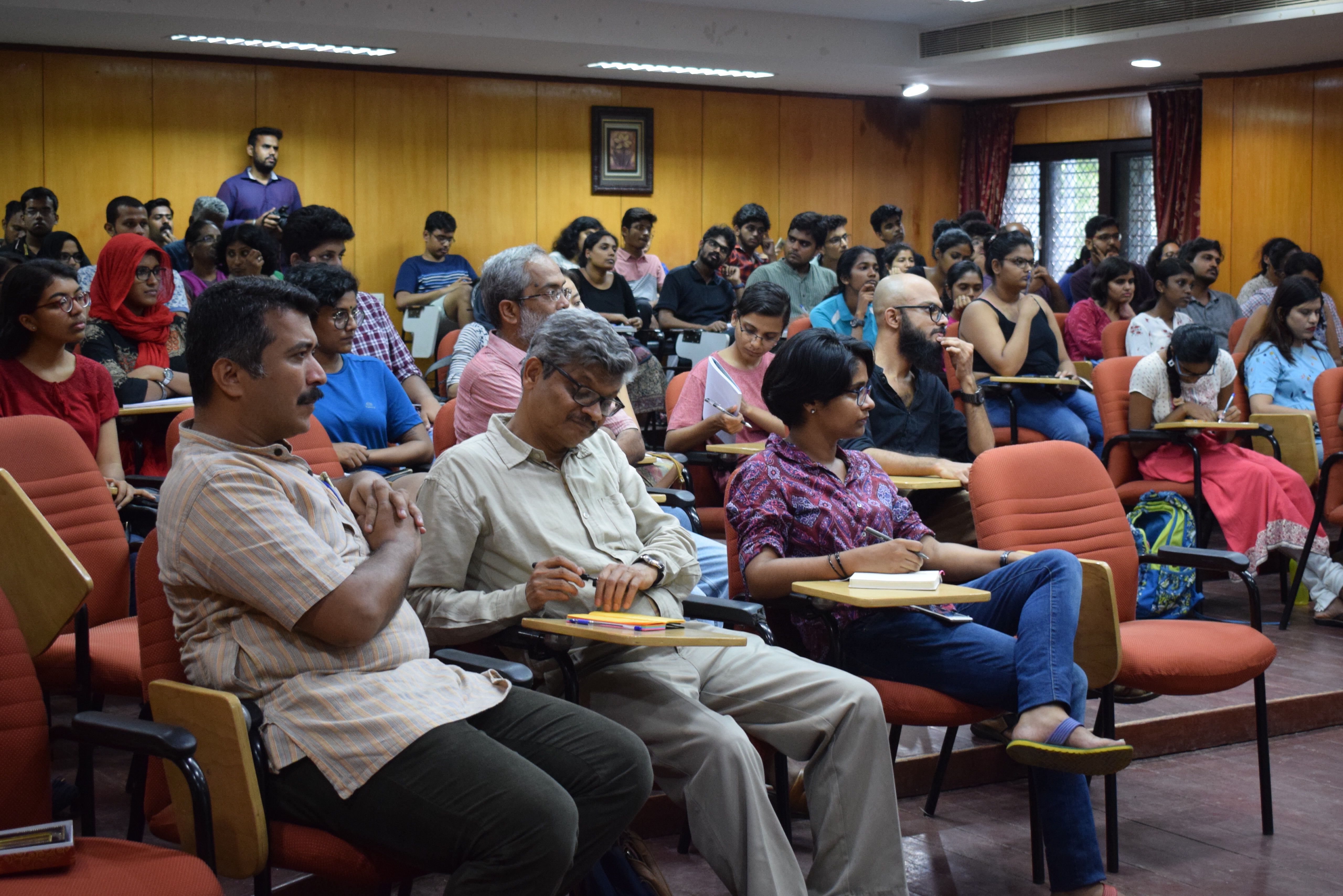
August 7th, 4:15 PM, marked the day of the lecture by Sujata Patel. HSB 356 was filled with refreshed students and scholars after a cup of coffee and snacks. The event began with a welcome address by Professor Santhosh R, who introduced Sujata Patel, one of the leading sociologists in the world with specialization in social theory and urban studies. The topic of the lecture was: How to Think Cities and Urbanization in Today’s India. It aimed to answer questions related to India’s urban modernity and specific patterns of spatial inequalities and exclusions.
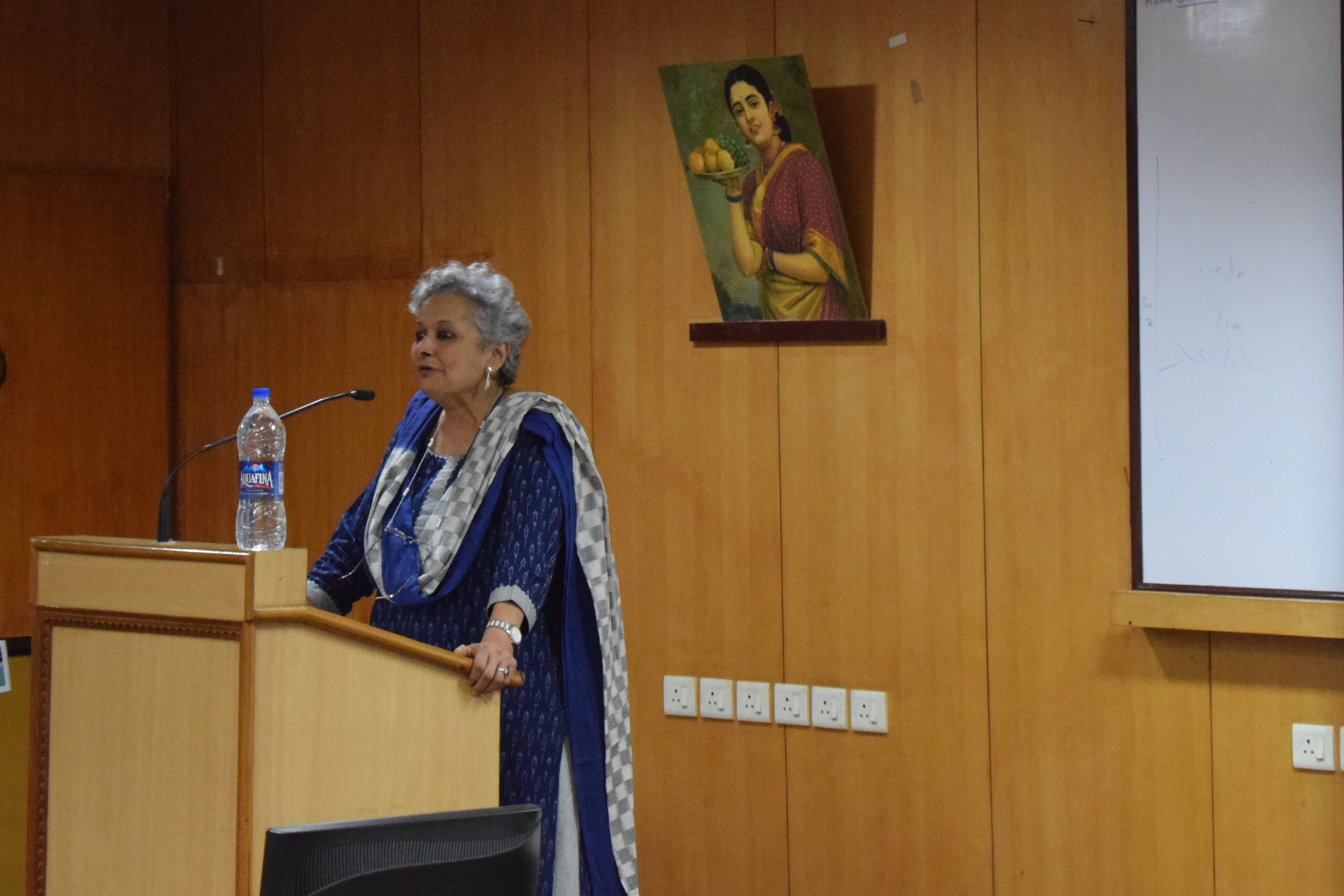
She began by addressing the importance of studying urbanization in the first place. It is a process which changes the lives of millions of people. She initially wanted to study the city of Ahmedabad but quickly realized most of the available resources addressed the process of industrialization. Urbanization was seen as a consequence of this industrialization process. Nation states strived to convert villages to cities. It was a way to achieve modernity. The formation of cities was a way of replicating the European dream. Cosmopolitanism, consumption, consumerism and several other urban characteristics (as set by the West) were aspired as it was a way to become modern.
Professor Patel then talked about how she was asked to conduct a conference in Bombay regarding Urban Studies and Spaces in December, 1992. This was set against the backdrop of the Bombay riots, in which around 700 people died. The communal riots were a reaction to the demolition of Babri Masjid. Here was Bombay, an Indian city which was supposed to symbolize an urban space, having one of the worst communal clashes. This brought up the important question of what qualities urbanization represented. Here she mentioned the concept of vernacularization as introduced by Thomas Blom Hansen in a paper titled The vernacularization of Hindutva: The BJP and Shiv Sena in rural Maharashtra. In this paper, he explores the inability of the Congress (in the 1980s) to incorporate the new upwardly mobile groups thrown up by the intensified commercialization in the rural areas, as one of the reasons for the conquest of political power by BJP-Shiv Sena in Maharashtra.


Moreover, this so-called industrialized, urban Bombay, had seen the Great Bombay textile strike in 1982 which led to the closure of several mills and left 150,000 workers unemployed. This is led to the realization that there was hardly any organised labour force in Bombay. The labour population had been deskilled: they moved from agriculture to the textile industry to whatever job they could find. It was clear that urbanization and industrialization had nothing to do with each other. Hence, it was safe to assume that there was a new model where urbanization could occur without industrialization. This led to a completely different social structure than was seen in European cities. Professor Patel referred to Saskia Sassen’s pyramidical structure of European cities: From a triangular composition of cities (large working class, smaller middle class and fewer elites), European cities transitioned to an hourglass composition with a disproportionately large middle class. She argued that this transition which occurs due to a change in the economy from secondary to tertiary sector, had taken place in Indian, South-east Asian and Latin American cities even before its occurrence in European cities. This is because in many ex-colonial countries, urbanization had taken place without industrialization.
The characteristics of urban cities here were completely different. Urbanization was occurring without doing what it was supposed to do, i.e. housing, electricity, transport, communication and other social infrastructure. The existence of slums in some of India’s “urban” cities are a clear indicator of this. The cities were marked by the existence of high inequality (not only income, but also the above mentioned). The Indian Census had certain indicators based on population, density, workforce, income, etc. to determine whether a certain region is “urban” or not. But is this how you should measure it? She made an argument about how instead of cities, villages get urbanized. But the Census figures (2500+ Census towns) do not reflect this because of the understanding that urbanization is facilitated only by industrialization. At this point, Professor Patel introduced the concepts of ruberization (rural urbanization) and subaltern urbanization. The concept of subaltern urbanization refers to the growth of settlements, whether denoted urban by the Census of India or not, that are independent of the metropolis and autonomous in their interactions with other settlements, local and global.
She further moved on to talk about planetary urbanization (introduced by Nick Brenner), which sums up the idea that urbanization processes affect the entire planet, not just particular places we define as “urban” or cities. There are several things like the hosting of the Olympics, construction of flyovers, setting up of tourist spots like Disney World, etc. which could lead to temporary creation of urban spaces without industrialization. She then talked about desakota which is a term used in urban geography to describe areas in the extended surroundings of large cities, in which urban and agricultural forms of land use and settlement coexist and are intensively intermingled.
The renowned sociologist concluded by calling urbanization a process of capitalist reorganization which allows certain advantaged groups to keep moving forward, while the point of urban spaces is supposed to be to make sure everyone gets equal opportunity. This lack of economic freedom for the disadvantaged translates to lack of cultural and political freedom. This leads to primordial identity movements, with people holding on tighter to their religious, ethnic, linguistic identities.
Report by N. J. Sadhana
Photographs by Sakshi Malpath

