
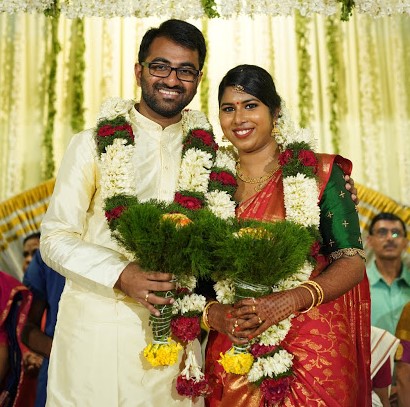
The Article 19 team in conversation with Arun Sudarsan and Chandni Chandran, who graduated from the Department of Humanities and Social Sciences in 2014. The two got married in 2018.
Chandni cleared the 2016 Civil Services Examination and belongs to the 2017 IAS batch. She is currently posted as Assistant Collector (Under training) of South Tripura district.
Arun graduated from the National University of Singapore with a Research Masters in Economics in 2018. Subsequently, he joined NITI Aayog, working on the Aspirational Districts Programme of the Government of India. However, he is now no longer with NITI Aayog and is instead looking for opportunities closer to Tripura.

Chandni
When did the ‘IAS dream’ catch up with you?
To become an IAS officer was a vague idea that I had since childhood. My father is a government employee, and he inspired me to think about a career in the civil services. It was not a single-minded devotion until the final year of MA, when I finally decided to take the plunge.
How did you deal with failures and disappointments during the preparation process for CSE?
My first attempt was just after graduating in 2014. I was under-prepared, and the failure was not unexpected. I still consider my second attempt as my best – I put my heart and soul into the preparation. Making it to the interviews but not to the final list was heart-breaking. To my luck, I had a supportive ecosystem and a backup that I loved.
If you hadn’t gotten through to the civil services, what would your other options have been?
After my failure in the second attempt, I simultaneously started preparing for a career in academics. I wrote and cleared PhD entrances and JRF and would’ve joined one of them.
In what ways do you believe the department and the course prepare you for a career in the civil services?
The Department played a crucial role in shaping my personality. The exposure to multiple disciplines and viewpoints expanded my worldview. Skills picked up from the department include being able to read and interpret difficult texts, spotting logical fallacies and making PPTs! I should accept that the core content of the course has not given me any edge in functioning as a civil servant, though I expected it to. The downside of the course in our department was the level of cynicism I had absorbed from there.
How has the journey as a bureaucrat been so far?
I have just started my career. To be bureaucrat is to be a cog in the system without jeopardizing your individuality. You need to strike a balance – which is an easy thing to say but is very difficult to put into practice. There are ethical dilemmas you are faced with. It might be a cliché to say – but the vast canvas you get to work in and the small changes you can bring to the lives of people makes it all worth it. My journey so far has been very enriching and satisfying. I think it will continue to be so if I manage to keep working without compromising my principles.
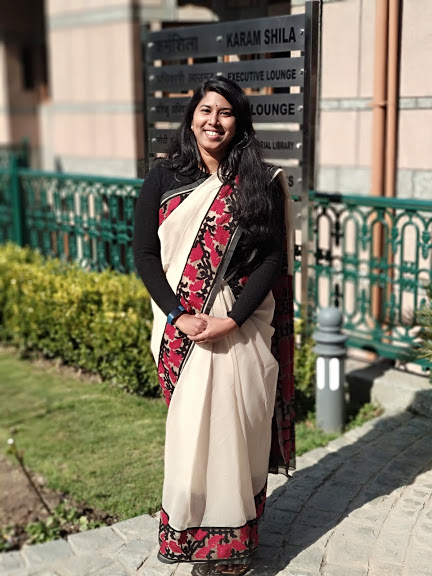
Kerala, Chennai, Delhi, LBSNAA and Tripura. Which of these places would you call ‘home’?
Home is home – so it’s Kerala! Chennai is very special to me though. It’s the city where I became an adult, fell in love and gained confidence to face the world. The first trip we took after getting married was to Chennai. The food, Insti, Bessie… it is also home! Being at LBSNAA was a dream come true. I am in awe of Mussoorie. The training is very happening and interesting. It is an opportunity to make friends for life and I had the best group for Winter Study Tour (aka Bharat Darshan). There are certain drawbacks to it though – more often than not we Officer Trainees are treated as just trainees instead of officers. Early morning PT even when the temperature outside is ice cold, making even cultural performances mandatory to attend, micromanagement of classes etc. were some of the killjoys. Simple, loving people, beautiful greenery and rich culture is what makes me love Tripura.
Arun
Having been all of the trio (Branch Councillor, Department Secretary and Placement Core), what was your motivation behind taking these up? How were you able to balance PoRs with academics?
My main motivation behind taking up the position of Branch Councillor was to become a member of the SAC (~SLC). I was extremely enthusiastic about SAC meetings and I had started attending them when I was in 2nd year. The work of a Placement Core at the time was a default responsibility of the Branch Councillor. Personally, I don’t think I balanced these responsibilities and academics very well. I spent a lot more time doing official work than my own academic work.
As a SAC (predecessor of SLC) member, you took leadership in drafting and implementing several important initiatives. What is your opinion on the nature of student politics and student governance in the institute? Do you believe the SLC is able to adequately represent student concerns?
I fondly remember my tenure as a member of the SAC. The SAC that year was extremely productive – we had more meetings than the previous three SACs combined. The long-delayed IRV system was finally introduced in the 2014 Student General Elections. We were also able to introduce the “Reject” option for the first time. Eleven members were disqualified for not meeting minimum attendance criteria and the IITM Student Honour Code was drafted. We tried to introduce reservation for women in Executive Wing posts which was unsuccessful. Maybe now is the time for the current SLC to think on how to implement it. Try looking up the Singapore model.
The student politics in IITM, especially at the institute-wide elections to the Executive Council, was based on regional identity. I don’t have to elaborate on this aspect as it’s well known. At the Department level, things were usually much more sane. The fact that placements were handled by the Branch Councillor meant that most Departments chose the best available candidate rather than going squarely based on some ascribed identity.
Do you think that positions in the student governance structure are being taken up as ‘just another PoR’? What advice would you give to students wishing to take these up?
Most students who take up PoRs, I feel, are motivated to work although their priorities might differ. During my tenure as Branch Councillor, my main interests were in academic culture in the department and reforms in the SAC. My advice to students wishing to take up PoRs – make sure you are passionate about it!
You pursued a Research Masters in Economics from the National University of Singapore after your graduation from the department. How did you go about choosing where to apply? What made you choose another Masters first (and especially a Research Masters) and then a work profile?
I made a conscious decision to apply for another Masters degree by 4th year of the program. I did apply and get admission in a few universities in the UK but all without enough scholarship support. After graduation, I worked with Dr.Subash as a Project Assistant. Finally I got admission in NUS. I joined NUS for its Economics PhD programme in 2015. However, during the semester break in December, I had certain health issues that forced me to miss an entire semester. Pro Tip: Don’t get sick in a structured PhD program, especially during the time of coursework! It derails your entire plan and you may have to make some tough decisions. I had to convert to a Masters degree subsequently.
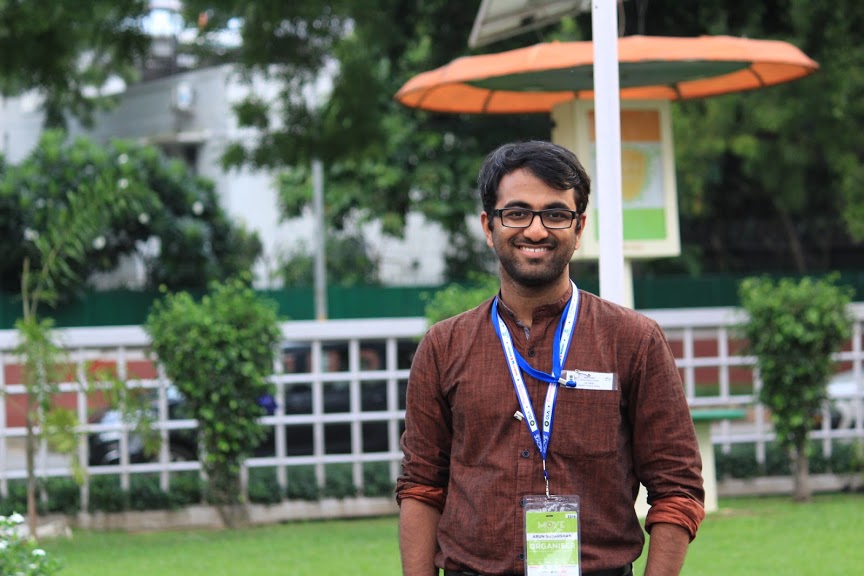
How different is the academic and student environment at IITM (and the department) and NUS?
My time at the Department of Economics within the Faculty of Arts and Social Sciences in NUS was an eye-opener for me. I was a Teaching Assistant for the Econometrics module for undergraduate students – they are taught more in the first 2 years than what we were ever exposed to in the entire 5-year MA programme.
The academic environment in our Department, I’m sorry to say, is not anywhere close to the standards expected from an institute of IITM’s repute. I often refer it to as a 5-year BA programme. There are excellent teachers and researchers in our Department. However, their collective political power is insufficient to effect any meaningful change in our programme. Inertial is a powerful force.
To be clear – there are good, mediocre and bad students and teachers in NUS as well. The core difference is that they have managed to set and keep a minimum standard. I still remember several cringe-worthy interactions with senior faculty members in our department regarding academic standards.
Me: Not all professors come prepared for the lecture.
Faculty member: Students don’t come prepared. Why should we?
Me: Kindly check every assignment for plagiarism.
Faculty member: Am I a dosa-making machine to put every paper through the computer?
Having handled multiple PoRs, pursued a Research Masters and now working with the government, would you rather describe yourself as a specialist or a generalist?
I’ve always wanted to be a specialist. However, I do more generalist work than specialised ones right now.
Is policy in India backed by research? Is academia in the social science disciplines conscious of the policy spillover of their research? Do you believe that academic research should be oriented towards development of policy?
All I can say is that our country’s policymaking, more often than not, is ad-hoc, ill-informed and almost always a few years too late.
Chandni and Arun
Could you tell us about your experiences working together as department secretaries?
We think we had a pretty good innings there. Organizing the 2nd Academic Conference ‘Negotiating Conflict’ was a task in itself; and we learnt a lot of leadership lessons from it. Its success prompted the department to make it an annual event instead of a biennial one. Constituting the Department Council with participation from all batches, mandatory female participation in cricket and football tournament etc. were some of the initiatives that we managed to take.
Imagine you woke up as the HoD tomorrow. What changes would you effect in the department?
We think this artificial restriction on the number of people who can take Development Studies or English should be done away with. There are several other suggestions we have. However that’s an entirely different essay!
Was the department where you both first met? How did you go from two students in the department to ending up being married?
We spoke to each other for the first time in front of the Central Library during a class discussion on Freshie Night. It took six months for us to become friends and six more months to be a couple. Those trips in cycle for NSS classes in Velachery, mutual friends’ group, Arun’s inability to understand philosophy and mine to make sense of statistics aided the process! Once we were in a relationship, we knew we had to do everything to make it last forever. We were crazy about each other and that small cocoon we made insulated us from all the stresses and hardships we had.
Interview by the Article 19 team
 Article 19