
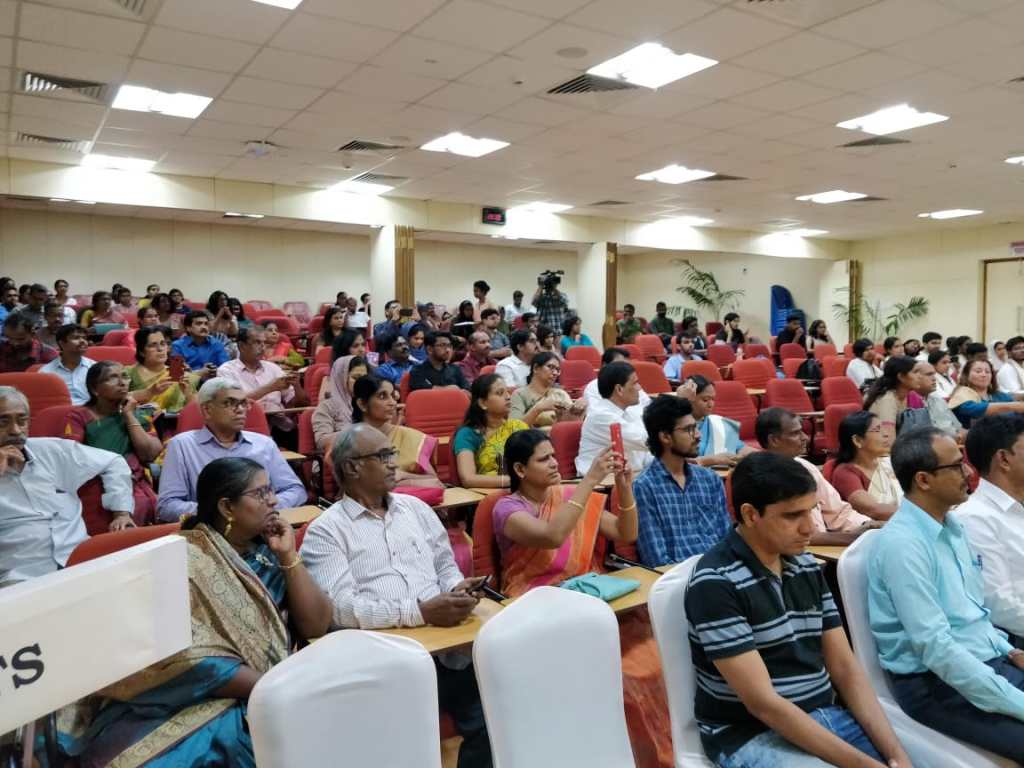
The department convocation began at 2:20 pm on the 30th of September in the Aryabhatta hall, to happy graduates and enthusiastic freshie volunteers, all clad in white. It started with the volunteers singing Vande Mataram to the crowd, following which Professor Umakant Dash welcomed the gathering to the 56th convocation of the department. He congratulated the students, faculty and staff for IIT Madras’ continued first position in the NIRF rankings, also urging them not to rely on past laurels but strive to maintain this excellence. He then gave a report on the department’s activities in the past year- including the China Studies Centre, the Annual Conference, the Research Symposium, the 2nd International Conference on Anglo Indian Studies, the workshops organised, the books and papers published by the faculty, the talks and R&D lectures conducted, and then the various kinds of research done by the scholars. He also talked of the students’ activities inside and outside the department, including the Prem Ranjan tournament held in March, won by the HS14 batch, the intra department badminton tournament, and the Bhargavi Memorial Word Games and Quiz tournament, in memory of the department’s alumna Bhargavi, conducted during the year with help and funding from the HS12 batch and Bhargavi’s parents. Prof. Dash also mentioned that the department saw the highest jump in placements, with 15 students getting placed. 7 of the students opted for higher studies, in India and abroad.
The Dr Dilip Veeraraghavan memorial award for the best student in Developmental Studies was won by Anwesha Pathi, and the Dr A.V. Krishnarao memorial award for the best student in English Studies was won by Divya Vijayakumar. Varsha Gopal, Sourav Ramesh and Meenakshi V received the Institute Merit Prize. K. R Ananthajith and Anwesha Pathi received the Dr V Ravikumar Memorial Prize, Divya Vijayakumar won the Gonsalves Foundation prize, Anwesha Pathi received the Swathi Janalakshmi Award for the girl student with the best academic record at the end of the prefinal semester, and Aiswarya Anand received the Institute Blues award for her numerous extra curricular and co curricular activities.
During the academic year, the department received 8 research projects, worth Rs 4.58 crore, and 8 industrial research and consultancy projects worth 1.81 crores. The Professor then expressed his gratitude for the Director, the Dean, the Chairperson, Placement office, CCW and the Engineering Unit for their continued support, and to the faculty of the department for their involvement in conducting the various events in the department.
After welcoming the chief guest, Dr Makarand Paranjape, Professor Dash concluded by wishing the graduating batch happiness, professional success and fulfilment in whatever they do in life.
Anwesha Pathi was then invited to address the gathering. She began by recounting her batch’s feelings about being in such a huge campus in their first year. While it was overwhelming to see people doing impressive things in the technological side, Anwesha noted that the Humanities students did things differently, which is looking at problems from multiple perspectives. She believes that these perspectives have helped them all grow as individuals. Anwesha concluded by reminding both her classmates and her juniors that what we learn in the institute and in the department are things that we will carry forever, and are things that many in the country aren’t capable of, and hence she urged everyone to do their best to give back to the society. She spoke about the power and credibility we get when we speak out as students of the institute, and she believes that it is our responsibility to take it forward and help those who do not have the same. She ended by congratulating her batchmates and wishing them well.
Divya Vijayakumar from English Studies was called upon next. She opened with a joke about how she walked into the department for the first time and was told that this was a great place to have an existential crisis. She expressed her gratitude for being given an education here that encouraged her and her batchmates to question themselves, to look beyond what they assumed they were interested in, to feel theory intimately and enjoy their work and also an education that taught them to value themselves in ways beyond just productivity. She concluded by saying that the department has been a place that taught them to think about things that they were trained not to think about, and that taught her not just to analyse and critique, but also to love whatever they do.
Professor Merin introduced the chief guest, Professor Makarand Paranjape, currently the director of the Indian Institute of Advanced Studies, Shimla. She also mentioned his various accolades and publications.
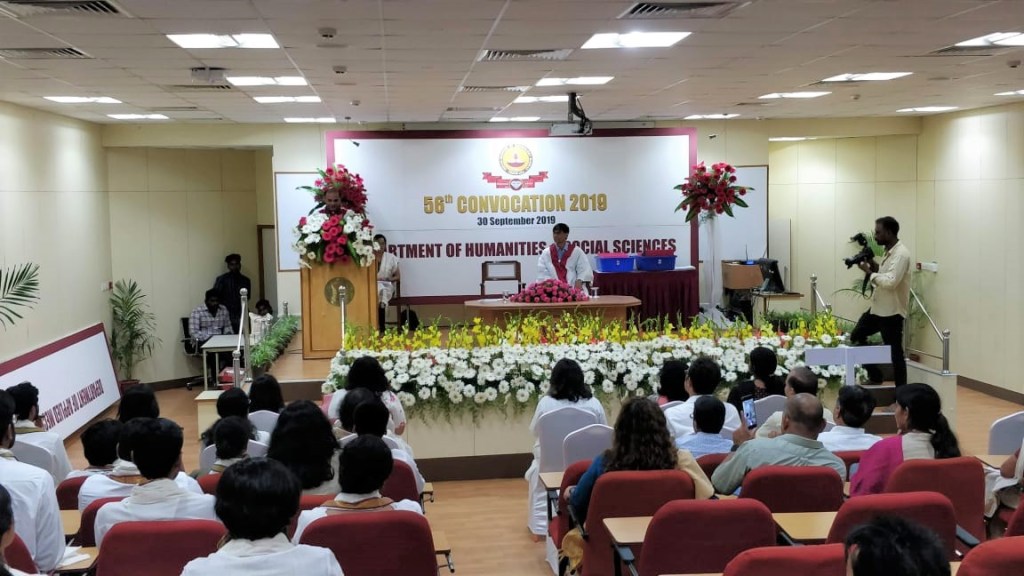
Professor Paranjape began by joking about how he worried that he’d miss his evening flight if the introduction went any longer. He then spoke about how before all the very famous convocation speeches now, the oldest recorded convocation speech is in the opening lines of an Upanishad. The teacher exhorts the graduating students thus – satyamvada, dharmam chara and so on. It is fantastic set of instructions, injunctions, and exhortations. “The instructions are to speak the truth, abide in the dharma and,” Professor Paranjape says with a laugh, “never be slack in your studies.”
He then continues with the same upanishad. It says ‘do only those actions that are in accordance with shastra and society – do not oppose this. It says ‘adopt good content and nothing else. After leaving here if you find a better teacher than us, then respect them.’ It is not the end of the journey after leaving this place, he says, and we should embrace our life then.
He then mentioned Sri Aurobindo who, 110 years ago in the inaugural issue of Karmayogi, said that India as a nation is building today before the eyes of the world, swiftly and palpably. Our aim is to build up India for the sake of humanity, and the time has come when we must take this great step and rise out of a material existence to a higher, deeper and wider life towards which humanity moves. Aurobindo especially addresses the young, who in his times were rising to do India’s work, god’s work, and the world’s work. He says you cannot cherish these ideals, still less can you fulfill them, if you subject your mind to European ideas and look at life from material standpoint. He says that India, in a sense, has a special purpose, which is not just to develop ourselves and make life better for our people but to offer a message to the world.

Professor Paranjape spoke of how he feels that the world has a need for a country like India today, as India has something to offer to the world. He then noted that the rousing words of Auribindo may not make sense immediately, but urged everyone to reflect on them, because looking around, all we see is dissatisfaction, anxiety, confusion and privation. One aspect of our individuality is given much more importance than the other, but, he pointed out, the principal function of the humanities and social science is to create an integral understanding of ourselves, of society, as well as the world.
He then went on to give a few anecdotes of his own life as a student. Addressing the graduating students, he said that he believes that all of them should follow their passion because that is what is going to bring them into a completely new zone. They have to break free from the things they have learnt so far, and have been conditioned to believe. He also spoke of how life would be far more complex now, and of his belief that their futures are bright, and that they can do whatever they set out to do.
He concluded by noting that IIT is an outstanding system as far as Indian education goes. He believes that there is a new dawn for the graduating students, and that all have a great role to play. He points out that they are all privileged to study in the institute and urged everyone to return the compliment by trying to serve India and the world. He concluded by addressing the graduating students, and spoke of his belief in the bright future of the students, as well as that of India.
Professor Merin then invited Professor Dash to read out the names of the graduating students and Professor Paranjape to give them their degrees. The event then came to a close with Professor Dash giving a vote of thanks and HS14’s shouts and cheers as Professor Merin invited the attendees for high tea afterwards.
Report by Meghna M.
Photography by Sai Chandan Kotu

