
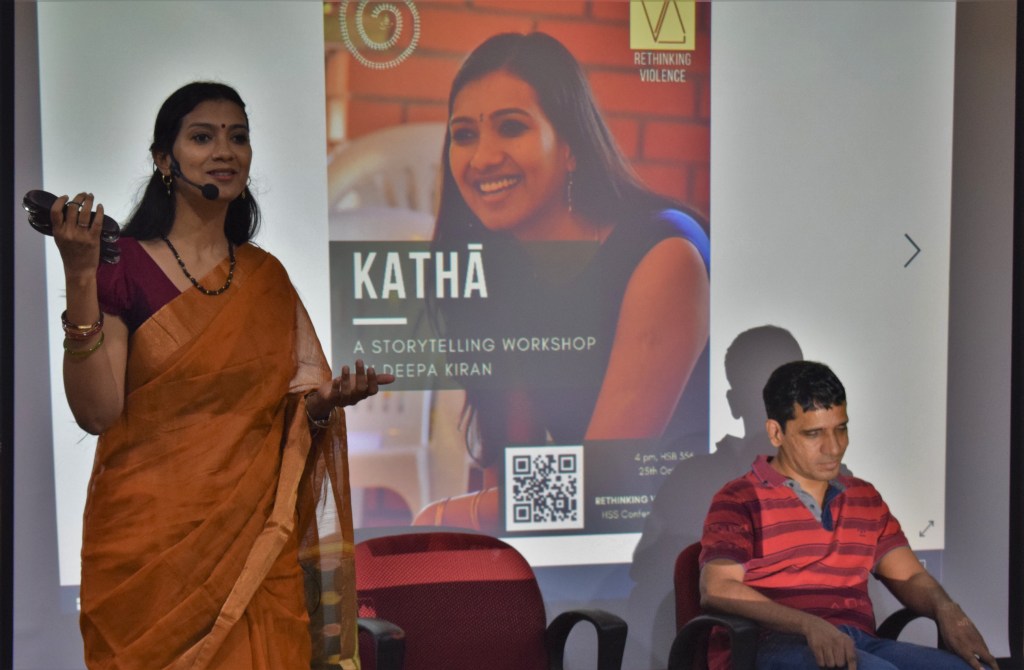
The Annual Academic Conference of the Department of Humanities and Social Sciences kicked off with the first pre-conference event on 25th October. After the customary tea and snacks, the students gathered at HSB357 for the Storytelling workshop by Deepa Kiran. The welcome address was delivered by Gayathri, the events head, who introduced the speaker of the day. Prof. Hemachandran was also present on stage, and the speaker recounted memories of him being her senior in college. Ms. Deepa began by informally addressing the gathering, talking about her parents. She shared that her father was an alumnus of IIT Madras, and that her entire family, distant relatives included, were extremely pleased that she was to be speaking at his alma mater. She also spoke of how her mother was especially glad at this, and how despite not being a doctor or an engineer she was still able to get into IIT some way or the other. She continued to lightheartedly speak about her mother’s views on her own unconventional career choices, including the typical indian parent mentality of “what will people think”.

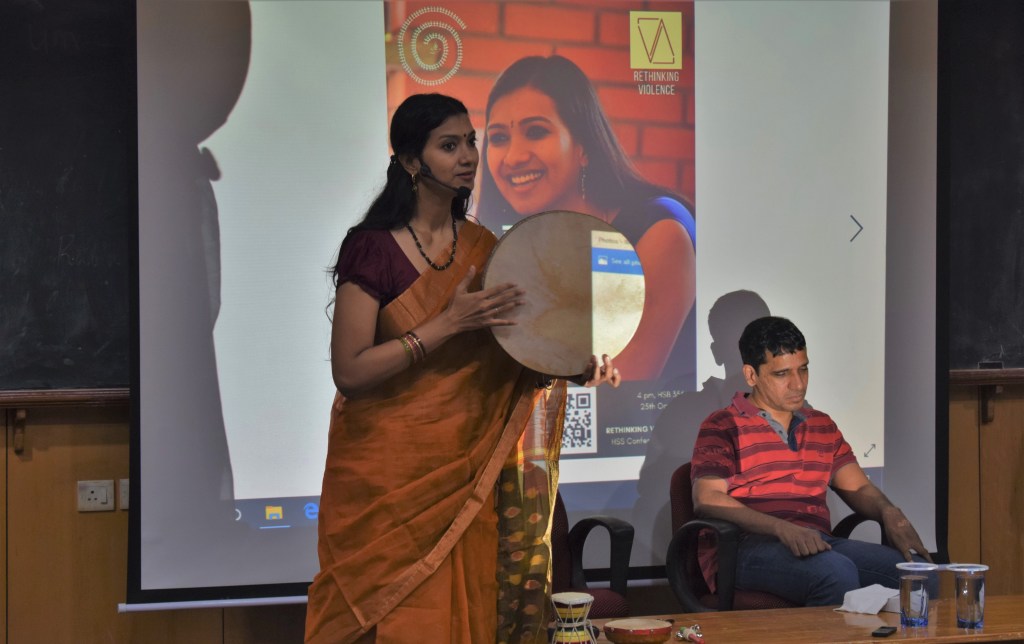
After this brief prelude, she moved on to telling a story in her own unique musical style, which incorporated influences from her training in classical music, violin and dance. She began to narrate the story of a woman who lived alone at the foothills of Mount Kilimanjaro, going about her daily routine and wishing that there was someone with her. The narration was accentuated by her use of instruments that mimicked the sounds of flowing water and rain, as well as the use of castanets to emphasise and bring a musical quality to her story. The story described the life of this lonely woman in the foothills who longed for some company, and was one day given gourd seeds by a mountain spirit and asked to plant them. Once the gourds grew and became bigger, she moved them to the roof in order to dry in the sun before selling to a Kalabash maker – all except one, the largest, most perfectly round one, which she kept hidden in her kitchen. To her surprise, the next morning, the gourds came alive as children who merrily played around her house, helped her with chores, and kept her company, including the gourd in the kitchen who was called Ketite. However, since Ketite was kept in the kitchen and not exposed to the sun, he was not as capable as his brothers and sisters and couldn’t do any chores or speak; yet his mother loved him just as much as the others. During the daytime, they would come to life and help her with her household chores, and at night, they would all return to the roof and become gourds again. One fine day, while the woman was carrying a pot of hot soup in the kitchen, she tripped over Ketite and dropped the pot. In a burst of annoyance, she cried out, “You’re better off as a gourd!”. Although she immediately regretted her words, the damage had been done. She had hurt Ketite, and all the other gourd-children also did not approve of her actions. That night, they all went up to the roof as was their custom, yet the next day none of them returned as children.
After narrating this story, Ms. Deepa Kiran asked the audience for their responses. The audience said that they were hooked by and drawn into the story, experienced goosebumps, noticed certain parallels with the Harikatha tradition including powerful singing and the use of castanets, noted the importance of repetition in narratology, especially in oral storytelling, and commented that the catchiness of the songs brought the story to life. The speaker then explained why she chose to narrate this particular story; in order to illustrate the verbal and emotional violence that parents inflict upon their children, and throw light upon the violence present in the space of parenting and teaching. She quoted Shanta Sinha and the idea of ‘adult-archy’, and how children are completely under the power of their parents, who can impose things upon them. She said that narrating these stories was also a way for her as a parent and educator to constantly remind herself of these facts and be aware of her actions.
She then spoke of the education system, and how academics has been given an all-important place in the lives of children, leading to a shift in priorities. The final receivers of knowledge in this system are also at the receiving end of violence. A 15 year old who has fever would still be sent to write an important exam because the alternative of missing the exam with no re-test is seen as much worse. In the process of making such a big deal out of academic success, we seem to have lost sight of what is actually important. She also gave the example of the recent incident in a Karnataka school where children were made to wear cardboard boxes over their heads to prevent cheating, and asked, “If these are not moments of violence, then what are?” She noted that we are all implicit in this system, and that the system is telling us that we can only engage with it in this manner.
Parents also become agents in this system, to the extent of physically beating up their children when they do not finish their homework, since they are in a place of fear and anxiety due to the violence coming from the school system. She recalled her initial comments about her mother and how she worries about her unconventional career, showing how all parents are affected by the system’s definitions of success and failure. Here, the speaker made a reference to a video in which Kurt Vonnegut talks about the shape of stories, where he mentions that primitive stories took the form of a straight line, whereas stories now resemble a more squiggly line with ups and downs. The fairytale “happy ever after” is not actually how our reality is, and the speaker made reference to it not being so in her own life as well. She pointed out how one can lose their community’s support, and be labelled or branded as something. Parents fear this happening to their children, and hence want them to conform to the prevailing measures of success.
Ms. Deepa then moved on to talk about how as a parent, she herself falls into these modes of thinking sometimes. When she hears other parents or teachers praise her son’s music ability, she is pleased, but also wants to push him to be the best. When a child is doing well in a certain field, they are sent to classes or tuitions in order to become the best in that field, often leading to the child overworking themselves, losing interest, or even having breakdowns. She also noted how flippantly other parents make insensitive comments, not realising the effect they have on the child. They take liberties in the comments that they make, and don’t even realise that what they’re saying is insensitive.

Ms. Deepa concluded with a short presentation about oral literature. She spoke about the history of oral storytelling, and contextualized it as being as old as human speech. She quoted Ursula LeGuin – “There have been great societies that did not use the wheel, but there have been no societies that did not tell stories.” Storytelling was a way to bridge gaps between strangers, since a stranger is someone whose story we do not know. She also referred to storytelling as ‘licenced daydreaming’ as it involves a great deal of imagination. Ironically, though most stories end with a “moral”, they are not an imperative way to tell others what to do, but rather a way to become meaningful listeners. Stories are an effective way to share things with children that might otherwise be difficult to share, and trusting a child’s wisdom and letting them know that you want to listen to what they have to say is the way to move forward.
There have been great societies that did not use the wheel, but there have been no societies that did not tell stories
– Ursula K. Le Guin
Prof. Hemachandran then presented his views on the event, and said that the changing tones and sounds of instruments seemed like a world of enchantment that took him back to his childhood. He noted that the world seemed to be taking away this sense of enchantment, including in the humanities where education seems more focused on analysis rather than on human beings themselves. He expressed his desire for a rediscovery of this space of enchantment and magic, not just for children but adults as well, to escape from the violence of rationality. A lively question and answer session followed, in which several audience members spoke of their own personal connections to the issues discussed and the idea of storytelling as a stress busting exercise and a way to unwind. The event came to an end with Gayathri delivering the vote of thanks.
Report by Shravya Chavali
Photography by Sakshi Malpath
 Article 19