
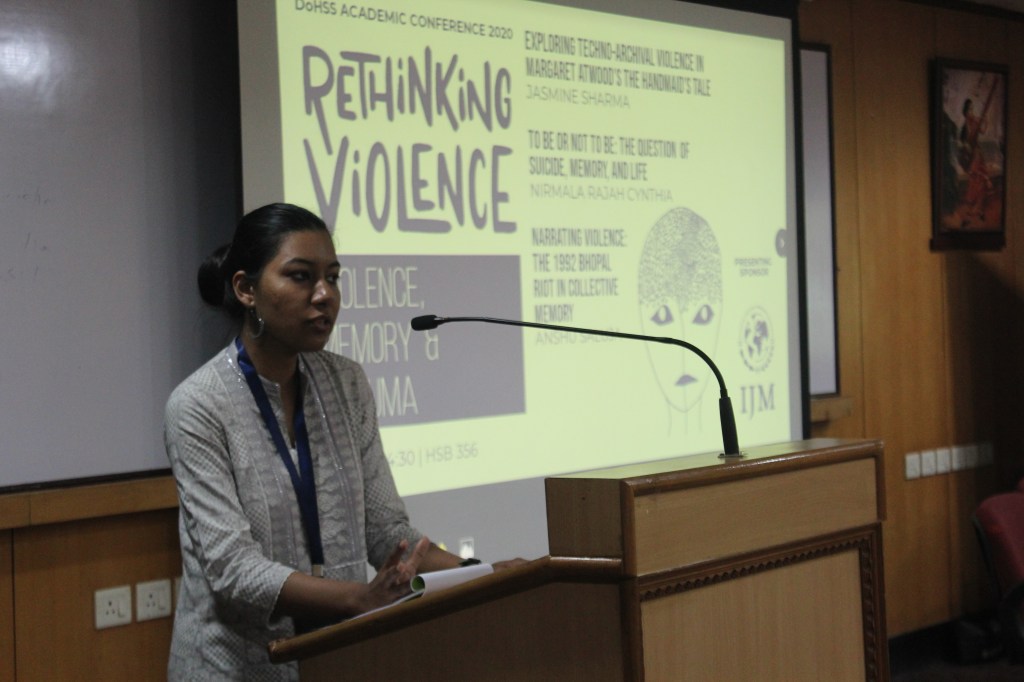
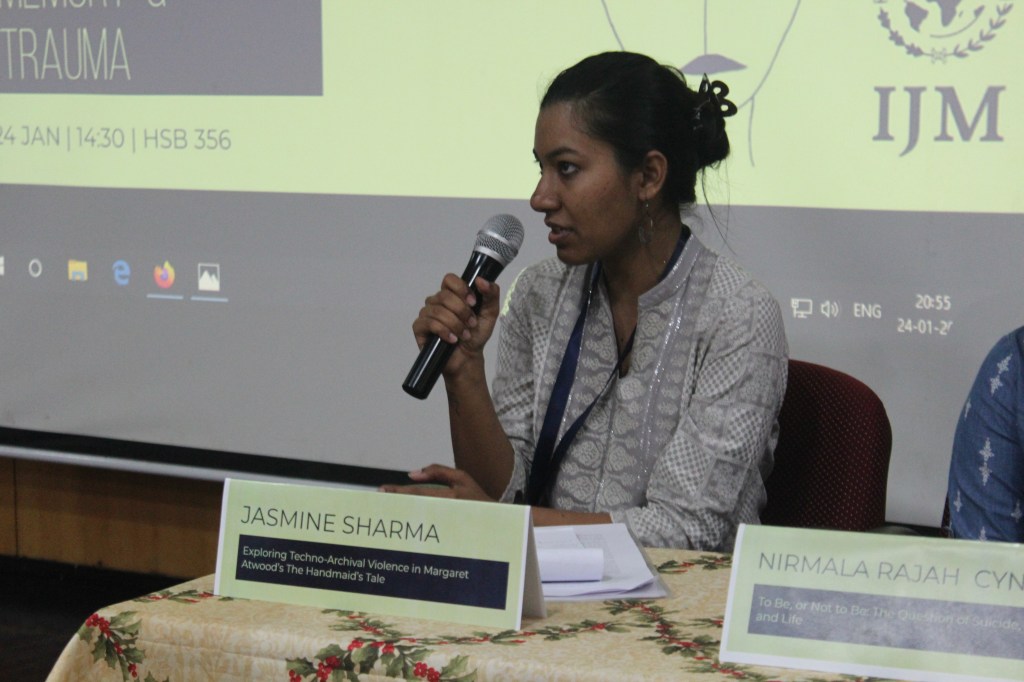
The third panel of the Annual DoHSS Conference 2020 was titled “Violence, Memory and Trauma”, and was moderated by Dr. Avishek Parui. Dr. Parui began by introducing the presenters of this panel – Jasmine Sharma, Nirmala Raja Cynthia, and Anshu Saluja. The first paper was titled “Exploring Techno-archival Violence in Margaret Atwood’s The Handmaid’s Tale”. The speaker sought to identify the ways in which archival texts were misappropriated in the epilogue of the novel, which deals with historical notes – The tape recording that is left behind by the character Offred can be considered as a type of techno-archival memory. The speaker mentioned the undue importance placed on a documented past that provides information for research, neglecting the other unofficial histories that may not have been deemed important enough to preserve, invoking Foucault and the privileged position of the archive. She also used the idea of memory as a cultural process mediated by modes of representation and recall, and saw the tapes as carrying Offred’s non-physical presence. The act of remembrance is individual as well as cultural, and involves the recovery of lost experiences; but in this novel there is a phallic mediation in the act of remembering because of the male professor who is analyzing the authenticity of these tapes. The professor brings his own prejudices and misinterpretations into his reading of these tapes, particularly with respect to his attempt to understand the political situation prevailing in Gilead at that time using only the personal narrative of Offred. His interest is not to uncover the truth or what actually became of her, but more towards the documents themselves. Political history is given greater importance than the personal. The speaker also pointed our attention towards the idea of History as “His-story” rather than “her-story”, which is especially noticeable in this case. The tapes themselves are haphazardly arranged and contain changed names to protect identities. The consumption of memory through such technomedia is therefore different from the way it was produced or intended, raising questions about what is meant and what is destroyed, sanctioned history and the control of the past. Therefore the violence of the archive also involves an element of pleasure that arises out of destruction.
The second speaker began by quoting Hamlet – “To be or not to be?”, and introduced the idea of suicide as an inexplicable chosen death, as also mentioned by Camus in the Myth of Sisyphus. She sought to look at representations of suicide through works such as the Virgin Suicides, the Long Walk, and Norwegian Wood; pointing out several interesting features about the way that it is treated in these texts. In the movie The Virgin Suicides, the individual act of suicide is held in contempt by society, especially since the story is narrated by the neighbourhood boys who do not understand the reason for the girls’ suicides, resulting in frustration. The boys also keep certain relics of the girls, highlighting the morbid fascination and fixation with death that is almost necrophilic. Society does not allow us to address these things, as is evident by the fact that a suicide attempt in the movie is euphemistically called an “accident” and deemed unworthy of front page news. On the other hand, the novel The Long Walk treats suicide as a glorious and spectacular event that young boys aspire to almost as a form of entertainment. These boys don’t actually realise what they have signed up for, and cannot accept reality even when faced with the dead bodies of their friends. In this situation of walk or die, it is ironic that even though they have made the choice to die, they still fight to live; highlighting that suicide is deeper that death due to the element of choice. However, the speaker also raised the example of the Stanford Prison Experiment to show that in situations such as these, where power and powerlessness come into play, it becomes very hard to distinguish between choice and coercion. The speaker also highlighted the role of the media in glorifying the long walk and representing it as an honour instead of the systemic murder that it is.
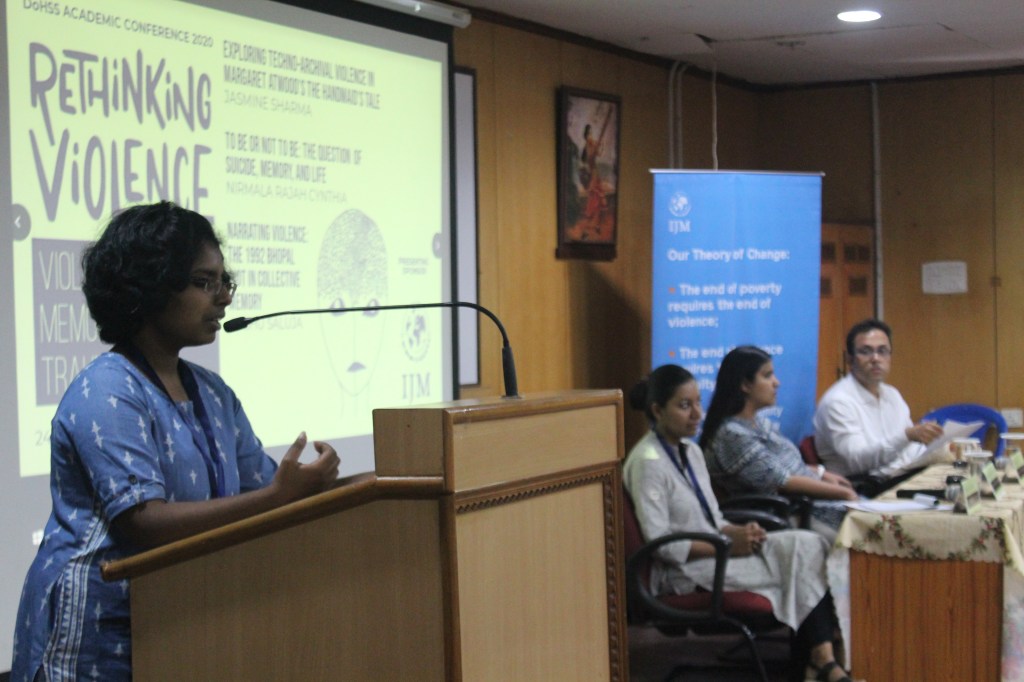
The speaker also delved into the etymology of suicide, and its association with murder. The use of euphemisms also hides and softens the actual reality. Our nervous reaction is to condemn suicide as making a decision that is better left to God, a sin of sorts. However, it is also important to note that death is not apart from life, but a part of life. This understanding comes through in the novel Norwegian Wood, in which death is not considered a possibility unless it hits close to home. In the contemporary context, issues like farmer’s suicides or the Rohith Vemula incident don’t get attention unless there is a death. We tend to think that since suicide goes against the biological urge of a human being, there must be some meaning to it, yet we are only faced with futility.
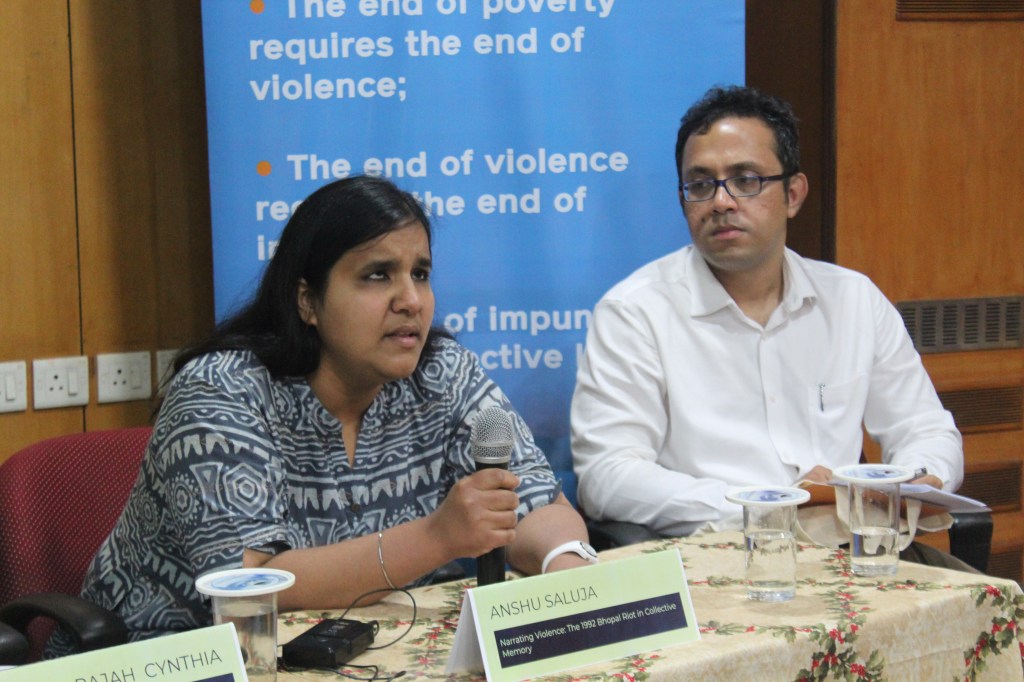
The third speaker spoke of the inter-community violence and conflict resulting from the decision on Babri masjid, including the state sponsored violence before and after its demolition. The ‘92 Bhopal riots were actually the third largest at that time, but despite its death toll they weren’t given much attention. The social fabric of the city was altered by these riots, exacerbated by the volley of false rumours that fed into the ongoing violence, a vicious cycle of sorts. As a city, Bhopal had escaped the blemish of communal violence during the partition, yet it flared up at this point. In the aftermath, the survivors’ memories and testimonies were not fixed or singular, but constantly in flux. Remembering is not passive, but rather an active process. The sense of hurt and loss delivered a hard blow and resulted in the straining of cross cultural communication. The speaker also noted the role of state agencies and administration in failing to provide credible and lasting social dialogue. The normalcy that prevailed after the riots were vastly different from that before, and it is not possible to quietly slip back into the status quo – the refashioned normal cannot afford to forget.
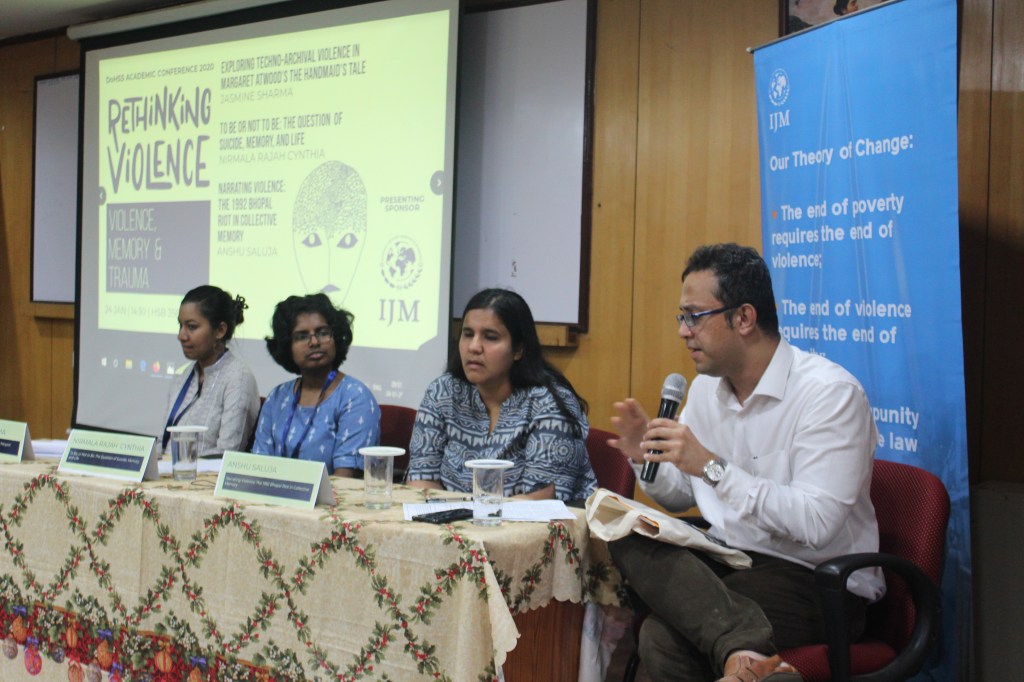
Dr. Parui wrapped up the session by providing a summary and comments on the papers presented, with special attention to the gendered quality of memory and spectacle and the contagion of half truths. The panelists then engaged in a lively Question and Answer session with the audience.
Report by Shravya Chavali
Photography by Ganesh Dileep

