
The fourth panel featured the speakers Bushra Punjabi, Ivy Roy Sarkar, and Ruth Susan Mathew, and moderated by Santosh R. The speakers all spoke about a similar form of protest against the state which came from unconventional positions. As the state clamped down on regular forms of protest against laws, especially in Kashmir which was the topic of two of the presenters, the protestors turned to other forms of protest such as graffiti, which occurred both in Kashmir and Manipur. Another form of protest was rap music used specifically in Kashmir as a form of protest.
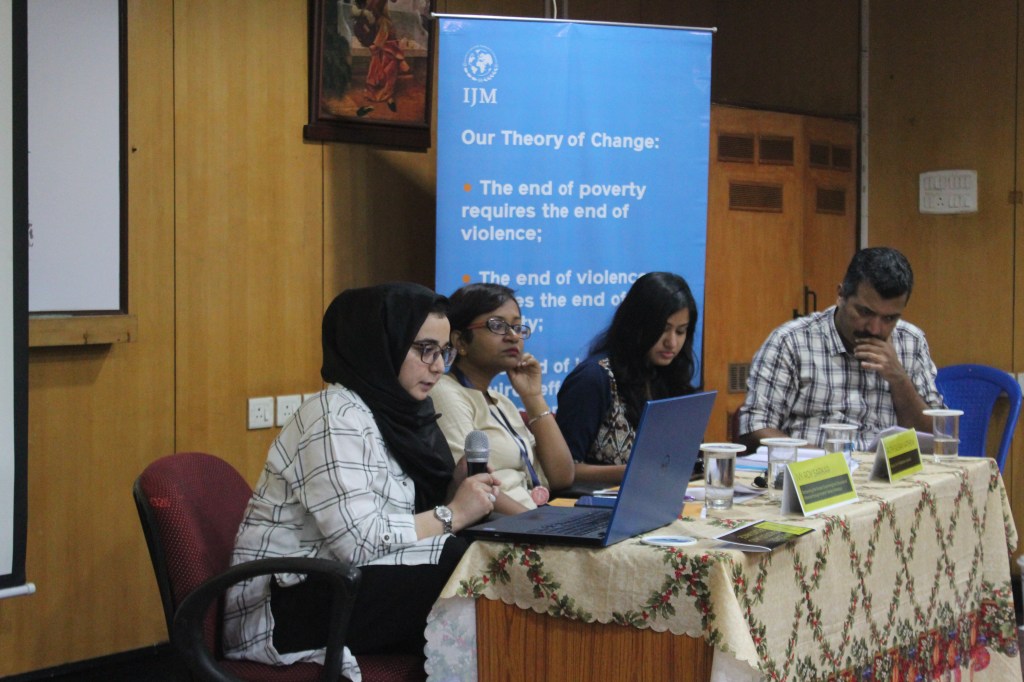
The first speaker asked the question if there was any strict definition for violence as such. It carries different meanings for different groups, and experiences and realities differ from person to person and are therefore extremely subjective. Therefore, it isn’t prudent to generalize. For some, it was physical torture whereas for others, it was a restriction of freedoms and routine paramilitary checks. It is very tangible, and focus needs to move beyond this tangible violence into the realm of mental violence. She talked about the disillusionment of the populace with the democratic process and their taking up of arms against the state. Kashmir violence thus has become pervasive and is visible everywhere. Srinagar has become the hot spot for graffiti with slogans like Freedom! and Go India Go Back becoming popular as a form of protest against the ruling state. It is their only potent tool, as they have no other way to protest. Their graffiti keep them anonymous and thus protects them too. However, it seems to only be irritating the state and nothing more, not causing a rethink of actions, she concluded.

The second paper by Ruth S Mathew was a natural step onward from this paper. She looks at other hidden forms of resistance in Kashmir, particularly the rap culture. The rap culture is subaltern and rebellious, and through the use of catchy yet revolutionary lyrics, she shows how the protests have taken on yet another form. It shows the precarious life of the Kashmiris as well as the marginalisation of them by the state. She used this as evidence for ignoring the official narrative and only relying on the narratives put forth by the people. It was a case of multiple subaltern narratives. She also argues that the protest culture is vital and history’s recording of the Kashmiri issues as a threat against the state needs to be stopped.
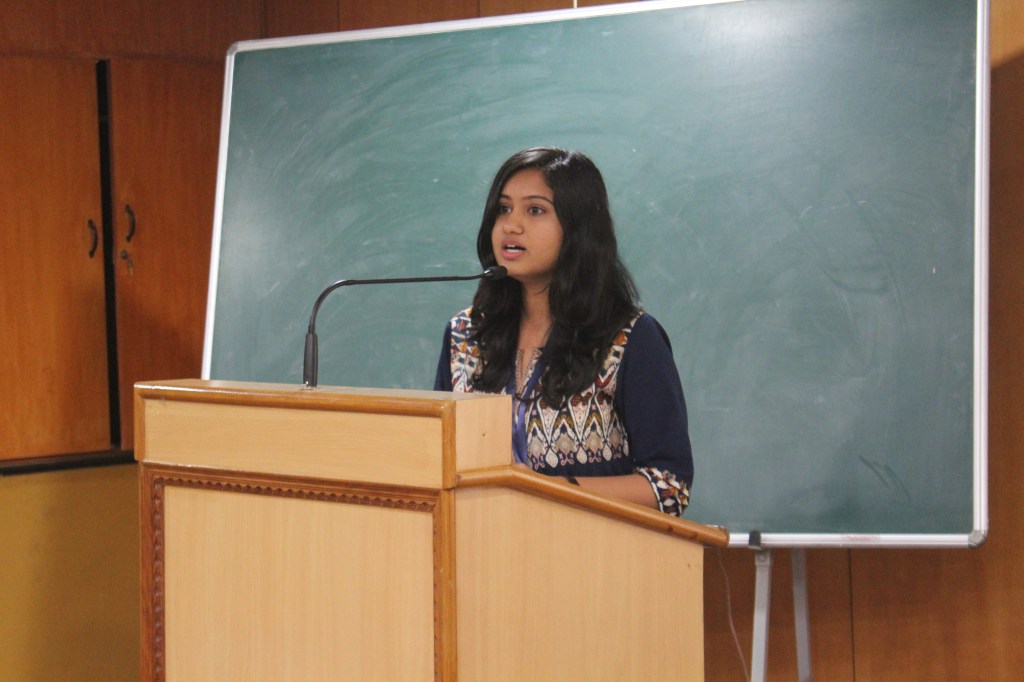
The final paper was by Ivy Roy Sarkar. She also spoke of non conforming modes of resistance. Protestors use the art form as a medium to convey their unhappiness with the state. This study took place in Manipur, where much like the two instances of Kashmir given above, music and graffiti were used in order to give a better picture of what was truly happening in the state, which was very different from the official narrative. It started from the grassroots, and hence was always in close connection with the people of the region. Using the soundscape and landscape of Manipur, they produced raw and uncensored lyrics illuminating their opinion on the draconian laws which had been put in place in the state, most notably the AFSPA. What were ethno-nationalist movements once operating inside the state between various tribes became labelled as insurgency and counter insurgency. This warranted a governmental intervention. And thus, the AFSPA was put into place. A brutal law, it gives the Indian armed forces extraordinary powers in normal circumstances in order to maintain public law and order. Essentially, this alternate history being told is the people’s story first hand, one which we should look at more closely. The insurgency and counter insurgency only lead to a more draconian implementation of the AFSPA, which only leads to more strife. AFSPA is a relic of colonial British rule, and as such shouldn’t be utilised anymore. Due to this, even the cultural spaces have been violated without being preserved. The protest songs are not for any aesthetic purpose, but for the sole purpose of protest. Music videos are simply used as a doctrine for people’s protests. They reject the term “disturbed area” which is used to describe Manipur, arguing that the state should stop its authoritarian regime over the land and the situation will normalise with no outside influence necessary.
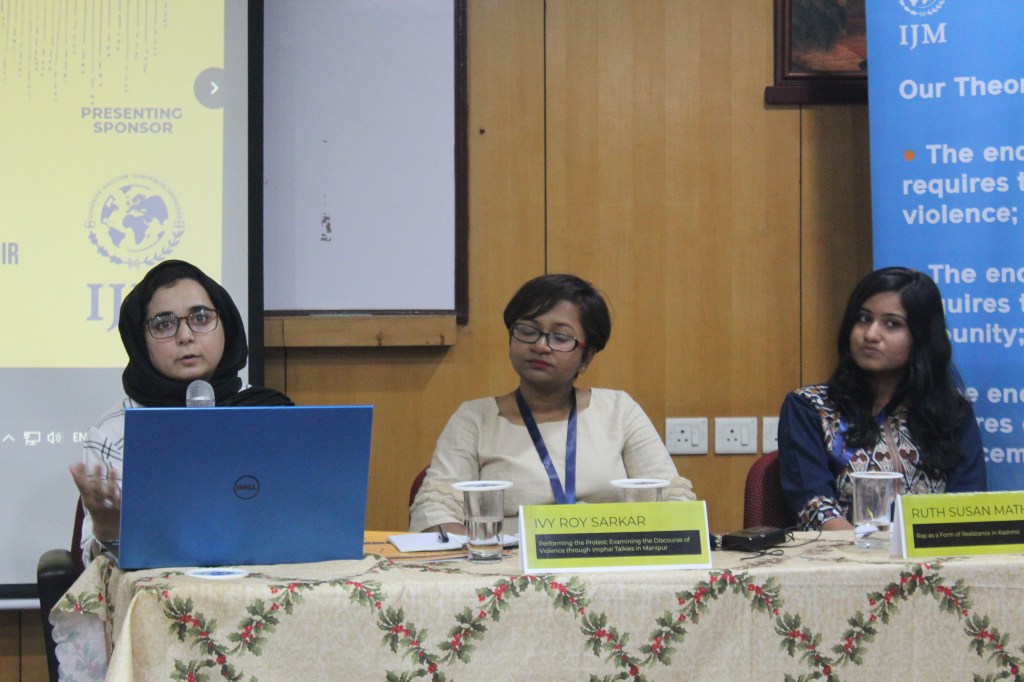
Thus did the three panellists lay out similar arguments based on forms of unconventional protest against an authoritarian state to show that greater nuance and understanding and a move away from the conventional brutal silencing needs to be explored. The panel came to an end with a session of Questions and Answers from the audience.
Report by Simha Y. N.
Photography by Ganesh Dileep

