
The fifth panel of the conference was titled “Gender, Sexuality and Violence, and was moderated by Prof. Binitha Thampi. The session started off with Priyam Sinha investigating the representation of disability in Bollywood cinema, not just how it is, but how it was and how it has changed over the years. She used a methodology that combined a narrative prosthesis, Crip theory and the Social, Charity and Medical models of Disability and Feminist epistemology. Historically speaking, disability was shown in mainstream Bollywood cinema often with a sense of vigilance and an inability to acknowledge the disabled person’s sexuality. Only recently, since the 1990s, has Indian cinema been able to portray them as fully sexual beings, with the focus being shifted away from the obvious into rickety terrain. Finally, issues of violence, feminism and sexuality enter into the mainstream as directors were prepared to take risks and studios were willing to voyage into the unknowns. This was also due to the fact that female directors started to step into the limelight around this time as well.

One of the main issues that come into view was desirability and disability as seen together. She discussed these ideas with regard to three films, beginning with the movie Black. She went on to suggest that the very fact that they were not allowed to discuss about themselves as sexual beings was violence. She spoke about this in connection with the feeling of normal and abnormal, as well the feeling of self doubt that sets in due to not being able to express their feelings fully or clearly. She then moved to Margarita with a Straw, which not only delved into disability but also homosexuality. She pointed out the problems that the disabled community faced, including an acceptance of independence only after financial independence was achieved. Absence of sexual education along with the normative nature of heterosexuality meant that the characters in the movie are seen to be violating norms, in this case a two-fold flouting. The movie portrays this as undesirable, she went on to say. Finally, she comes to Barfi where she illuminates the problems that occur when a disabled man enters into a relationship with a normal woman. He is therefore less desirable than a groom which her parents have selected for her. The speaker pointed out the structural violence which occurs as a result. As a final note, she argues that their problems must be portrayed with more sympathy and empathy and we need to help them, and not add to their problems. Thus, she argues for a more positive treatment of disabled people in Bollywood mainstream cinema.

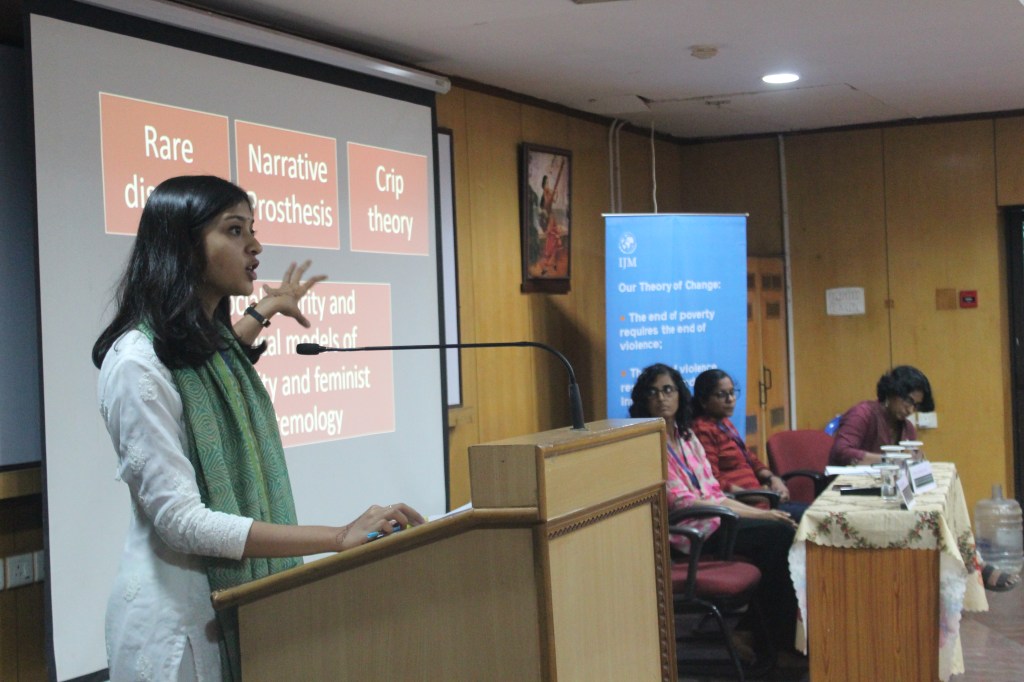
Kirthi Jayakumar was the next presenter, who took up the issue of queer groups amidst conflict, specifically war. She commented that sexual assault during wartime being punished was a recent phenomenon, since it had always been considered a by-product of the war; a position which is changing now due to increased visibility of such violence. In addition to this, there was a regendering of the woman as well. The previously limited understanding of wartime sexual violence was undergoing a dramatic shift in knowledge known and perceived. Before, women were thought to be nothing more than their reproductive function and capacity. However the view that sex and gender were not equal to each other is now being accepted, and this has led to the removal of the previous pigeonholing that women were subject to when they were the victims of violence in wartime. Now, unique experiences are given the foremost attention, and there was a queering of the gender binary which took place as well. Earlier, a criminalisation of non binary, non-cisgendered bodies was considered natural, but now, the queering has expanded the understanding of sexual violence in conflict, and acknowledged it as well. It also helps address the issue of sexualised violence more clearly. However, as these issues have only recently begun to be explored in detail, there remains a long road to follow and the end is still far away. She even proposes that the definition of rape be expanded, as it currently targets its victims, instead of providing justice to them. Finally, she advocates the exploration of the issue of men’s rape too. As it previously was a taboo to discuss or even acknowledge, a queering of this issue may well make it feasible to do so. Not just men, but intersex people as well. A better and more rounded understanding in dealing with of this type of violence is absolutely necessary, and she wished to highlight these issues in her paper.

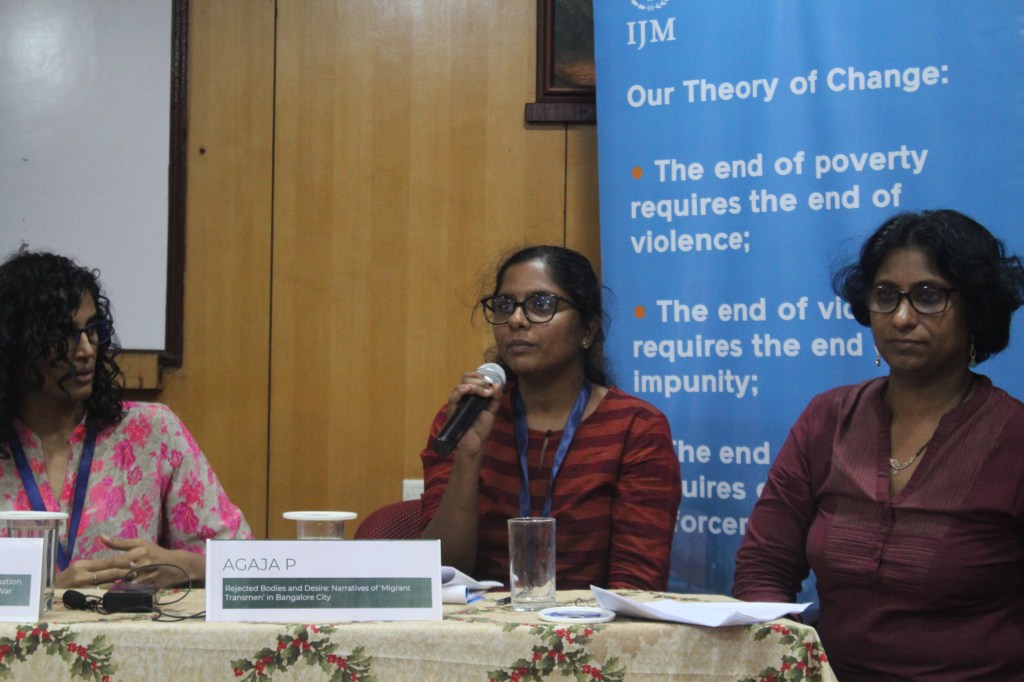
To close it out, Agaja presented her paper on the subject of migrant transmen in Bangalore. Most of these men only managed to truly be themselves in the city, and often had to migrate in order to escape ostracization. Using Judith Butler’s subject and non subject study and a qualitative analysis, she recorded their struggles, trials and tribulations. Of particular interest was how the difference between the two transformations was received in the wider society. For instance, when men transitioned to women, it was often more readily accepted in the Indian society than the other way around, which is what the trans men in this story had to go through. Most of them came from rural backgrounds. There was no possibility for them to gain acceptance there. They also faced mental and physical violence from their own families as they tried to coerce them into conforming with the gender that they had been assigned at birth. They had but one choice – to migrate to a place which would accept them, and allow them to have surgeries done. Their main interest was that their mind and body should coexist in harmony. Until coming to Bangalore, they had little idea of gender and sexuality, and looked at it as one monolith rather than two separate categories. They also faced far less violence in the city than in the villages as they were able to embrace their status as trans men rather than live closeted. In short, the city is a refuge for them. They depend on this migration in order to live without fear. Thus, there is hope for them in the cities and more of them migrate every year.

The panel came to an end with an interactive Q&A session with the audience.
Report by Simha Y. N.
Photography by Ganesh Dileep
 Article 19