
The second Keynote Lecture of the Conference was given by Dr. Paulomi Chakraborty, on the topic of Women and the Partition. Dr Chakraborty explained how the partition was a time of population transfers and migration, both on the east and west of India, but what was common on both sides was the rampant violence against women. In trying to understand the scale of violence, it must be noted that there is a spectrum of violence that women experience, especially given the relationship between the family and the state, and that the partition is not the only way in which it manifests. The partition provides a critical insight into the structures of violence that hold everyday life together. This violence should be understood both as the extreme violence of the partition as well as a problematique of everyday existence. She referred to oft repeated feminist slogan, “The personal is political”, in order to illustrate the concept of the everyday world and lived realities within domestic spaces also having a connection to the political world. Thus there is a bridge between the private and the public, designed to connect the domestic to that of the political. By keeping these links constant, the ordinary banal world lays the conditions for an extreme event of violence to happen. Dr. Chakraborty here referred to Hannah Arendt’s idea of the banality of evil, which explains how evil often does not look like the extreme of a gas chamber, but rather is produced by the everyday regime of violence that we take for granted.
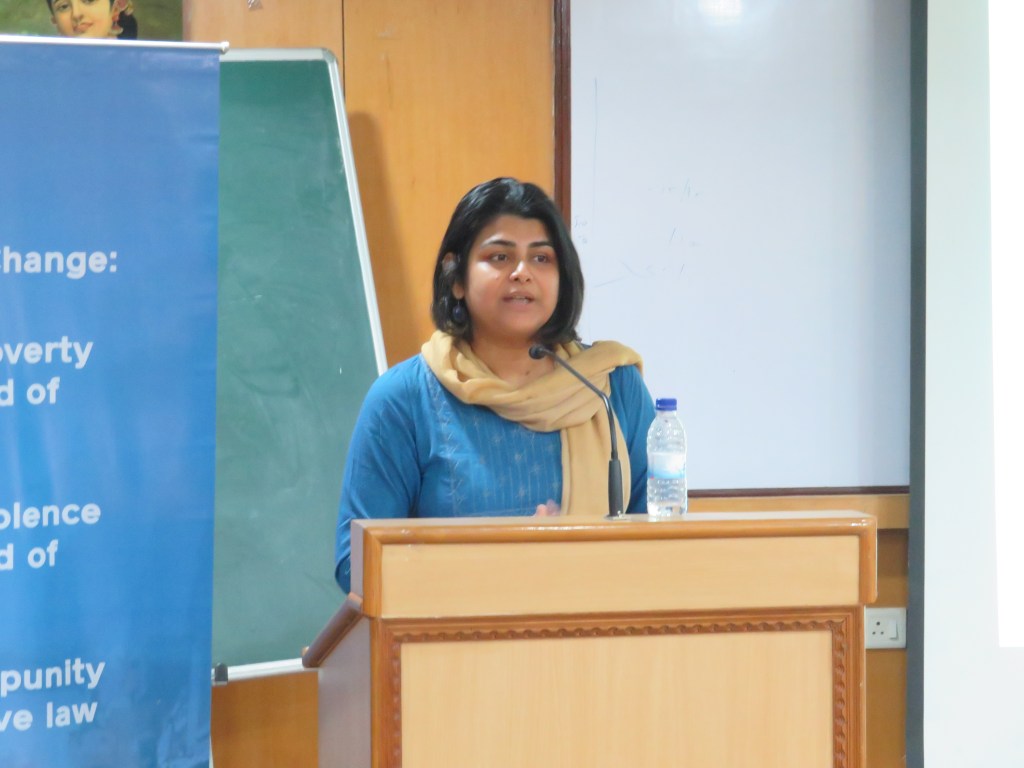

The first part of her talk was about the Abducted Persons Act of 1949. We tend to view events such as the partition either as bracketed off from our normal lives or as a moment of corruption, but fail to realise that they are actually produced by the everyday. The area of partition studies details the increased vulnerability of women to violence, often sexual violence, during times of upheaval. They occupy a precarious position with respect to the “other” community, yet the prevailing norms of purity and chastity often lead to violence from their own kin and family ostensibly to protect their “honour”. These women are also sometimes driven to suicide. Situations such as these lead us to questions of consent and coercion, including why such suicides aren’t considered violence and these women aren’t considered martyrs. The Act also defines abductees as male children below the age of 16 and women of any age. The women couldn’t give consent, they were not conceived of as thinking people or legal subjects, and the circumstances of their abduction (which varied greatly) were never taken into account. The focus seemed to be on the recovery and return of these women to their “home” country without considering the consequences. A return to their pre-partition lives was not possible, especially for caste Hindu women who were pregnant with the enemy’s child. The status of these women was called into question, since they could not be seen as single parents or guardians, complicated by the legal status of the unborn child. In cases where the father was from a different country, these women were even forced to leave behind their young children as part of their return to the country. The act did not take into account the wishes of these adult women, many of whom did not actually want to come back. The fact that this act was passed two years after independence also seems to point to the recovery program being driven by the prerogative of getting back “our” women, displaying both patriarchal and paternalistic rationales.
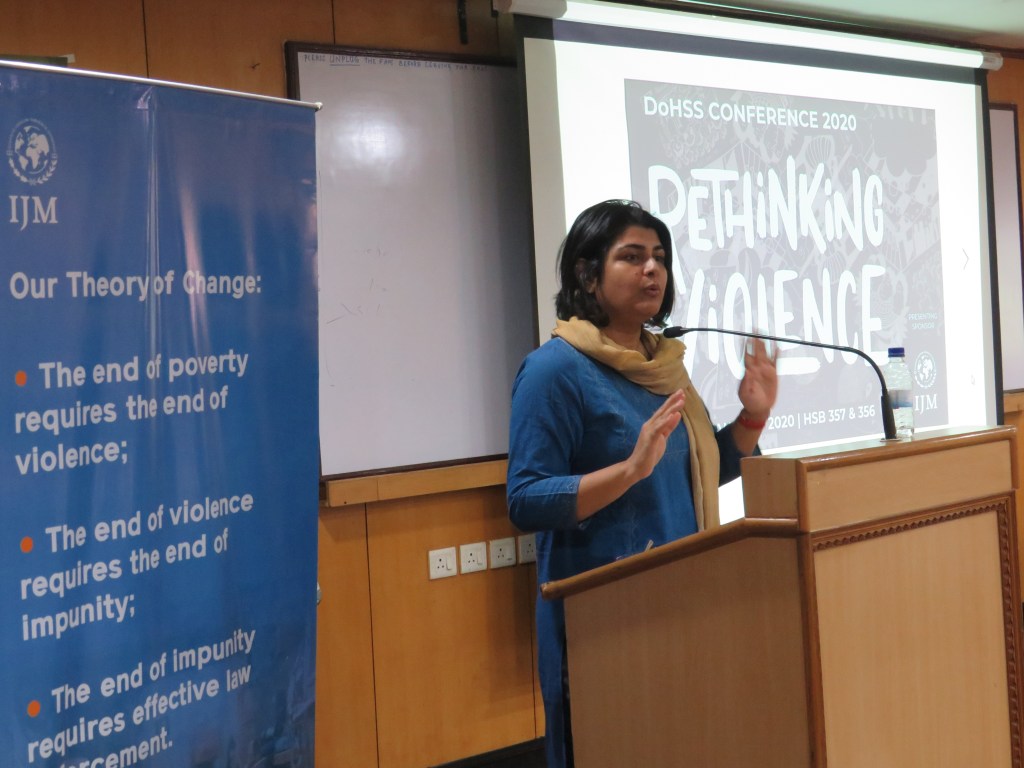
The second part of her talk focused on history and the everyday. Violence should be seen as within the ambit of history, and not a historical aberration. The emergence of communalism and cultural nationalism are both connected by their use of the woman as a symbol, assigning the symbolic value of “Bharat Mata”. Here the speaker raised an oft repeated question – What caste and nationality can a woman have? She belongs to someone else. However, at this moment of crisis in the nation making process, she stood for nothing else. This leads to a paradox about the duality of the condition of women. The legacy of imagining the nation as a mother deity dates to the mid 19th Century where initially the nation was conceived as being the ideal Hindu wife. However, the idea of the nation as a wife caused problems, leading to the shift to the image of the Mother, which was in turn politicized. The process of nation making was negotiated through violence, and therefore women became the space in which this negotiation played out, following an already written script. There is a complex layering of violence, which the speaker illustrated through the story Lajwanti by Rajendra Singh Bedi, which is an important work in partition fiction. It depicts the contiguity of violence in both spheres, and the overlap of extreme gendered violence in banal household arrangements. Ultimately, the story throws light on how patriarchy orders both the nation and the household.
Due to a lack of time, the speaker was only able to briefly mention a few movies that serve further to illustrate this point, including Pinjar (2003) and Quissa (2013), that explore the impossibility of choice and the category of “woman” as such. The session wrapped up with an engaging question and answer session with the audience that also brought in other examples from literature. The talk provided a lot of food for thought for all who were present.
Report by Shravya Chavali
Photography by Ganesh Dileep
 Article 19