
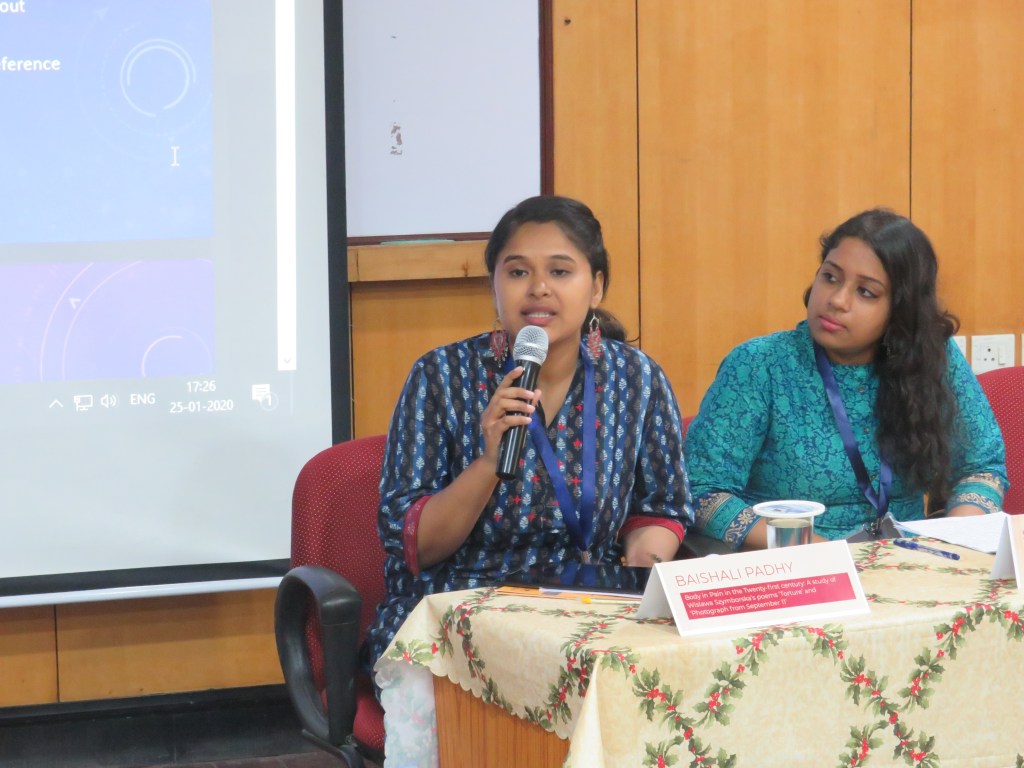
The 7th panel of the conference was titled Violence and Literature, and was moderated by Dr. Divya. The first speaker, Baishali, began by referring to Elaine Scarry’s The Body in Pain. She described how experiencing physical pain leads to the destruction of language, since language becomes inadequate to communicate or express the reality of that physical pain to those who are not in pain themselves. A crucial factor of pain is its presentness, the fact that it has a temporal aspect. To express pain, it becomes necessary to objectify it. The speaker used the poetry of Wislawa Szymborska to explore such images of pain. The first poem, titled “Tortures”, dealt with the unmaking of the victim’s world in response to torture, and the collective memory of 9/11. She mentioned how technology has lengthened our lifespans, but has not changed how we experience suffering. She also read torture as deprivation, and saw moments of pain as being frozen in poetry. Pain has remained the same from the prehistoric times until now, and the act of inflicting pain remains the same although society has progressed. Our capacity to negotiate with pain remains the same, and it is often justified to maintain social hierarchies. The second poem was titled “Photograph from 9/11”, based on an actual photograph from the New Yorker. The poem has a slanted structure, which can be seen as a metaphor for the body in freefall. The poem provides vivid descriptions of pain, and draws out the tension between static and movement. The slow paced pain of impending death means that one dies a thousand deaths in anticipation of that moment, and sees their life flashing before their eyes. There are also multiple layers of pain that cannot be expressed, again harkening to the idea that language is insufficient to express pain. Physical pain in this poem is a way to resist resistance.

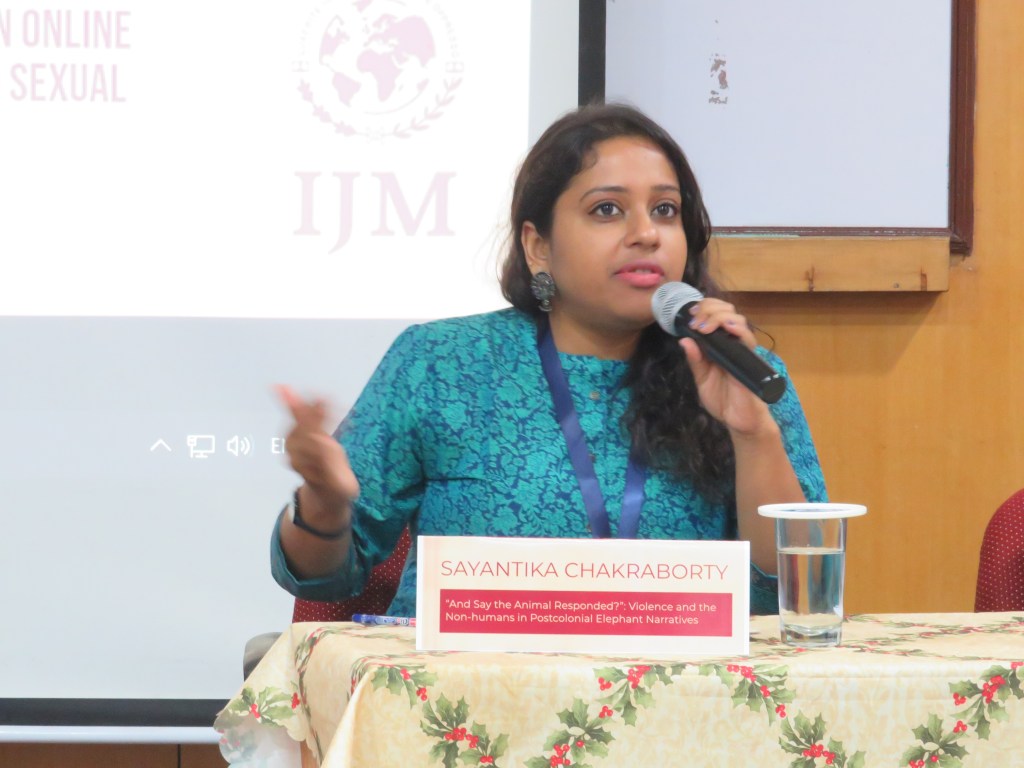
The second speaker, Savantika, presented her paper on Violence and the Non-humans in Postcolonial Elephant Narratives. She explained how postcolonial studies assign a marginal status to animals because of the fear of ignoring the human narrative. However, it also offers interesting insights into the prevailing norms of the time, including how metaphors of bestiality were used to refer to Dalits as pariahs, and so on. The speaker sought to reconcile this human-animal distinction by looking at connection and interaction between humans and no-human animals in two texts. The journeys of the elephants in these narratives are intertwined with that of the humans, and they become victims of human ambition and greed. The brutality of violence inflicted on them in captivity is part of the painful process of making them suitable for human needs. The texts also show how the elephants are attributed human qualities, and also describe how the turn from victims to perpetrators. In The Tusk that Did the Damage, the elephant Gravedigger displays psychological gratification after killing humans for revenge, although he eventually displays remorse. In The Elephant Company, Bandula, who is named after a bloodthirsty and vicious general, also becomes a killing machine. The second strand is just as problematic as the first, due to the covert, epistemic violence it displays by interpreting non-humans as a monolith. Since there will always be gaps in our understanding of animals, it becomes necessary to maintain a respectable distance.

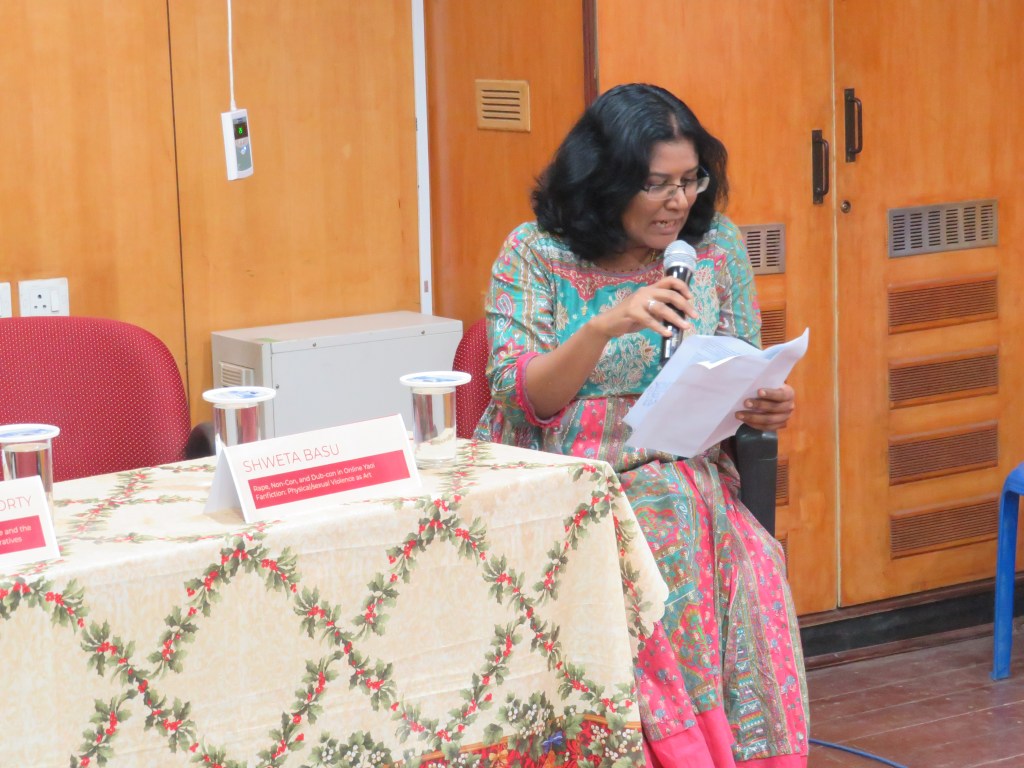
The third paper was about the depictions of violence in japanese fanfictions or yaoi. These yaoi are generally written by women fans intended for female readers, although they feature homosexual male characters. The themes explored include BDSM, kinks, sexual violence, questions of consent, and other such explorations of sexuality. This does not align with the understanding that women are supposed to write their own desires and their own bodies. The anonymity of these forums also allows these writers the self gratification of being able to claim their desires. They also have a degree of self awareness, that they are perverse but also subversive, and reclaim terms that refer to them as deviant. The speaker also spoke of the differences of fanfiction written in the Western world and Japan. While in western “slash” or homosexual fanfiction, the most popular characters exhibit overdetermined masculinity and fit into patriarchal norms like being muscled superheroes, as in the case of Captain America and Bucky Barnes. Meanwhile, the Japanese ideal takes a gendered perspective and features the prepubescent “beautiful boy”. The anime or manga that these characters are from are visually graphic forms, resulting in fanfiction that is also very graphic and descriptive. These literary explorations often feature rape as a backstory or motivation for antisocial behaviour and angst, and stories involving non-con (non-consensual) and dub-con (dubious consent) often end with the forgiveness on the part of the victim becuase of love, falling into the trope of hurt/comfort – hurtful situations ameliorated by romance. In questioning the motivations of these writers, and why they would want to write about something they wouldn’t want to happen to themselves, it is important to keep in mind the fact that fanfiction forums are a space that encourages the marginalized to express themselves. As opposed to the mostly abstinence-focused sex education that is available in most places, fanfiction becomes a source of information. However, actual gay men see this as an objectification rather than representation, since it is produced and consumed by women. These stories also set impossible body standards and also reinforce heterosexual gender norms and ideas of submissiveness. Therefore Yaoi provides an opportunity for sexual exploration by women while not actually involving the female body, thereby not being threatening.

Dr. Divya wrapped up the panel by offering her comments on the papers presented, and opened up the floor to questions from the audience.
Report by Shravya Chavali
Photography by Ganesh Dileep
 Article 19