
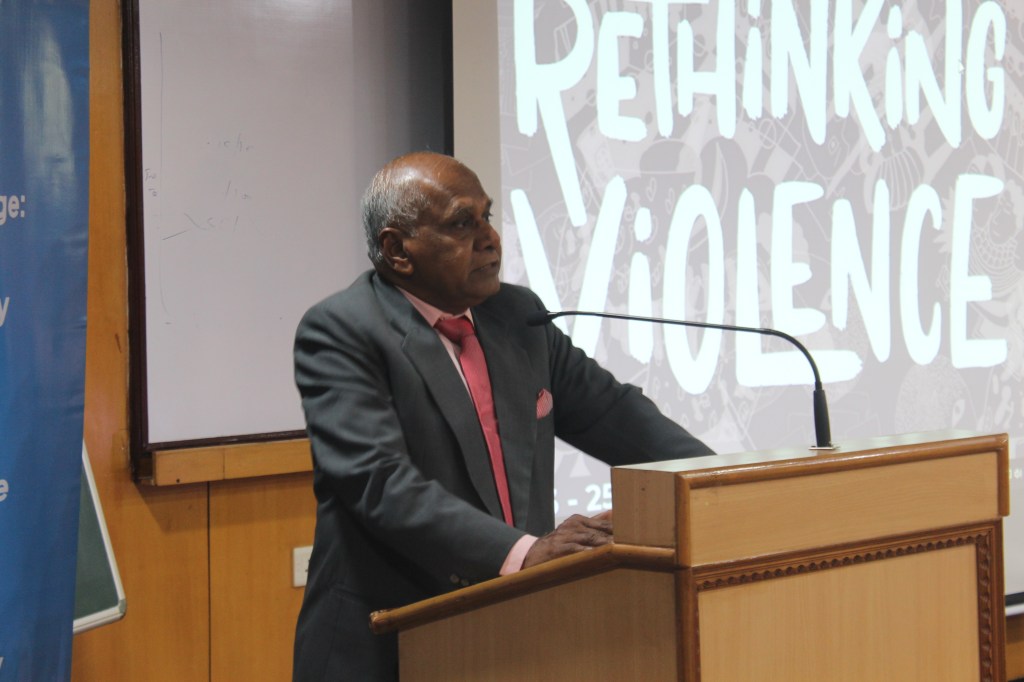
On Saturday, 25 January 2020, the last keynote lecture of this year’s Annual Academic Conference was delivered by Professor K. Chockalingam, Chairperson- Rajiv Gandhi National Institute of Youth Development. He began by stating that his lecture will provide insights on violence from the perspectives of criminology and victimology. He defined criminology as a scientific angle of studying and explaining crime. Professor Chockalingam traced the evolution of the discipline as it initially focused on the causation of crime, and later when the focus began to lie on the punishment system and the purpose of punishment.

Punishment originated as a means of revenge, and has gradually developed aspects such as rehabilitation and deterrence. Segueing from punishment, he defined the field of victimology as the treatment of victims by actors such as the police, doctors, courts and state. Subsequently, Professor Chockalingam defined crime as an act which has a punishment mentioned by law and is done with intention (mens rea). He argued that violence is an extreme form of aggression whether in terms of rape, murder, assault or more. Then, he laid down the three sections of his talk: Researchers on violence; How violence has been accepted and responded to in different cultures; and Victimology. Professor Chockalingam put forth his argument that if the income gap between the rich and poor is lesser, instances of violence are also lower. Income inequality and social relations have a close relation. He stated that statistics show that there are relations between the nature of social relations and behaviour of the people. He further argued that cultural traditions play an important role in determining the behaviour of people and instances of violence. He used statistical data and his observations through the years to state that low social capital is correlated with increasing violence. Consequently, economic capital, i.e. rising income inequality causes socially corrosive behaviour and rising violence. He argued that the relationship between violence and inequality (social and economic) is robust, and has been confirmed by various researchers. He noted that this is the reason for the concentration of violence among poor people and in slums. According to the scholar Wilkinson, disrespect and threat of “loss of face” are the most important reasons for violence. The Harvard academic James Gilligan also concludes that disrespect triggers violence. Professor Chockalingam argued that greater inequality also results in greater institutional violence. Taking his data from the U.S. National Violence Commission, more than 40,000 deaths occur around the world annually because of violence. 60% of the dead are male. He argued that violence causes a strain on healthcare, justice, and law and order. He claimed that weak governance, poor rule of law, rapid change, and unemployment are some of the factors causing violence. According to Professor Chockalingam, the policy response to this research-based conclusion must be in the form of strengthening data collection, linking and integrating prevention programs, and revamping the services to victims.
He then moved on to the second part of his talk which centered around the cultural differences in the responses to violence. He took examples from the United States and Japan. He argued that while the Americans are easily provoked, and likely to respond aggressively, the Japanese are not easily provoked, and do not respond aggressively. He argued that the people of the two countries understood violence differently. Americans perceived fear for their lives as violence and therefore, they respond aggressively. They also perceived a violation of one’s private property/space as a grave form of violence. However, the Japanese consider verbal aggression as a form of violence. While the Americans are more willing to use weapons and allow the police to use weapons, the Japanese do not. Professor Chockalingam claimed that powerful gun control laws have contributed significantly to the lowering of crime rates in Japan. He stated that the Japanese were not likely to use violence and force to protect their private property, unlike the Americans.
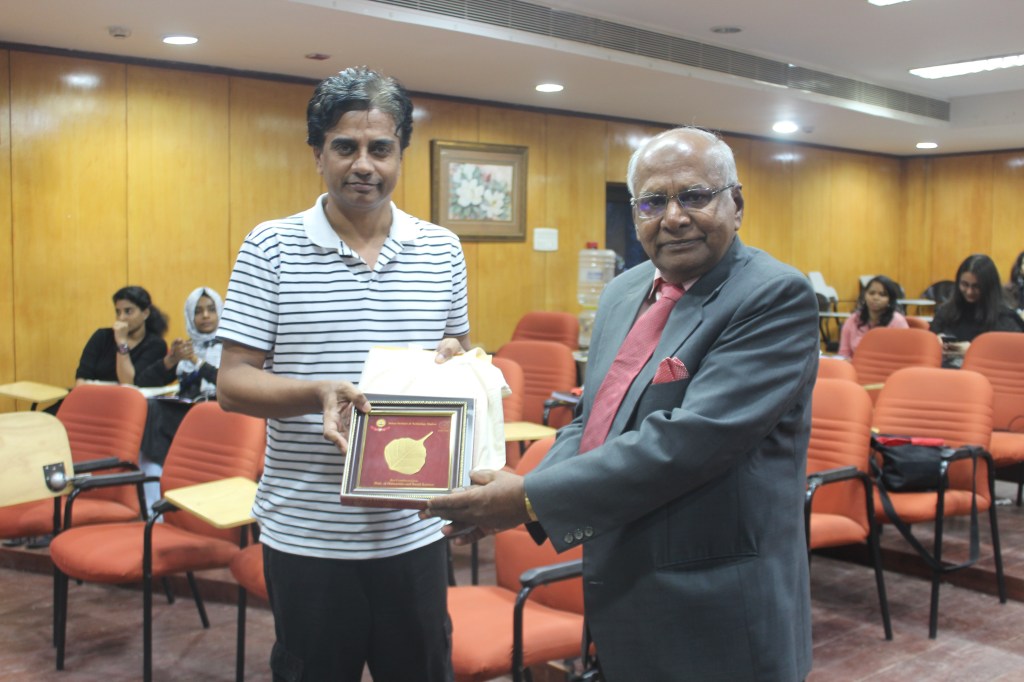
In the last part of his lecture, Professor Chockalingam spoke about the field of victimology, which developed in the late 1930s. Reforms in the treatment of victims and victim justice laws were taken up by the World Society of Victimology. He notes that the UN Declaration of Basic Justice for Victims of Crime (November 1985) was a landmark moment in the field of victimology, something that he also contributed to as part of India’s convoy. It declared that victims are entitled to get compensation, restitution, service/assistance, and justice. In India, the Victims Compensation Scheme was launched. However, he noted that the amounts of compensation vary drastically from state to state. Therefore, he called for uniformity in the compensation amount. He argued that the awareness among the judiciary in the last 10-15 years was paramount in taking victims’ treatment seriously and shifting the focus of the judiciary from eking out punishment to the offenders, to assisting the victims and bringing them justice. He ended his talk by stating that violence is a crime, but it is one of the many crimes that take place in society. At this point, the floor was open to questions. One member from the audience asked a question on whether cruelty to animals comes under the ambit of violence. Professor Chockalingam responded by stating that the intention is an integral part of violence and therefore, cruelty to animals does not fall under this category. Another question that was raised pertained to the state of assistance to the victims in Kashmir, where the state and its agent are also implicated in the violence. Professor Chockalingam responded by stating that the Indian Society of Victimology has been doing work in Kashmir. He stated that according to the UN Declaration, there are victims of crime committed by society members and victims of abuse of power. The people of Kashmir come under the latter category. He stressed that while there are several laws enshrined in the system, they can only be successfully implemented if there is a political will. He notes that such a will is lacking in the case of Kashmir. With this, the Q&A session came to an end. Professor Rajesh presented a memento to Professor Chockalingam and thanked him for delivering the lecture.
Report by Meenakshi V.
Photography by Ganesh Dileep
 Article 19