
—Ganesh Dileep
“I’m a Warli Adivasi. Our story is an ancient one.
We are indigenous. We bring life where there was none.
In this jungle even our lives are green, Waghoba is our feline God.
Put a hold to your ‘development dream’ back off from our forest, be gone forever!”
‘Warli Revolt’ by Swadesi*
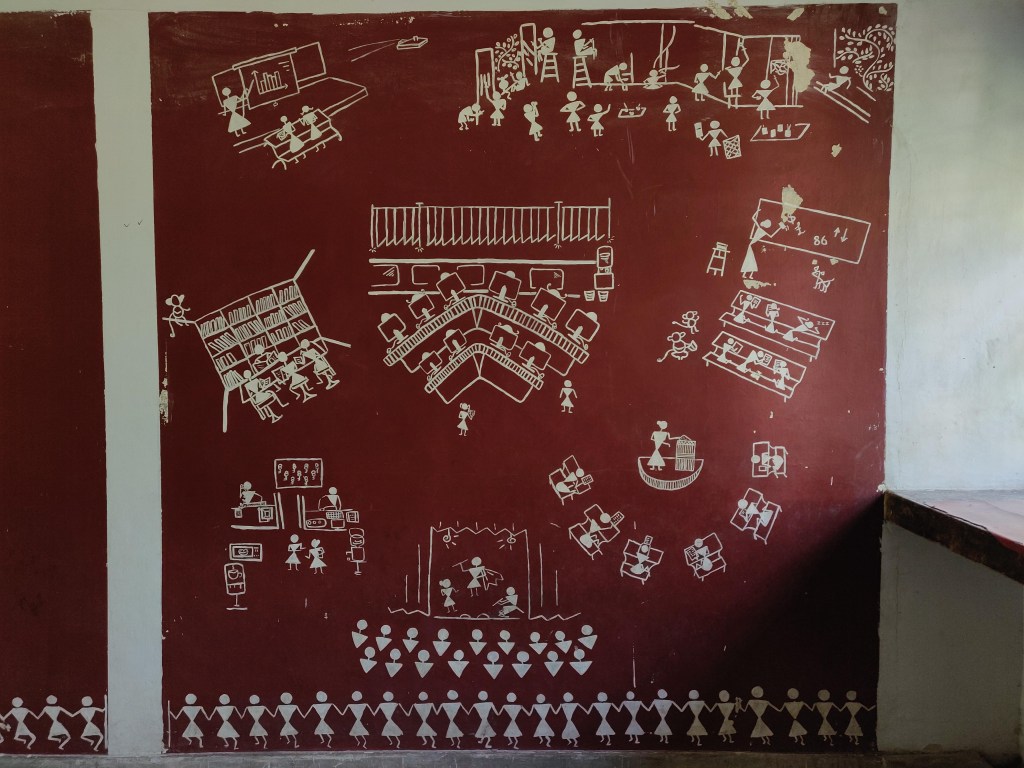
For years, students passing along the rustic corridors of the HS department have stopped to look at the giant circles of Warli dancers and the fascinating mural of insti’s aerial map done in Warli style. Over time, the department seems to have taken this piece of art to be synonymous with it, and the Warli dancers have found a place in its official logo. It has become symbolic of our department’s ethos—enriching humanity and aiding in its pursuit of happiness while being mindful of our roots, nature and the most vulnerable amongst us. Surely all this is reason enough for Article 19 to adopt this ancient art into our logo as well. However, committed as we are to speaking truth to power, this choice is also consciously political.
The Warlis are among the several tribes whose land—in the Aarey forest area in Mumbai—has been encroached upon to construct a metro car shed. Following protests that saw participation from the Mumbai elite, the Supreme Court on October 7 restrained the authorities from cutting any more trees in the Aarey Colony. Chief Minister Uddhav Thackeray also ordered a stay on the construction. However, it was too late. The Mumbai Metro Rail Corporation had already cut 2,141 of the 2,185 trees identified for felling. Further, twenty-nine citizens who had participated in the protests have been charged with serious criminal offences.
Warli people have long been at the mercy of local goons and corrupt politicians, and have a long history of oppression at the hands of those in power. Classifying their land as ‘uninhabited’, citing the absence of land deeds, and clearing the forest is only one in a line of atrocities that have been committed against these people. While Warli art is world-renowned and thousands in the fashion industry profit off of it, few bother to learn about the plight of these people and the systemic oppression they are survivors of.
Warlis are not the only tribe whose land—which they worship and protect – is at risk. Forests all over India and their indigenous populations are under threat of loss and destruction. The Ministry of Environment, Forests and Climate Change (MoEFCC) has consistently tried to abrogate and dilute the rights of traditional forest dwellers while continuing to do the bare minimum necessary to meet the relevant international obligations. The latest of these moves is the government notification regarding Environmental Impact Assessment (EIA). The notification facilitates easier sanctioning of projects involving clearing forest land and evicting forest dwellers. It legalizes post facto clearances, accords relaxations on the validity period with the monetization of offences, and exempts more industries from mandatory public hearings involving the participation of forest-dwelling communities. It also removes legal prohibitions against environmental destruction in places newly defined as ‘Border Areas’, making it easier to recklessly tear down forests, destroy riverine ecosystems and build highways. This is cause for concern, given that these Border Areas include much of the Hindu Kush-Himalayas (HKH) region, which has the third-largest ice cap in the world. The notification openly defies norms regarding transboundary environmental impact. It would not only threaten the backbone of the largest watershed region in Asia but also have drastic impacts on the climates of Nepal and Bangladesh.
The EIA notification is only one in a sequence of state decisions taken at the expense of our forests and its people. The MoEFCC, whose minister, ironically, also happens to be the Minister of Heavy Industries and Public Enterprises, has passed the Mineral Laws Amendment Act, 2020. The Act facilitates easier forest clearance by diluting norms for several mining companies. The justification is that it improves the ease of doing business, thus stimulating the economy in bio-diversity hotspots like the Western Ghats, the Himalayan region and Northeast India. Accordingly, clearances have been handed out like candy during this pandemic period. The passing of such an Act at the time of a pandemic suggests that the timing was a deliberate choice intended to foreclose popular protests.
These are calculated moves by a government that is hell-bent on torturing its indigenous population, depriving them of their rights, and dancing to the tune of corporations that stand to profit from these ‘development projects’ that ruin and pillage our natural wealth. In the thick of this pandemic, the MoEFCC has been destroying the livelihood options and migration patterns of pastoral communities by restricting their access to Protected Areas. This is in complete violation of the Forest Rights Act of 2006. Lockdown regulations have been used as an excuse to grant environmental clearances to projects without conducting site visits.

Our forests and its people are under attack today. However, its silent sentinels—our tribes—have not been silent victims of this pillage. They have been resisting and fighting the armed machinery of a nuclear state, day and night. From people wielding agricultural tools to guard the hills of Niyamgiri to our beloved Warlis resisting goons and the police alike in Aarey, the original inhabitants of our ancient forests are doing all they can.

This is our fight as much as it is theirs. There are no victors in this battle. We all stand to lose if our forests are made the cost of our development dreams. Humanity as a whole faces the risk of climate change. Simplistically put, we are all going to die—horrible, gruesome, painful deaths at that. We have a responsibility—to ourselves as well as to the other species that inhabit this big blue marble—to do our best to mitigate the effects of climate change. And that cannot be without supporting the rights of those who are willing to lay down their lives to protect the jungles they inhabit. It cannot be without protecting our forest, mountain, riverine and riparian ecosystems. We cannot be silent and be complicit in our own destruction. Not when the art we consider symbolic of our ethos is the contribution of a community that is about to be sacrificed at the altars of unsustainable modernity by a suicidal state.
Edited by Swathi C S
*The ‘Warli Revolt’ by Swadeshi features Prakash Bhoir, the Warli chieftain of Aarey. The song can be found on YouTube.
 Article 19