
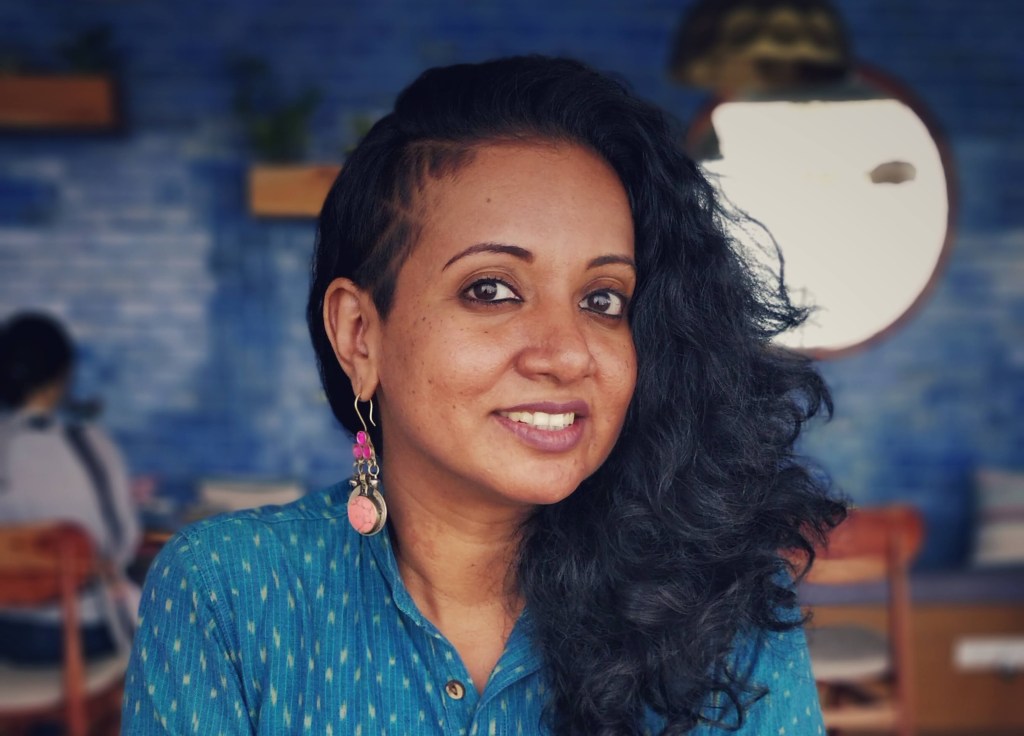
Students know Dr Mathangi Krishnamurthy as the person who changed what feminism means to them. Her classes encourage them to prod into the workings of society and leave them questioning everything about gender they thought they knew. In accordance with the theme of the month, Pride, Article 19 correspondent Madhumitha R talks to her about the visibility of the LGBTQIA+ community, gender identity, and her experiences teaching students of the department.
Growing up, how did you first get exposed to the LGBTQIA+ community?
Can I rephrase this question? Just because, I don’t think awareness of a clearly identified community was necessarily the starting point to my knowing that gender and sexuality as identity and body lie along a spectrum. Growing up in suburban middle-class India, one is always aware of casual homophobia and the relentless cultural homage paid to heterosexual pairing, especially if exposed to popular Bollywood cinema of the 80’s and 90’s. And yet, because of the class and caste diversity of the small town that I grew up in, there were also a number of people—classmates, teachers, neighbours—who, don’t get me wrong, were all name-called for not necessarily behaving in a typically gendered fashion, but continued to be full individuals in their own right and continued to shape my awareness of a world that needed to front-end difference. I would trace my earliest understandings of gender, specifically to these experiences.
My other set of formative experiences with respect to LGBTQIA+ communities, rights, and cultures came due to graduate school in a remarkably queer city (at that time, anyway), Austin, Texas. Which, incidentally, also boasts a great performance scene of drag, burlesque, and such. Austin was also where so many of my friends were community activists, scholars, and performers and who really allowed me entry into thinking about not just gender and sexuality but also intimacy, kinship, ally-ship and friendship in more responsible and more joyful ways. It was also in graduate school that I was exposed to the radical joy that is queer theory. So yes, the usual suspects, Butler, Foucault, you get the drift.
And lastly, my ongoing understanding continues to be shaped by my research involving medical care in India for infants with ambiguous genitalia, some of which you should read about elsewhere, lest I run over my word limit here.
How has the LGBTQIA+ community gained more visibility over time, and what has changed?
This is not a question that I can answer because my work or my journey has not been involved sufficiently in such. Also, the answer changes depending on where you locate it in time and space.
Let me start by saying however, that the community has always had visibility, whether through the remarkably stupid and pernicious stereotyping of popular film or through culturally specific forms of recognition, but as “other” and as “different”. I’m assuming the visibility you speak about is related to the kind of visibility that guarantees rights, equality, legibility and equal access.
One thing is for sure, that over the last twenty years, LGBTQIA+ identities and concerns have become more visible as located concerns and not those specific to First World countries only and this has been hard fought. In India, for example, the journey to the Supreme Court declaring Section 377 as unconstitutional in January 2018 has been a long one, thanks primarily to the relentlessness and courage of LGBTQIA+ communities, organizers, lawyers, and individuals in India. In parallel, I would direct you to the cultural productions of the community (novels, zines, films) to try and understand why this is a cultural struggle for visibility as much as a legal one and often comes to light only, as Walter Benjamin reminds us, in moments of danger. Visibility also came, for the world, tragically with another pandemic, AIDS, reminding us that the need for recognition is also tied to very real rights, the absence of which are a matter of life and death.
In short, change is a matter of time but also persistence and risk but as always, the story is more complex and I am not the right person to detail for you the various aspects of this story.
Do you think that the Department, or IIT, can do more in the line of consciousness raising?
There is always work to be done. The question to ask here is what is the role that a department like ours can play with respect to the necessary project of expanding the spectrum of gender and sexuality. I suspect you all can direct me and us better in this project.
What do you like most about teaching Feminism?
That I get to play. That what I teach changes how I live. And that I get to feel all over again, along with all of you, everything I felt when I first realized that identities look solid, but are fluid. Every single time. I also get to invite people into the joys of collaborative living, non-binary thinking, and a commitment to egalitarianism, no matter how utopian all of the above.
Is it difficult to hear viewpoints that are in stark contrast with what you believe in? How do you deal with this?
Oh, I hate it as much as the next person. But that’s just always my immediate split-second reaction. I try and remind myself to ask why I believe in what I believe in. Is it because of something I have thought through or is it an ego enterprise? It’s sort of like, when we say things such as “I am a phone person” or “I’m only a text person”’; what are we really saying?
And hearing things in stark contrast is a very common experience if one teaches “Feminism”, which suffers from a number of contrary characterizations. Also, it seems to be something about which everybody has an opinion. I found myself in the early days of this course, seeking to clarify that this is not about man-hating. These days, I focus on gender as an axis of difference, also because I do not think the act of teaching should always be about saving people’s feelings. The world is a tough place, and beyond a point, it would be useful for everyone to learn to check privilege early. And this applies to me, as much as to anyone else.
Are there any interesting anecdotes that you could share about teaching Feminism and researching gender?
My favorite story is always about a student, now a scholar out and about in the world, who on his very first day of class gently suggested to me that gender didn’t really interest him, so he was unsure what he would get out of this class. I responded saying by the time we were done with class, he wouldn’t have a choice. I suspect that’s how it worked. And if any of you reading this story asks me nicely, I will direct you to him so you can ask him yourselves.
The second story I have would be about body and materiality. When at a perfume counter somewhere in the American Midwest, the saleswoman helping me out, a white, American woman, shared her life experience as a transwoman and the physical and cultural struggles involved. I was working on call centres at that point, and when I told her about my research on accents among customer service personnel, she demonstrated to me the switch she had to make between her past “manly” voice and her current soft, customer service woman accent. The switch was so seamless that in that moment I think I understood what Butler meant as possibility for the first time. I thanked her for that and she gave me permission to share this story as a way for others I worked with or taught to understand the relationship between performativity and gender. It also illuminated for me the malleability of body itself in its orientation to questions of gender, especially in relation to my obsessions at that time with voice.
What are your thoughts on Pride Month and the pride marches in India? Do you believe it can be something that makes us a more inclusive society? If so, how?
Your second question is a weighty one, so I will take that off the table since honestly, I hope so, but I don’t know. My thoughts on pride month and pride marches are, absolutely. Yes. And yes. Legibility, visibility, recognition, joy, the necessity of and insistence on being. These are important on all fronts.
Activism through social media is on the rise. It often feels like a space of solidarity, but the amount of content can also be overwhelming. Do you think social media can play a big role in hastening progress? Do you have any advice to your students about navigating the social media world?
I have very conflicting thoughts on social media. It is indeed a space of solidarity, a place to speak, and hopefully to be heard, although in the clamour for speaking, it is this last that is in jeopardy. Can social media hasten progress? As a well-trained social scientist, I hesitate to even speak to this notion of “progress” for it doesn’t look the same from the side of the table that is not mine. And secondly, it offends my notion of time, this rush to speak. I am slow, and I like to take my time, as you will attest, given how long I took to get back to you on this interview.
So advice? Pause before you speak or type. If you are unsure, wait. Listen. Be kind, hold back if you must, but be kind. To yourself, and to others.
 Article 19