
Anu Joshy graduated from the department in 2014 with a Masters in English Studies. Since then, she has been preparing for the UPSC Civil Services Examination and cleared it this year in her fifth attempt, ranking 264 at the national level. Her third anthology of poems, With Blue Ink of the Oceans, is available on Amazon.
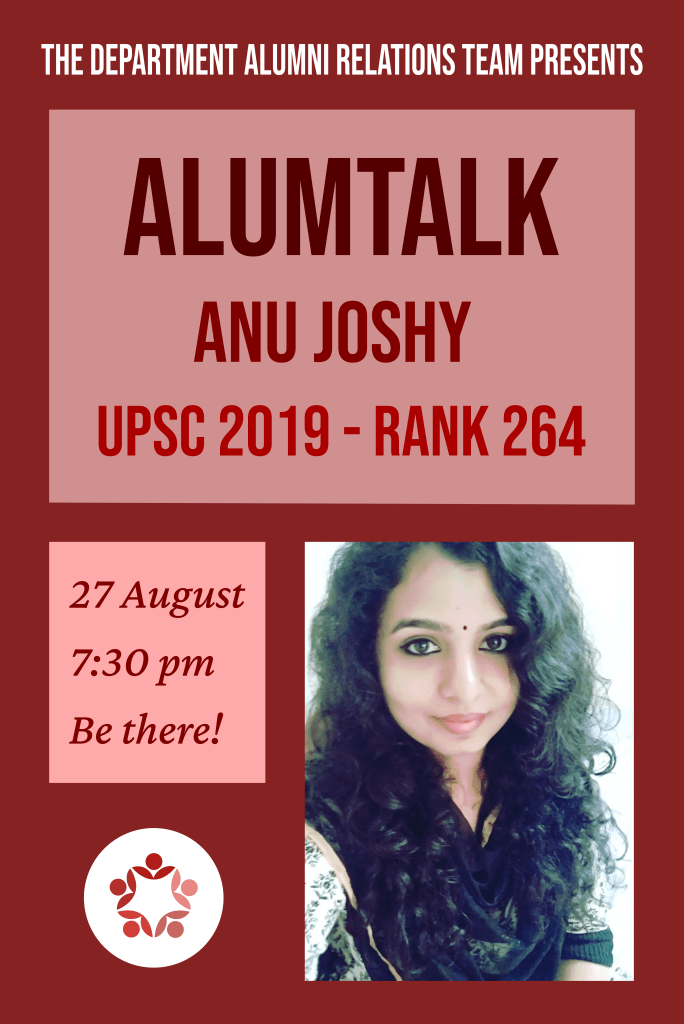
A few weeks after her success in the Civil Services examination, Anu Joshy was hosted as the second guest of the AlumTalks series. Anu was energetic and lively throughout her talk, despite life being predictably hectic for her in the past few weeks. The session involved as many techies as students from the department, and saw enthusiastic questions on the minutiae of the UPSC selection process.
Anu began by encouraging a career in the civil services if you’re passionate about bringing about large-scale social change. Sure, there are other paths to this, like NGOs and politics. She recounted her amusing attempt at starting an NGO with her friends at the end of their first year of college. Their earnest attempts were thwarted by red tape and the requirement that one of their houses be registered as the NGO headquarters, the latter being unacceptable to their parents. It was then that she zeroed in on the civil services.
She then touched upon the difficult five years marked by her repeated failures, about which she had written a touching Facebook post recently. From being the topper of her batch to being unemployed years after graduation, she discovered how strange and difficult life can be. She now calls herself an expert at failure and new to being successful. But success doesn’t teach you much, except to be gracefully successful. Failure shows you who your true friends are and, in her case, how much her parents loved her. She admits to having an extended teenage phase where she believed that her parents did not understand her. However, in the face of constant disapproval from her extended family—to whom she was an unmarried, underemployed woman over twenty-five—her parents shielded her, allowing her to prepare in some amount of sanity. What finally sustained Anu was her conviction that she was doing it for the right reasons—not for the salutes and the lal batti, but because she wanted to improve lives.
Her words were followed by earnest queries about the preparation and how the different stages of the process went for her. She credits the department with teaching her the art of answering questions one doesn’t know, which turned out to be an essential skill for UPSC. She picked up speaking skills from the many presentations she had to do over the five years. The interdisciplinary nature of the MA programme does give us an edge for it is exactly such a generalist understanding that UPSC asks for. She advises aspirants to begin reading the newspapers regularly from their third year. Full-fledged preparation can begin in the fifth year. It is important to do your degree well because that might be what gets you ahead if you fail this uncertain exam with a 0.4% success rate.
Anu says that UPSC was her sole pursuit and that she did not have a Plan B, unlike what is often advised. She warns that she is not a role model for she is less practical and more driven by idealistic visions of chasing a passion. But for the past two years she has been teaching at a UPSC coaching institute and says that if she hadn’t cleared the examination, she might have gone into teaching.
What is often left out about Anu is that she is an accomplished poet, with three anthologies to her credit. When asked when her next collection would be out, she is surprised and notes that it has been a while since someone asked her that. She has plans for a novel. Poetry comes easily to her. She began writing at six and now writes enough that by the end of a year, she can bring out a collection.
The session was engaging throughout and we hope Anu continues both her administrative and literary pursuits.
Edited by Abhirami G
 Article 19