
Our department is replete with wonderful people bursting with talent, ideas and hobbies. In the first article of the Beginner’s Guide series, I write about our department’s own second-year student, Narcissus Owarie, who was able to turn a quarantine-inspired hobby into a small business of sorts. The thing she makes goes with your t-shirt, pants, kurta, dresses, you name it; suits any mood, occasion and style; and is a perfect enhancement to any ensemble. No, it’s not your IITM hoodie—it is a scrunchie.

These pretty fabric-covered elastic bands can be used both for fastening hair and as an accessory—usually worn around the wrist. Scrunchies were all the rage during the ’80s and ’90s. Patented in 1987 by Rommy Revson, they were popularised by celebrities, as well as through pop culture—the 1989 high school movie Heathers, for instance, prominently features a red scrunchie. It came in several colours and patterns, true to the vibrant and larger-than-life aesthetic of the ’80s, but later suffered a dip in popularity during the 2000s. However, with the release of TV shows like Stranger Things, as well as an increased interest in the vintage aesthetic during the late 2010s, scrunchies made a comeback with new zeal. The statement, “history repeats itself”, cannot be truer when it comes to fashion. The fact that scrunchies provide a less damaging alternative to tying your hair, as compared to other options such as rubber bands and hair ties, contributes to their success. In fact, Narcissus’s own hobby-turned-business began with her love for thick scrunchies, which are not only useful for controlling her pretty but unruly hair, but also great at highlighting a bun—her go-to hairdo.

Unable to find cheap scrunchies of different kinds in stores, Narcissus decided to make them herself. Starting in March, when quarantine began, she says that she just wanted to do something to get rid of boredom—landing on DIY scrunchies on her trusted Pinterest app. She and her sister borrowed her mom’s sewing machine, as well as thread, fabric from old clothes, and elastic, to make them. Her mom taught her the basics of sewing and she switched to different styles, mastering it in less than a week. Narcissus says that in the initial few weeks, she worshipped the machine, making hundreds of scrunchies. She confirmed my vision of piles of scrunchies lying around her house—she currently has three bags full of scrunchies in all the colours of the rainbow. Narcissus prefers fabrics of different patterns and colours, as well as those containing sequins or star patterns. She says that while satin is the best for hair, her favourite material to work with is tulle. It takes her about twenty minutes to make a scrunchie—ten minutes for sewing, and another ten minutes for hand-sewing the ends. However, it usually takes more time than this, as scrunchie-making is accompanied by movie-watching. On average, she spends about two hours a day with the sewing machine, making about 10 scrunchies.
Even though Narcissus began with the intention of making them for herself, she and her sister decided to sell them as the pile started building up. Her sister made posters and circulated them among her friends from college (who constitute the major percentage of their market), followed by Narcissus, who started an Instagram page—Lonely Daffodil—for selling scrunchies in June. Although most of the fabric she uses is from recycled clothes, some fabrics, like tulle and satin, are bought and sent over by her sister. Her Instagram account displays amazing pictures of scrunchies taken by her mom, often modelled by Narcissus herself. Interested people usually message her on Instagram, to whom she replies with new photos, making them according to their preferences—the most popular ones being the tulle scrunchies with pearl embellishments (as seen here). The prices range from Rs. 30 to Rs. 70 depending on the material used, with added shipping costs which are handled through DTDC or Uber Connect. Her farthest customer was from Gujarat, who contacted after seeing her Instagram page. Decorations like bows are added on request, and she hopes to learn embroidery to further liven up her scrunchies.
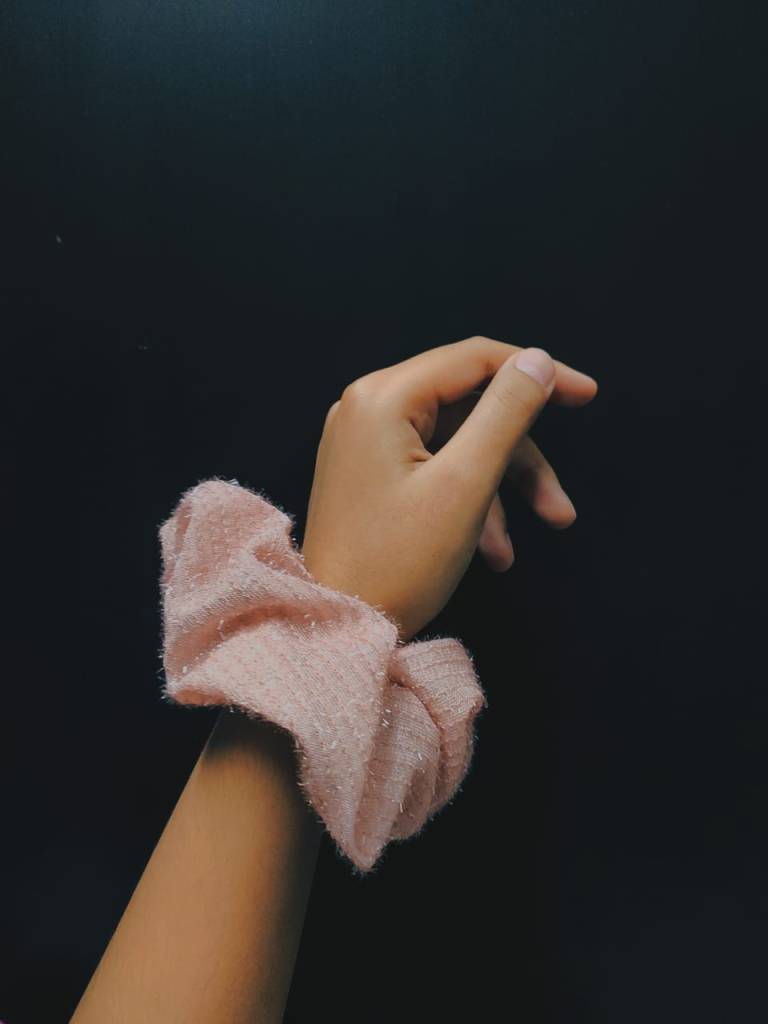
She states that it took her almost ten tries to perfect a scrunchie and to “not give up, keep at it and soon you will fall into a rhythm”. She says that using a sewing machine is easier than sewing by hand, but it is best to stick to what one is comfortable with. She also imparts a piece of major advice, and I quote, “don’t play with needles, it pokes”. Narci says that she doesn’t follow a fixed proportion for cutting out fabric. However, the thickness of the scrunchie depends on the amount of fabric used, so you can just have fun with it. Even though her sister has made and sold pouches and sling bags, she wishes to focus on scrunchies for now. Although she may have to put a hold on making scrunchies for now, she hopes to sell more once she gets back to insti. Narcissus confesses that it is a great source of pocket money, while also stating that DIY projects like making scrunchies, hairbands, and the like are a great way to reuse and recycle things.
Narcissus can be found on the Instagram handle @lonely.daffodil. For more information on making scrunchies, check out this step-by-step guide.
Edited by Abhirami G

