
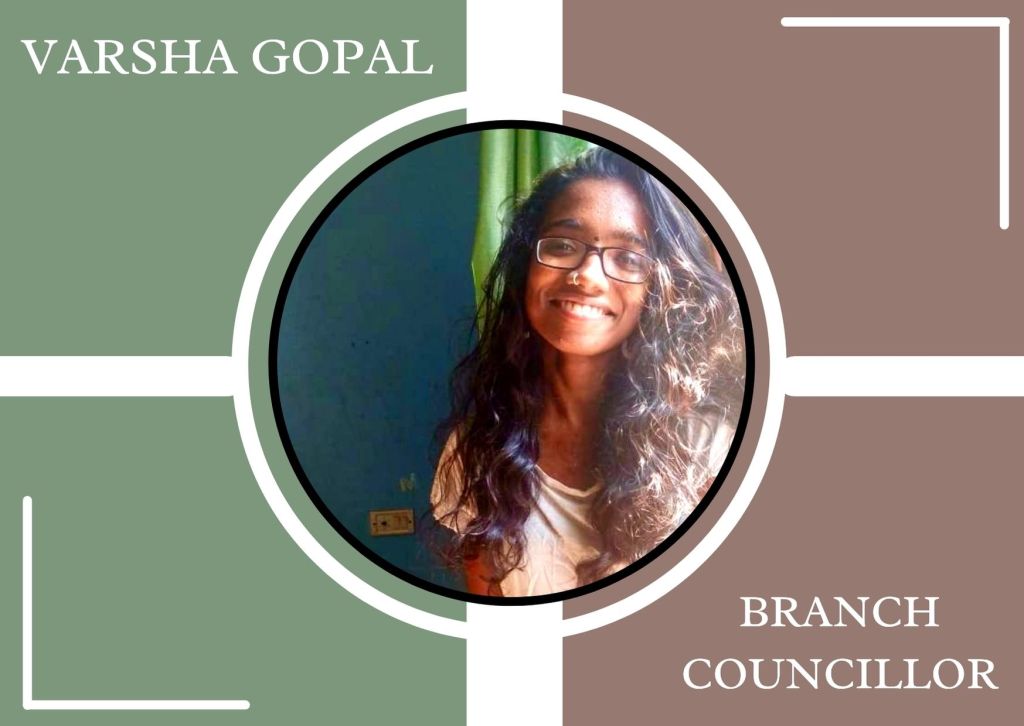
The Branch Councillor’s vision for this year was to aid the creation of a stress-free learning environment by making the curriculum and the course structure more flexible. Varsha Gopal also wanted to broaden networking with alumni to ensure that placement and internship opportunities are improved. Her manifesto consisted of 23 points – under the categories of academic initiatives, student well-being, placements and internships, department outreach, branding and alumni relations, facilities, accountability and SLC proposals.
The first half of her tenure was very successful and she was able to execute her academic initiatives. In order to make the course more accessible, the BC worked on updating the course catalogues by reorganising stream electives under the categories: Economics, Literature and Culture, Development and Philosophy. Varsha also put in place an indexing system that allows us to access the course catalogues easily, without having to comb through a hundred-page document with no guide. With the new list of creditable minors being released by the Academic Section, her aim to introduce Linguistics and International Relations as minors is half done. Making all of these new minors available without slot clashes is not practical but Varsha intends to attempt to make this fluid starting from HS19. She is planning to give them options to vote on the most preferred three minor streams, and thereby facilitate those minor streams at the department level. Those of us who are willing to schedule our classes by ourselves and ensure that there are no clashes, we can claim any minor. She also hopes to make NPTEL courses available for students to claim as stream courses, an idea that has been agreed in the Department Development Council, but is yet to be brought up in the Board of Academic Courses by the HoD. The strength of the class in courses like microeconomics have also been limited, making the grading and learning easier.
Another important area that Varsha wanted to work on is improving the overall mental health of the Department and students. This aspect of her vision has been more difficult to implement due to the pandemic. The BC’s modification of the buddy mentor system, in collaboration with the department secretary, is two-fold. One, she is streamlining the system by forumating guidelines and instructions, and also putting provisions in place to document interactions. Two, what had initially been a random allotment of mentors to mentees is now based on a questionnaire that both parties answer, putting down their interests and hobbies, what Varsha called ‘Interest Mapping’, an idea for which she is indebted to Aneesh. This ensures that if there’s something you love, you have some form of a mentor who knows how one can pursue it in the Department, or you can figure it out together.
She has introduced a new department team for Alumni Relations, and this team has been included in the Department Charter as well. As for making internships and placements a much less daunting prospect to students, Varsha, along with the Placement and Alumni Team, are conducting a series of Fundae sessions, which were kickstarted in January. The Internship Bluebook is being made by the Intern Team, with some assistance by the BC. She has also been working with the Alumni Team in the process of alumni mapping for the fourth years. Varsha has given networking and visibility considerable importance. The council has revived the LinkedIn account and page and have created an Instagram account (yet to be activated), which she believes can go a long way in branding the department. The branding of the department is also complimented nicely with her idea of creating a crash course that would prepare students for placements. A professor would be the resource person, helping students sharpen skills that are essential to the job market. She hopes to make this happen soon along with the help of the Placement Core; they have been in contact with some professors in order to make this happen.
The BC has also floated the idea of a bimonthly newsletter of important department activities, an initiative in collaboration with Article 19. This helps maintain a record of the events and activities that happen here. Maintaining records and documents that are accessible to all students has been quite an important part of the legislation that she has initiated. She also attempted to enhance digital access to newspapers such as New York Times, Washington Post and Telegraph, but the request was denied by the library committee, as they felt that the already existing subscription gives access to a range of newspapers. She has created a repository of published works, both academic and semi-academic, of students and alumni. She is also in the process of creating a repository of MAPs, and has updated the repository of Abstracts which was initially compiled by Parthiv. The MAP Database has also been an idea that students have jumped at, and Varsha is grateful for the support from the class representatives of HS19, HS16 and HS17. That said, the MAP database has been a difficult endeavour – it has been hard to contact older students from batches before HS11, and those that have been in contact don’t have softcopies and/or are concerned about plagiarism. Currently there are about 80 MAPs in the database, and the BC intends to increase the count over this semester following which the repository will be shared with the student community.
This semester is mainly going to be dedicated to raising proposals in the SLC – she wants to create a dedicated resource room for visually impaired or low-vision students, and pick up and drop off services. The Department Legislator wants to add modules of education for the prevention of sexual harassment, mandatory townhall meetings for all departments, thorough reviews of department charters and proposals for draft charters for departments that don’t have one. Due to the pandemic and online learning, the SLC proposals have not yet been fulfilled, but Varsha intends to spend the second half of her term seeing through the ideas feasible under current circumstances.
My conversation with Varsha was very heartening and she said excitedly ‘the council has been great this year’. While her manifesto was designed for a tenure that would be situated in the institute, her work has adapted very quickly to the online medium. The term of the BC has been successful so far – having fulfilled ten or more points of her manifesto, and adjusting many more to fit the needs of the pandemic situation. Article 19 wishes Varsha a wonderful time for the rest of her tenure.
 Article 19