
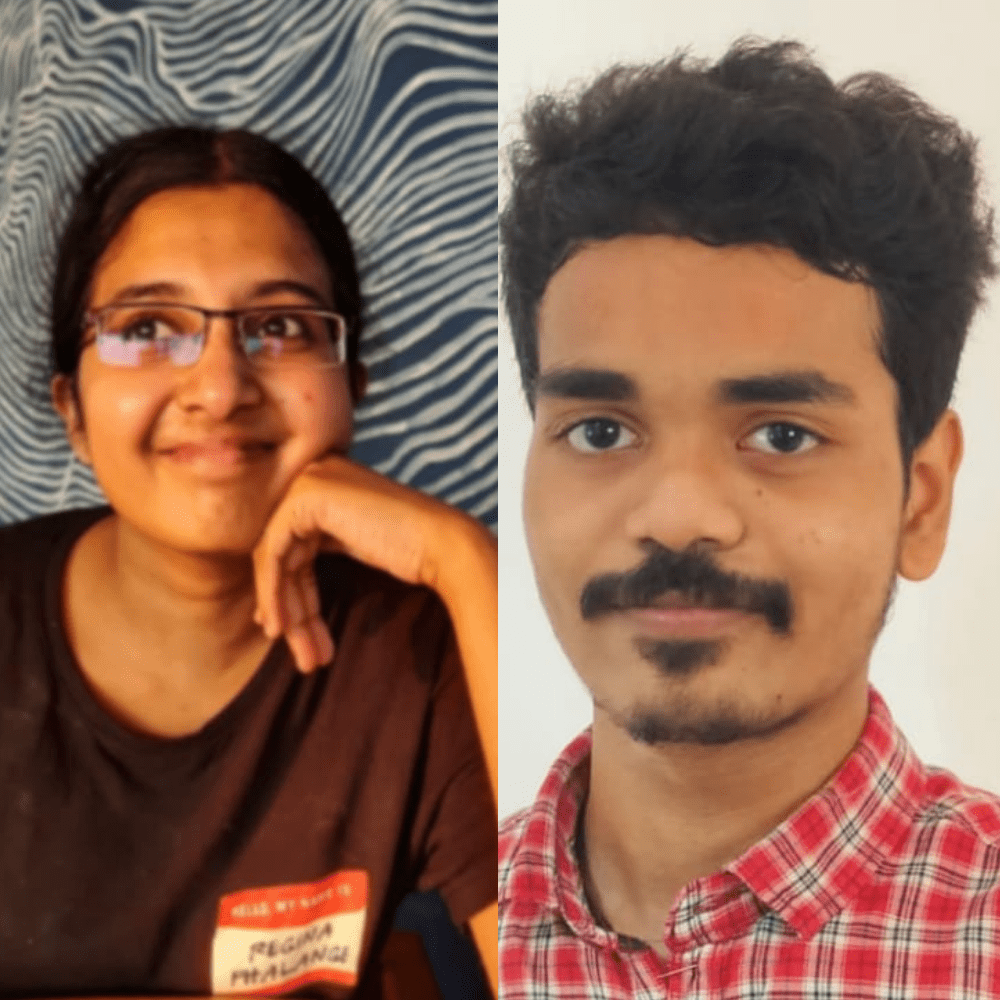
On the 31st of March 2021, the Department of Humanities and Social Sciences held the Soapbox for the position of Department Legislator/Branch Councillor, where the two conscientious candidates, Abhirami Girish Kumar and Anand Krishna G Unni, both from the HS18 batch, presented their manifestos and engaged in a captivating question and answer session which gave the department student body a lot more clarity on who they wished to vote for.
Find the manifestos, feasibility reports and statements of purpose of both candidates in this folder. Recording of the Soapbox can be found here.
The Soapbox began with Anand’s presentation. He had divided it into 5 categories of initiatives that were Academic, Student Welfare, Placement and Internship and Student Legislative Council Initiatives. He pointed out that he has a relatively less ambitious manifesto because he aims to fulfil all his promises. Under the academic initiatives, he has observed and noticed some discrepancies with regards to minor stream courses such as Introduction to Cultural Anthropology, and hopes to resolve these inconsistencies. Next, he aspires to expand the set of stream electives while simultaneously clearing up the air with the Head of Department to make the stream electives’ objectives more clear for all students. On the same agenda, he hopes to conduct orientation classes for ES and DS courses to make students aware of what they’re getting into while choosing a certain stream.
As a part of his student welfare initiatives, he is keen on revamping the buddy mentor systems and creating mental health support groups along with online grievance portals to increase the emphasis on mental health. He also plans on increasing interaction between the students and the faculty advisor by ensuring that at least two of such meetings take place every semester, with the help of the class committee chairperson. He also aims to create a series where he conducts sessions on academic writing each week and circulates it throughout the department, so that students are better equipped while writing their term papers. Additionally, he wants to open up mathematics and philosophy study circles, plans on revitalising the film club, hopes to utilise the Instagram handle and conduct interviews with alumni.
Anand’s placement and internship initiatives include an increase in departmental support and involvement in the department Internship Fair. Next, he wishes to establish a skill set guide which helps students develop their résumé, along with a chart of positions with their corresponding skill requirements. Moreover, he strives to push for the Alumni Relations Team to cover foreign exchanges, apart from what the fundae sessions and serve as guide in helping students choose colleges and courses. Other points on his agenda, include procuring online subscriptions of newspapers and magazines to help students with their entrance exam preparation, as well as revitalising the library by migrating it to an online platform and make a compilation of book requests put out in the MA-DoHSS group along with the existing books in the repository.
His Student Legislative Council initiatives consist of a more inclusive Saarang which welcomes postgraduate participation as well as that of Sabhas and vernacular Samitis. Next, he intends to work alongside the sports secretary and creates a guideline for the conduction of sports post reopening of insti. Lastly, he empathises with the visually challenged and thus plans to put in place online audio subscriptions of reading material. This brought Anand’s manifesto presentation to an end.
Following this was Abhirami’s manifesto presentation. She had divided her proposals and initiatives into 6 broad categories which were her Vision, Academic and Co-curricular initiatives, Accessibility, Accountability and Safety, Support for Placements and Internships, Department Publicity and Outreach and Student Legislative Council Proposals.
Her vision for the department includes creating an equitable environment by liberalising access to resources, thus allowing students to pursue both their academic and professional aspirations. As a part of her agenda, she guarantees a smooth shift from the online to the offline fashion of learning, thus allowing all students to gradually adapt to the new conditions of life.
Under her academic and co-curricular initiatives we have maths support groups for second and third year students who wish to revise concepts. It also serves as a bridge course for those who haven’t taken up maths in grades 11 and 12, but require it for their coursework. This can be implemented by dividing students into groups based on their prior knowledge of maths. Abhirami aims to compile a database of all PhD level courses that MA students are eligible to take in order to cater to students with specific research interests. Next, she is also pushing for the conducting of concept review sessions catering specifically to the HS20 batch due to the shortened courses which have resulted in a more shallow understanding of core concepts that might hold importance later on in the course. To facilitate the process of stream allocation, Abhirami proposes to bring about certain trial classes in higher level ES and DS streams for second year students. This will help them develop a clearer understanding of what the course has to offer and which one of the two is better suited to their interests, so as to make a more informed decision. Additionally, she hopes to complement the sixth semester English Studies Shakespeare course with a non-evaluated play at the end of the semester. Based on her discussion with Professor Swarna about the same, this initiative will help students build a performance perspective as well to analyse the plays.
As a part of accessibility, accountability and safety her proposals include the generation of a resource website which holds archives such as former handbooks, bluebook and other BC initiatives. Secondly, Abhirami is passionate about creating a virtual library which will serve as a repository of textbooks prescribed by faculty and ebooks which aren’t available online. Thirdly, she strives to update the DoHSS website with a comprehensive list of all courses offered by the department and what they entail. This helps students get a gist of the course’s framework and gives outsiders and aspirants a birds’-eye view of the 5 year MA programme and what it necessitates. Lastly, since going back to campus might be on the table now, Abhirami is ready to formulate a plan, in collaboration with the department secretary, for social distancing within department facilities such as the DCF, MML and Department Library.
Her agenda with regards to placement and internships include expansion of the student’s horizon with regards to learning. She has consulted Professor Vipin for a lesson plan for programming workshops for interested students. Next, she is desirous of compiling a Skill Bluebook in collaboration with the Placement and Internship teams. This book will serve as a guide to those applying for internships as it will enlist the skills required by one for an internship or a full time position. Additionally, she also plans to give the student body information on how to acquire these skills.
Abhirami has come up with a new initiative to improve outreach in the department. She is keen on establishing a Department Publicity and Design team which will streamline and organise social media handles of the department and handle design requirements. With regards to outreach and helping out aspirants, she highlighted the importance of the HSEE blog for aspirants and proposes to include it under the Department Publicity and Design team. One more important point on this agenda is the movement of Article 19, the department’s media body, from its current WordPress domain to a custom domain.
Finally, as a part of her Student Legislative Council initiatives, she’s pushing for the expansion of CCASH protection to all genders and bring student representation within the body, introduction of gender and sexuality sensitisation sessions for all students, formulation of guidelines for regulation of student-faculty interaction and Increase HS related content and representation in the Institute Orientation as well as Like Skills classes. Lastly, she suggested guidelines for more transparent grading as well as an option to avail feedback on one’s work from professors. This will serve extremely advantageous to the student community. This brought Abhirami’s presentation to an end and concluded the manifesto presentation segment of the soapbox. This was followed by the question answer segment where the candidates questioned each other.
Question and Answer session:
Anand to Abhirami:
Q: What are the incentives for a student to take part in a non-evaluative end of semester Shakespeare play? (Referencing Abhirami’s academic initiative)
A: Students who take ES usually enjoy their courses and they feel that this is another avenue that they would be interested in pursuing. The Shakespeare course has scope for interaction and a play allows you to see the content within your course from an actual performance viewpoint. This brings the class together and also calls for a lot of interaction. The students I spoke to reacted positively towards this initiative.
Q: With regards to the indexing of courses on the department website, many of the courses have already been indexed including small descriptions of them.
A: The course list is already provided by the department on its website, but what we need is a more clear idea of the learning outcomes that a student would get out of these courses. The department website does not give a lot of emphasis on what topics will be covered and the course list is incomplete too. Thus, my initiative will complete the list, make it more detailed and more inclusive for all students to reap its benefits.
Q: In your SLC initiatives, you spoke about achieving more transparency in grading and a feedback system. How do you plan on doing that? Isn’t it too ambitious to ask for complete transparency?
A: I discussed this with the incoming Academic Affairs Secretary and he mentioned that most courses that require complete transparency are HS courses because we offer many of the term papers and presentations. This will apply to all departments, but will have a greater impact on HS professors because of the course style. We can get closer towards this goal when students start to express interests in the reason behind the grade they received.
Q: You spoke about an introduction to Python and other programming courses. How is this going to be taught? Is it going to be in the form of an elective, study group or a crash course?
A: Based on the outline that Professor Vipin offered, this is going to be on the lines of a study group where interested students could come together and discuss related concepts. I had in mind a self guided study group where people with the same aspirations in this field could come together and discuss. It is more of an interactive discussion and project based course rather than something which is taught.
Abhirami to Anand:
Q: You had mentioned that the department film club would be revived in your manifesto, however the department film club does not come under the jurisdiction of the branch councillor. What would your role be in this revival process?
A: The branch councillor is an additional stakeholder along with the department secretary.
Follow up 1: As an additional stakeholder, what exactly would you be doing with the club?
A: This will be in contention when we come to the institute. There are problems with regards to getting workspaces and telecasting certain films that requires procuring a licence. I’ve spoken to the current HOD and I have understood that as an additional stakeholder I can formalise the department film fest when we get back to the institute. We can also get the help of faculty in obtaining the required resources.
Follow up 2: I am aware about Professor Aysha’s involvement with the club, but I fail to understand how it comes under the purview of the Branch Councillor.
A: If the film club gets added to the department charter as an official club then I can serve as a link between the club and the administration.
Q: You mentioned more departmental support for the intern team, could you elaborate on it?
A: Upon speaking with the HOD about the internship fair, I came to understand that he did not know much about the workings of the fair and the department’s role in it. When I asked him about scaling up the internship fair he said that if they have a proper proposal from the internship team with faculty backing, then the department could intervene and provide better facilities for its conduction.
Follow up: Have you consulted with Akshaya, the current internship team head, about the same?
A: I spoke to Akshaya about what I could do for a department intern team and about who the next intern team head could be. Akshaya said that The internship fair is in its initial stages and any support could be advantageous because of its current position. She also wholeheartedly welcomes it and will talk to the next intern team head about the same.
Q: You proposed giving additional guidance to students while selecting stream electives. What are your plans regarding this?
A: We once had department orientation sessions in the Mahatma Hall. With regards to the guidance we hope to have similar extended sessions to get professors to talk to you about what they say in the first class of their semesters as to what to expect from the course and what the syllabus entails.
Follow up 1: Talking about the different streams and electives is already being done by the professors in the second year. How is your proposal different from what the professors are already doing?
A: What the professors do is insufficient and they stick to a briefing of a maximum of 5 sentences about their course. We envisage a proper introductory session where we elucidate the process and professors shed light on the respective courses that they teach. We want to provide students with a consolidated view of what happens on the first day of the fifth semester through this initiative.
Follow up 2: Since professors already cover this in class, how would you get them to take on additional responsibility to do this and what’s their incentive?
A: Looking at it from a qualitative perspective, professors usually notice that students don’t know much about the course when they show up for their first class after the streams have been allocated. Professors can take 15-20 minutes each and brief the students about the subject they teach and the stream, thus eliminating any sort of ambiguity.
Q: While talking about resolving issues among minors, you gave the example of ‘Introduction to Cultural Anthropology’, a course taken by Professor Mathangi. However, there is no problem with this course as Professor Mathangi has already agreed to add it to the minors list. If this problem has already been resolved, what would your part be in this entire situation?
A: This problem has been resolved, but there still exists a problem with the international relations minor where European Union Studies hadn’t been added to the list. I spoke to the HOD regarding this and he said that they couldn’t add EU studies, but students who have already taken it could come on an individual basis and the issue would be resolved for them.
Follow up: As a branch councillor it is your duty to resolve such academic disputes anyhow, what is your part to play in this particular case involving minors?
A: The HoD did not know the existence of the course and its internal problems. Thus, as branch councillor it will be my duty to provide solutions to students’ troubles. I will come up with solutions that benefit both stakeholders, i.e. the students and the administration.
Questions posed by the current Branch Councillor, Varsha, to the candidates:
Q1: Out of all the SLC meetings that took place this year, which one was the most significant and why do you think so?
Abhirami: The SLC meeting that took place last semester where you brought up NPTEL courses under stream electives as it seems extremely useful to HS students.
Follow up: Do you think you could’ve added something additional or different to the discussion?
Abhirami: The other points discussed were to do with TechSoc budgets and other details, so no, I don’t think I would’ve added something different.
Follow up: What do you think we haven’t been allowed to do NPTEL courses as stream electives so far?
Abhirami: Stream electives are specific to the HS department. All other departments have phased this concept out. Due to its specificity to the HS department it hasn’t been brought up in the past because of which they weren’t offered as stream electives so far.
Branch Councillor: This is because stream elective courses are supposed to be specialisations which have to be 10 or 12 credit courses, but NPTEL courses are often only 9 credit courses.
(The same questions were posed to Anand)
Anand: I attended the meeting where the Chennai situation and reopening was discussed and compared with other IITs. This meeting and the previous one went over the Co-curricular affairs budget and Sangam budget respectively. I found them to be quite important.
Follow up: Why were they significant considering the fact that budgetary discussions take place quite often?
Anand: These were important for me because I was a part of the Sangam team and I was thrilled about the reopening discussion because I yearn to go back to campus. I attended and paid attention during these particular meetings because of my vested interests in the topics being discussed.
Q2: What was the biggest drawback of the department council this year?
Anand: We were trying to hold online sessions, but even within the department secretary’s council there were a dearth of people attending these sessions. I believe that this low attendance in department council online meetings is one major drawback.
Follow up: What is the difference between a department council meeting and a department student body meeting?
Anand: Council meeting only has the department secretary’s council, the team heads and the HS legislator.
Follow up: How will you rectify the drawbacks that you’ve pointed out and what suggestions would you give to the relevant council members?
Anand: I don’t expect people to have equal access to online facilities, thus I can’t get everyone to attend. Discussions in the poll format should be introduced for the relevant stakeholders. Here, the discussion could take place on the MA BC chat and people could vote on different resolutions via a poll.
Varsha: For all department council meetings and the GBM, everyone from the council was present, so I’m not sure whether this addresses the issue of the lack of student participation. You need to analyse which batch is not attending and narrow it down in this manner.
(The same questions were posed to Abhirami)
Abhirami: The greatest drawback was that the semester was online. However, in spite of this, the initiatives put out by the department council were completed on time, thus reducing the number of hiccups while transitioning from an offline to an online mode. Due to the fact that the semester was online, there was less incentive for an average student of the department student body to understand what was happening in the department council. I would rectify this by circulating information about what goes on in these meetings to different students through class groups etc. Thus increasing awareness could incentivise students to attend meetings.
Q3: Mention initiatives proposed by the aspiring Academic Affairs Secretary which are relevant to MA students.
Anand: I am not familiar with most of the ideas, so I don’t have an answer to it.
Abhirami: I recently spoke to the Academic Affairs Secretary regarding this and he proposed the introduction of Python and Data Sciences as core courses in the HS department. Secondly, he mentioned instituting an academic mentorship cell at the institute level under which the buddy mentorship programme of the department figures in.
Q to Abhirami: You hope to move Article 19 from a WordPress domain to a custom domain. Who will fund this?
A: I plan on bringing up during the budgetary discussions for the odd semester and get approval this way. Based on my conversation with the HoD, it came to my understanding that the office only provides funding for the department conference.
Follow up: The office primarily funds the conference series, but could invest in other things as well. How much would the private domain cost?
A: The lowest tier of the premium membership would be apt for us. We can avail free services for the first year and Rs 3600 for every additional year.
Follow up: Have you thought about trying for an IITM domain website?
A: I haven’t given this much thought because ‘The Fifth Estate’, IIT Madras’ official magazine, has its own web domain. However, an alternative is to provide the Article 19 magazine link on the website, so that more people have access to it.
Varsha: Getting Article 19 an IITM domain website does not require anything from the student fund, so this could also be a beneficial alternative.
Q to Anand: You mentioned expanding the alumni relations team to include foreign exchanges as well. What feasibility checks have you done for the?
A: I have spoken to the current chair of the Alumni Relations team and the Outbound Office and thus formulated this plan for foreign exchange lectures. The additional benefit of having 2 Alumni Relations team heads helps distribute the work better.
Follow up: Do you plan to alter the team and make into two divisions with one head each?
A: No, as this is not a lot of additional work which is not specialised.
Follow up: What are the administrative changes required in case this is approved?
A: Three administrative changes which include restructuring the department charter and bringing foreign exchange under its purview, specifications about the structure of the team and contact with the Outbound office.
Questions from the council:
Akshaya (Intern team head) to Abhirami
Q: What will your sources be for the compilation of the skillset bluebook that you proposed?
A: This will be based on the internships taken up by students inside and outside the department who have taken up internships in particular sectors. Moreover, we could also contact alumni who have done such internships.
Follow up: What do you think are the difficulties you might face during the process, especially while collecting student responses?
A: This will be done in collaboration with the intern team and the placement team. The primary difficulties involve screening of sources and picking out the legitimate ones. Another difficulty is contacting and collecting data from alumni. We would start small with students from the department.
Follow up: Would it be a compilation solely of skills or also of resources?
A: The guide would also include specific resources from where we can acquire these skills.
Akshaya’s questions (Intern Team head)
To Anand:
Akshaya’s clarification: You talked about scaling up the internship fair and you also mentioned talking to me about this?
Anand’s response: I messaged you about the initiative and you said that any help from the department would be welcome and I talked to the HoD about this.
Akshaya: What would the departmental help or upscaling include and how feasible is this initiative?
A: I spoke to the HoD and asked for administrative support for the internship fair and proposed that we mail certain companies and ask them to come to the campus and advertise their internships. I plan on communicating with the other stakeholders to make this possible.
Follow up: How different is this from the existing internship fair in terms of procedure and what is your role?
A: I would act as a mediator between the department intern team, professors and the administration. In this system, companies have to directly file requests to the department and should get the HoD’s approval. I haven’t dealt with the financial aspect of it yet.
Baladitya’s (Placement core) questions:
Q: Run me through the placement timeline briefly.
Anand: The timeline starts in May where prospective companies are emailed. Résumé sessions are held in August and September. Coordinators are put in charge of final year students where they communicate with them about companies and their preferences. Coordinators then help them prepare a portfolio. Then, in the month of November portfolios are finalised and applications are sent to the Institute Placement team.
Baladitya intervenes and asks when students have to register with the Institute placement team. Anand’s answer to that question was the last week of November which happened to be 2 months late because registrations take place in the month of August.
Anand: Screening and aptitude tests are held during December.
Baladitya intervenes once again. He clarifies that screening and aptitude tests are held in September and the final interview takes place in December.
Abhirami: Team selection happens in May. June and July is when a database of potential companies is created and these companies are emailed. In. August, registration takes place. Pre-placement talks and tests are scheduled for September and October. From the 1st to the 10th of December, is when the Institute placement drive takes place with supervision from coordinators. In January, the department placements open up and registrations take place. The actual placement process takes place through the course of February and March.
Follow up: When is it important to be supportive of the placement core?
Abhirami: This is mainly required while contacting companies and while students are preparing for placements. They might need help with resumé building, and crash courses as well.
Bala added that they would need support during the institute placements as well, as it is a very hectic time for the entire team.
Sadhana’s (Article 19 Head) Question
Question to Anand: This is with regard to the academic writing initiative that you mentioned in your manifesto. Varsha, the current Branch Councillor, has already worked on this area by conducting academic writing sessions. What are the significant changes that you plan on bringing about?
Anand: It could be a workshop series. I plan to open involving Professor Arvind and getting seniors to contribute. This could be in the form of a series of recordings. I also hope to hold a session with buddy mentors on the topic of academic writing and how they could help out their mentees with the same.
Follow up: How are you going to ensure its continuity and consistency?
Anand: I wanted to divide the series week wise where I assign each senior a particular week and they conduct the session.
Sadhana contributes to Anand’s academic writing agenda by suggesting student feedback on the concept of academic writing as a whole, thus to narrow down the points of difficulty that would require additional focus by comprehending the exact kind of help that students need in this section.
Janani’s Questions (Alumni Relations Team Co-Head):
Janani: You put out a point in your feasibility report where the Alumni relations team should expand their operations to the Masters as well as PhD students. However, this was already covered in the fundae series, and Masters and PhD talks were among the first in the series. Also elaborate on your global engagement point.
Anand: I hope to expand the services offered by the Alumni Relations Team by creating a team which caters to HS students and helps them with foreign semester exchange programmes in collaboration with the Outbound team.
Arul’s (Department Secretary) Questions:
Q: Varsha held a few mental health awareness sessions every semester for the department. How do you both plan on taking it ahead?
Anand: As I mentioned in my presentation, we would have mental health support groups with buddy mentors. I also hope to integrate Varsha’s initiative into my plan. Additionally, we would also help professional mental health counselling sessions to ensure high spirits throughout the semester.
Abhirami: My intention is to further Varsha’s initiative which starts in April. I also hope to reach out to the students and understand the issues that they’re facing and deal with this on a case by case basis. The vital point is to get all students to attend mental health sessions and deal with each and every one of their concerns. I would suggest expanding the grievance cell to complaints beyond academic grievances.
Follow up for both: How do you plan on getting funding for professional mental health counselling?
Abhirami: Varsha has already gotten the funding approved, if not we could approach the office, else we bring it up during budgetary discussions.
Anand: We could approach the department association and get them to fund it, else pass a resolution in the department student body, or even outsource the project for funding.
Follow up for Anand: Varsha and I had already revamped the buddy mentor system. What would you like to contribute additionally?
Anand: The academic writing initiative and help with mental health are the new additions to the buddy mentors’ responsibility list that I propose.
Comment for Abhirami: There are currently 3 visually challenged students in the department, but you did not put down any points in your manifesto to support them.
Abhirami: There were some initiatives put down by Varsha and prior BCs that could not be completed. Since I wasn’t able to conduct any feasibility checks for my ideas to help the visually challenged, I did not include it on my manifesto. However, I do plan on pursuing this end during my tenure.
Sathya Priya’s (Conference Secretary) Questions:
Q: Could you elaborate on your online grievance platform proposal which you mentioned in your feasibility report?
Anand: This is a grievance collection platform which is on an online platform because of the offline privacy issues involved. This involves anonymous grievances posted which only the Branch Councillor and Department Secretary can read.
Follow up: Could you also elucidate on the standardisation of course outlines point brought up in the manifesto?
Anand: This gives information on the structure of the course and the previous year course material. This was also approved by Professor JBL.
Questions from the student body:
Aditya Mukherjee to Anand:
Q: How are your proposals regarding stream elective discrepancies and the addition of minor courses an initiative as compared to a responsibility that a Branch Councillor is obligated to fulfil?
A: Some students took up the European Union Studies course, but later on it was not considered a constituent of the International Relations minor. My initiative was to resolve this discrepancy. Since it was a huge concern of mine along with my desire to expand the minors basket, I consider this an initiative.
Akshath to Abhirami
Q: The whole working of an online conference hasn’t been very productive. How do you plan on combating this?
A: Coordinating with the Conference Secretary to ensure that the conference series runs smoothly is vital. It is not directly under the purview of the Branch Councillor, but I find it a pertinent issue to address. There is a significant fragmentation of resources due to the online mode. Ensuring that teams are coordinating with each other by communicating could help eliminate some hurdles.
Akshath to Anand:
Q: Our department does not have connect with aspirants, with regards to information about the department and what it has to offer. Your manifesto does not emphasise a lot on outreach. Do you have anything in mind to contribute to this?
A: I wanted to come up with an Outreach team, but that seems too ambitious in an online semester, so I plan on sticking to my points which are higher on the priority list. With respect to outreach, there is a telegram group run by the juniors which is more useful than the blog. I plan on consulting to help with maintenance of the blog as well.
Tejas to Anand:
Q: What was the reason behind the delay when it came to uploading the manifesto?
A: I was unwell. I approached the Student Election Commission for an extension and their late response contributed to the delay.
Tejas to Abhirami:
Q: How is facilitating students with ES and DS classes before stream allocation any different from auditing?
A: Apart from auditing, students don’t have an opportunity to experience higher level courses and professors might not let students audit without having prerequisites. Here, students get the opportunity to attend a few classes from each stream without too many clashes and thus make an informed decision. This is what I’d like to do as a point of contact between the students and the professor.
Varsha, the current Branch Councillor intervened and pointed out discrepancies with slotting. Instead she suggested passing around recorded videos from the online semester to serve as an equivalent alternative.
Aryan to Abhirami:
Q: Based on my conversation with HS20, I could infer that they didn’t understand a lot from the courses because of how it was crammed up. The SDS candidate proposes to bring about an academic advancement programme, how can this benefit HS students?
A: The Academic Advancement programmes are tailored towards B.Tech students, which are completely different from HS freshie courses. If the SDS’ policies extend to certain courses in the HS department then I can see some scope for collaboration.
Ajmal to both:
Q: Among the points in your opponent’s manifesto which one will you elect and why?
Anand: Abhirami’s point about greater transparency and the feedback system was quite impressive and I would definitely work towards implementing it. Next, your Publicity and Design team idea is very intriguing. Even if I’m not able to do the exact same thing, I would work towards building a foundation for it.
Abhirami: Anand’s mental health support groups initiative caught my eye. I liked it because it helps people interact with others from outside of their friends circle. The online grievance portal is also quite feasible and comes with a lot of benefits.
Sai to Anand:
Q: The position of Branch Councillor is of at most importance to the student body and doing a good job as a Branch Councillor heavily relies on dedication. Your statement of purpose is very similar to that of Varsha’s. How does this reflect on you as a candidate?
A: I haven’t copied anything. Varsha’s manifesto had points on the creation of an amicable environment and cultivating a vigilant student body. These are points I feel strongly about too, so irrespective of whether it’s in Varsha’s Statement of Purpose, it would be in mine. I agree that the points are almost the same because it is my vision as well. However, we differ in points regarding standing committees.
Follow up: In your statement of purpose you talk about how you’d like to create a “stress free learning environment to confine the current curriculum” and other such points which are also present in Varsha’s manifesto. I would rather have a BC who writes their own manifesto which is not up to the standard, rather than have a BC who has copied his manifesto. How would you like to justify this?
A: It is the same line, but it’s not the same manifesto. This is not outright copying. I read previous year manifestos and then made my own. Since we all face similar problems the solutions might be the same, but these are my ways of combating them.
Aditya Parameswaran to Anand
Q: Given your credentials, do you think you are the most capable person to carry out the duties that come along with the post?
A: Yes, I will be. Taking into account my contributions to the Nova club…
Baladitya and Ajmal intervene and clarify that Anand was not a Nova head. He was only a QMS representative appointed to Nova. However, Anand had explicitly stated Nova head in his credentials page. Anand goes on to apologise to Ajmal and the administration for the error in his credentials page. He also said that he was unaware of lying on his manifesto, which Ajmal had accused him of. Since he handled Nova events he believed that he was the Nova head. Ajmal added that he should have had more clarity on his official position, despite the work that Anand did for the club.
A: I have successfully conducted multiple events and created publicity plans for various clubs of CFI. These credentials of mine have required ideating and implementation, thus I feel that I am quite capable of doing the job.
Baladitya to Abhirami:
Q: You talked about the creation of an official Publicity and Design team. Right now, this happens unofficially on a case to case basis. What extra does your initiative bring to the table?
A: There are only a minimum number of designers available in the department. My initiative allows students who don’t have much design experience, but are interested in the field, to join and acquire the required skill set. This creates one point of contact for any design help and also provides students with a chance to try out digital designing.
Follow up: Why not just expand on the existing teams, like the Article 19 team, rather than creating a whole new team?
A: Article 19’s needs are more illustration based and not inclined towards poster making. They might not have the resources to tackle the other designing needs of the department. This new team would include both social media and design, thus improve both the designs being produced and the outreach. Professors also have a legitimate point of contact after the creation of this team. The team would have 2 heads, one incharge of social media and the other incharge of design. We might have 6 coordinators in total.
Akshath to Abhirami:
Q: What do you mean when you say that you want to formalise the HSEE blog?
A: The blog is currently run by the freshies and informally mentored by seniors who have already run the blog. This blog would be formally brought under a department team to ensure that it runs smoothly and content is updated on a regular basis. This could be brought under the Publicity and Design team to guarantee accountability.
The soapbox then had to come to an end, as it had already extended for 3 hours. The Branch Councillor Varsha thanked the candidates for answering all the questions posed to them, as well as the students of the department who had attended the session.
Full disclosure: Abhirami G, who is one of the candidates for Branch Councillor, is currently the Executive Editor of Article 19.
 Article 19