
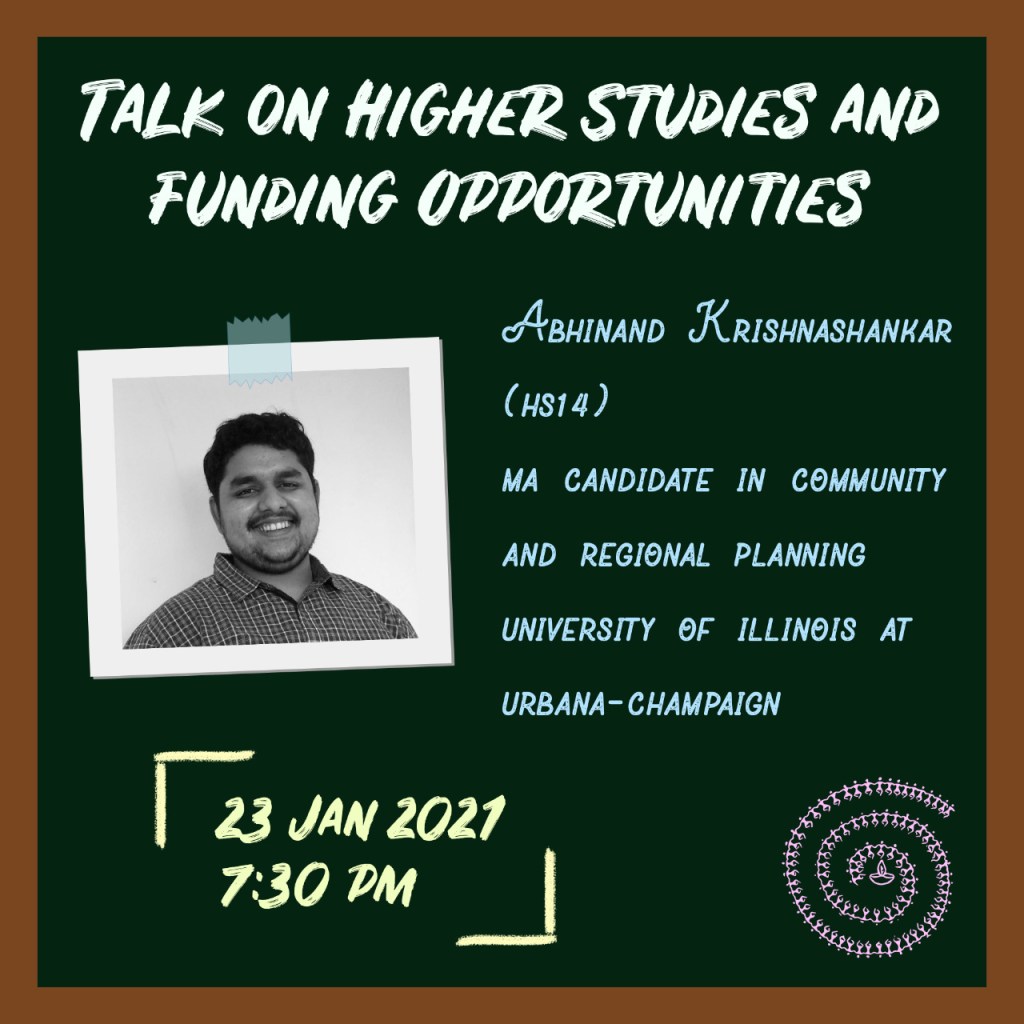
As part of the Placement, Apping and Competitive Exams Fundae Series organised by the Department Council, a higher session fundae session was conducted on the 23rd of January 2021. This was the first session of the series and it went on for about an hour. The fundae session was conducted by Abhinand of the HS14 batch, who is currently pursuing his M.A in community and regional planning at the University of Illinois at Urbana Champaign. The session followed a Q&A format and primarily focused on American higher studies experience. The major points of his session are given below.
In the session, Abhinand emphasised the importance of taking STEM category courses from a job perspective. Furthermore, it ensures an extended stay of three years in the US after graduation while others only offer a one year stay. He also says that even though STEM entails science, technology, maths and engineering, several schools offer courses that are similar to STEM and are suitable for us. Information about this can be gained from the respective websites and admission committee. Regarding choosing between an M.A and a PhD, he said that most of the US colleges offers in the format of M.A + PhD while most of the STEM category courses comes in the M.A format. M.A format is good for those who want to navigate the job market and allows a quick exit while PhD is largely oriented towards the academic job market.
According to him, a lot of factors go into choosing the best University for you. Funding opportunities are one of the most important things in this regard. Most US schools give two deadlines. To be considered for funding in the US, the application should be submitted by the early action deadline. Usually, the application fee can waived, if given a valid reason. He advises going through several websites and handbooks to filter down the courses that we prefer. It is also important to look at University rankings as well as the department ranking – the latter being more important. Another important thing to be kept in mind is living expenses, which can vary across states, regions and cities. Requirements such as GRE cutoff, TOEFL/IELTS, etc. are usually explicitly stated in the respective websites and handbooks. He also says that the PoRs that we do Insti can also be considered as work experience by the admission committee.
He says that it is imperative to have correspondence with admission committees early on. This will give the appearance of being consistently interested in the programme. Usually, applications require three Letters of Recommendation. Probably the most important component of the application will be the Statement of Purpose. SoPs should not be confused with Cover Letter. It should show one’s academic engagement, professional experience, professors you want to work with and should speak to why you want to be part of the programme.
Abhinand also gave a tentative timeline for the apping process. He advises using the summer before the year of graduation to look at potential programmes and school to attend. He also got his TOEFL and GRE by the end of July. It is best to spend September and October drafting the SoP. It is also the best time to let the Profs, who can be potential recommenders, know about your intent and interest in applying. He also stresses the importance of letting your SoP draft be reviewed by a number of people, including batchmates. The early deadlines usually fall during December and early January. Lastly, he talked about the Grad school experience itself, which is a potpourri of things, of relationships you build and friendships forged.
 Article 19