
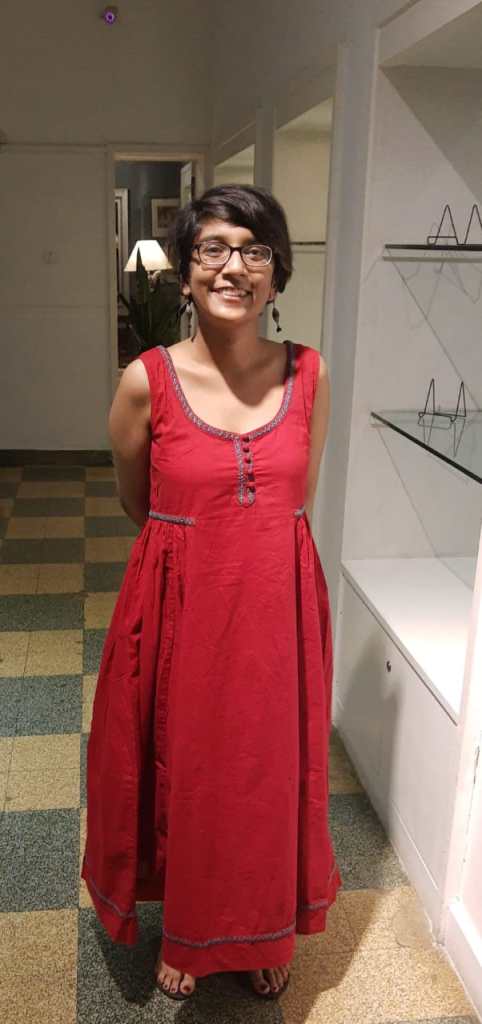
Madhura Balasubramaniam from the HS13 batch is a researcher. Article 19 correspondent Madhumitha R talks to her about her experiences in the field, within the department and after insti.
What do you love most about research, and what is most challenging about it?
What I love and find most challenging about research are very similar which is getting stuck with a question, a perspective or a piece of writing. I find that sometimes when I work on something for a while, and begin to read closely, engage in conversations and put together multiple perspectives, I get stuck. Sometimes the details begin to weigh me down and I find it hard to step away and find the broader perspective on where my work is going and the argument I wish to make. This is something I find very difficult about doing research. But this is also what I find most exhilarating about research. When I start thinking through the knots, something suddenly clicks. It could be just that one sentence that I wrote that day. But there is something very satisfying about crafting that one sentence with more clarity than what I could muster a few weeks ago.
Beyond this, working with and working through the ethical questions that research throws up is something that I find challenging as well as very important. What are the methods we choose? How do we think of research in a way that is collaborative and not extractive? There are no easy answers or quick fixes to this. Recognising and acknowledging power differentials and writing in a manner that is, over and above all, empathetic are thing that I am learning about through my research journey.
When you were a student, what were your interests and how did you balance this with academics?
I came to the department because I wanted five years of exploring, I didn’t have any plans. I didn’t want to specialise in any subject and I had no professional goals that I wanted to achieve at the end of 5 years. My only goal was that at the end of 5 years, I should feel like I had the space to explore all that I wanted, learn as much as I can and should feel like I have grown as a person. In some ways, it was a very liberating position from which to enter the department. I was in classes, I was learning and I was super thrilled. Outside class hours, I was looking for ways to learn more about what I was being taught in classes. I wanted to learn more about questions that interested me and also learn more about what it meant to do research in specific domains. In some ways, it tied in neatly with my academics. For example, at the end of my first year, I worked as a research intern and what I learned on the field was something that I was able to understand better when I did sociology in my second year. Simultaneously, my fieldwork informed the ways in which I engaged with the material in class.
Between my second and fifth years, I worked with Dr Sonika Gupta. We explored Chinese multilateralism and Taiwanese domestic politics and how the two functioned in the context of one particular intergovernmental institution (IGO) that we were studying. It was a great learning experience and more than anything else, it was a passion project that kept me going through the program and helped me feel anchored on the days when the program got too much to handle. In many ways, it was really the equivalent of having an extra-curricular activity and I had to figure out a way to balance my coursework and the project.
However, to give you a more conventional answer, I spent my second year experimenting with extracurriculars before I decided they weren’t for me. I worked as a coordinator with the Oratory Club for a year and was working with the convener to make public speaking a more accessible activity for students on campus. That was fun, I was also involved with the Department Conference that year, was a Project Representative for a NSS project and participated in LitSoc At the end of the year, I decided that this was not something that excited me. I was in the department to read, so I spent the next few years doing just that.
What are your fondest memories from your time in the department?
I met my best friend in the department and I am so grateful for that. I’m really glad that I also made some really good friends in the department. One of my fondest memories was watching the 2016 ODI World Cup semi-finals between India and Australia in the DCF. It started out with three or four of us, watching the match on one system. Soon, the DCF was full and we used the projector in the DCF to watch the match. That was a really fun incident because sometimes in the department we really have to plan to bring batches together but that day, the department just coming together spontaneously, was awesome!
I also really enjoyed a lot of the everyday activities of the department like going to the mess for lunch with a few friends, hanging out in the DCF, going for R & D lectures, catching up on how the day was, things like that. There was this one semester where every Friday, we would go and eat lunch at IRCTC (which I am told no longer exists). We also created an International Relations reading circle. While it ended quite quickly, it was great fun to actually do that. We had a great
time reading together.. It’s really the everyday things that I remember fondly and miss. I spent two years after graduating working on campus, and it was really the simple things like going to the mess to eat or hanging out and chatting with friends that I missed.
Some of the content that we study have the potential to alter our worldview and change views that we’ve held as students fresh out of school. Did anything change for you because of the department?
When I was out of school, I had set views on a lot of issues ranging from women’s rights to the environment. You name it, I had a view on it. I think what changed quite quickly into the program was that I learned to pause. I think that pausing is so important, especially in our times where the prevailing view is one of ‘you’re either with us or you’re against us’. The department taught me to pause, to listen closely and empathetically, and that it was okay to take my time to form a view. I also learnt that it was okay to not have ready answers. This was a very important transformation, something I’m very thankful for because I think it gives me the space to really think for myself, rather than feel pressured into sharing an opinion.
What was the most challenging about your time here and how did you deal with it?
Somewhere around the third or fourth year, I started feeling very bogged down by coursework and just being in the department. I was constantly feeling this kind of pressure that I couldn’t understand and I lost a bit of the pleasure that I had in the first two years of coursework. There was something so pleasurable about taking that time to learn, and stepping outside of the classroom and having the leisure to read. I felt like somewhere I started losing out on the pleasurable parts of the programme around the third year and the fourth year and that took a bit of a toll on me. I think it helps to have a passion project to which I could redirect my energies and find some of the pleasure of reading and engaging again. It really, really helped to have a bunch of wonderful friends. I think that’s something that we don’t speak enough about. Camaraderie and companionship are so important to navigating this department. Otherwise, you start feeling like you’re alone in making sense of your challenges. We lose sight of the fact that other people are also figuring this out along with you. Companionship makes all the difference because you know there is someone else who is walking a similar path and will cheer you on. It makes a big difference in coping with the hard times.
Which was your favourite course in the MA Programme?
I really loved the MA programme and there were really very, very few courses that I didn’t enjoy. In saying that, my most favourite courses were International Relations: Theory and Practice and China in Contemporary Global Politics, with Prof Sonika. I also really enjoyed Feminism: Theory and Practice with Prof. Mathangi, Globalization and Change with Prof. Santhosh, State and Development with Prof. Chella, Microeconomics with Prof. Bhandari and Econometrics with Prof Sabuj. In my first year, I felt very intimidated by the programme, by the professors, the course content and even by my classmates. I started withdrawing into myself, felt very conscious of what I was saying and doing and just stopped interacting in class. For me, Prof. Sonika’s International Relations really helped me find my voice at a time when I thought that I had completely lost it. Prof. Mathangi’s Feminism course built on that and together both the courses helped me gain confidence in my own skin, and in my place in the program. More than the academics aspect of this, the courses helped me grow as a person. Microeconomics and econometrics helped me learn to engage with questions from a different perspective. I was so sure that I would not understand or like economics. But that really changed and together, the interdisciplinarity of the program helped me consider and straddle multiple perspectives.
How did you decide your topic for your MAP thesis and what was your experience working on it?
By my fourth year, I was already exploring and learning more about how research is done in domains like foreign policy. At the same time, I was also interested in broadening my horizons a little bit. I had a free-flowing conversation with Dr. Sonika where we spoke at length about what I was interested in and she suggested some readings. My MAP topic emerged through these engagements and multiple conversations. I think it is very important to be open to conversations and to be okay with not having immediate ideas and topics. I do notice there is a common illusion about the MAP where it feels like everyone has a research question set in stone and you approach a supervisor with it and you work on precisely the same question as the one you started out with. But it’s never a linear process. For instance, I thought I would work on norm setting practices within international organizations but ended up studying India’s policies towards the Tibetan refugee community. My thesis explored the framing and implementation of the Tibetan Rehabilitation Policy and its impact on the political subjectivities of Tibetans living in exile in India. I had an absolute ball working on my MAP! The MAP came at a time when I was on a break from field research and I was not sure if it was something I wanted to revisit. It really helped that I had an amazing supervisor in Dr. Sonika. She helped me ease my way back to field work and engaged with me and addressed my many concerns over field research. I thoroughly enjoyed writing my MAP too. The process of receiving feedback, reading more, polishing sentences, paragraphs and most importantly ideas was incredibly helpful.
What do you miss most about life in Institute and being in college?
I really miss being around my friends in the department. I also miss the energy of the department. When you’re in the department, there is always a buzz of conversation about what someone is reading, watching, learning or doing, even when we are getting coffee at Usha to desperately get ahead of the 3 pm slumber mode. I miss the conversations a lot. I also miss hanging out in the DCF and later the department library and catching up with whoever walks in that day. I do not miss the monkeys one bit. I am thrilled to say that I can finally eat outdoors again without being hypervigilant to safeguard self and food from a stray monkey attack.
If you could change anything about your time in college, what would it be?
If there was anything I could change about the way I did the program, I would go back in time and tell myself to calm down, take it one day at a time and enjoy the experience. Sometimes when you’re in the thick of things, between coursework, other projects and passions, and managing lives outside the program, you get so caught up in the anxiety of going from one task to the next and you forget that you can take a minute to catch your breath and to just be. I think this would have helped me deal with the program with a lot more confidence and a lot less anxiety. I also wish I had taken my mental health a lot more seriously. I do think it’s important that we think of physical and mental health as important concerns to work on everyday, even as we juggle everything else. I am not suggesting that there are no structural issues here. I think it is a very important and valid critique for us to engage with. I did find that there was something about the way I engaged with the program that made me de-prioritize a lot of other things. This is something I wish I could have changed for myself, but also something that I wish would change within the larger context of the MA program itself.
How did you decide what you want to do after graduation, and how has your experience been?
By the end of five years, I knew that I enjoyed critical reading, engaging with texts, working with ideas and writing and also liked teaching. So I knew that I wanted to locate myself in research/academic spaces for a while. At the end of the program, I continued to work on some of the research that began with my MAP and I worked as a Project Associate on a project on the Tibetan exile community with Dr. Sonika for two years. My journey has been a bit tumultuous since then. I am currently taking a break and am in the process of figuring out my next steps.
Do you have any final thoughts for the current students?
It’s very hard to give advice in a programme that’s constantly changing and constantly evolving. If I had to say anything, I would take the program one day at a time, make friends and most importantly ask for help. It really helps to remember that you are not alone here though on some days it can certainly feel like that. Community is so important through this journey and personally through my time in the department, I have met some wonderful people who are friends and mentors for life. I would also say prioritize your physical and mental well-being. It is incredibly important and we don’t speak enough about it in my opinion.
 Article 19