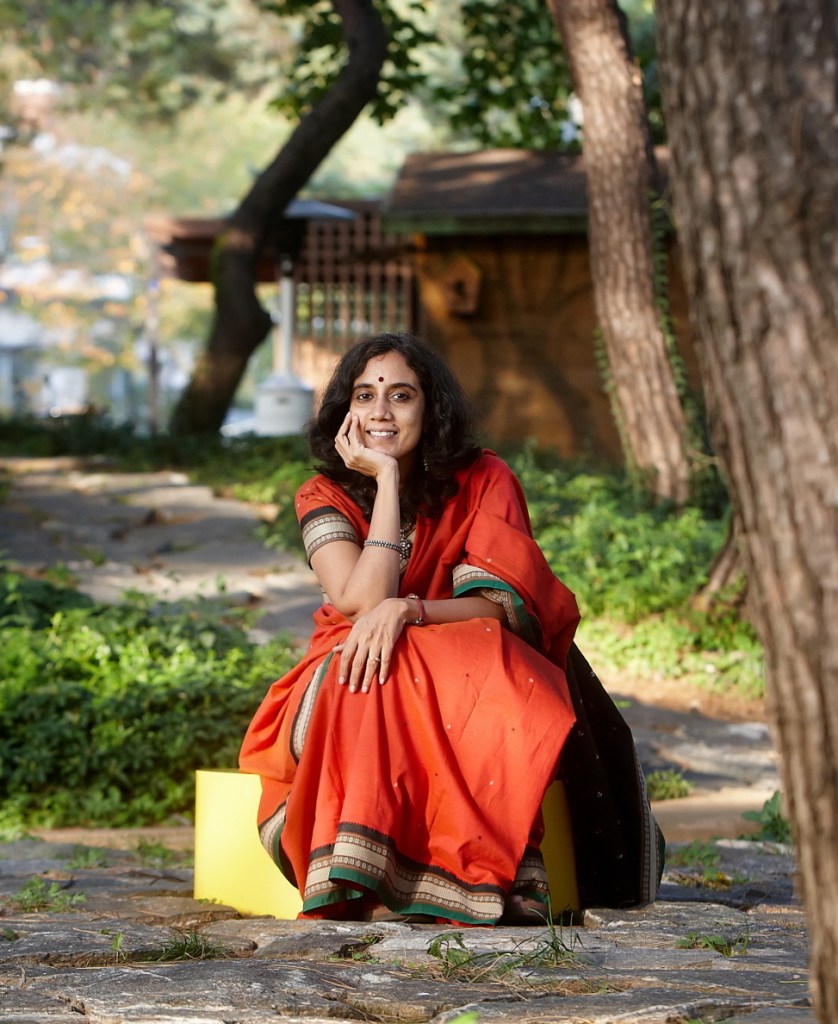
Professor Srilata, in addition to being a wonderful teacher is also a talented poet and writer. Her classes have succeeded in bringing a little bit of creativity and stories into the lives of her students. Here, Article 19 correspondent Lakshmi Priya talks to her about literature, poetry, books, corona and writing.
Can you tell us how or when you discovered the influence of poetry over you and how and why it became an important mode of expression for you?
I was an only child, happy in my own company. I grew up in the years before television and the internet. I read whatever came my way – poetry, novels meant for adults, even stuff I could make no sense of. Since we didn’t have too much money to blow up on books, I would borrow books from the school library, dip into the library of other folks – like an uncle of mine who owned a lot of books. So words felt somehow very important and gradually, without any conscious planning on my part, I started writing poetry.
Can you describe your writing process and how you overcome writer’s block?
I try and write something every day or whenever I can make time for it. I do take a break between large writing projects. For instance, a novel in Tamil by Vatsala – The Scent of Happiness which I translated with Kaamya has just come out. It took years of work. Following that, I began working on an anthology of disability writings that Amazon/Westland is publishing later this year. This did leave me a bit depleted so I took a short break from writing. But if you get out of practice it takes longer to get back – that is when this writer’s block begins to bother one!
What do you like the most about teaching literature? Also, how do you balance between being a writer and a professor?
I like teaching literature because it gives me a valid, professional excuse to read deeply and closely, to think about texts. I am used to the ebb and flow of the semester, having been a professor for close to two decades now. So my days are structured in chunks of preparation time, teaching time, writing time, and time for students whom I guide. What is harder is to account for personal and family time – there is all the work of being a mother and a daughter, sometimes a caregiver – all of which is non-negotiable but also something I signed up for.
Creative works are often born out of personal experiences and lived reality? Do you think the online Sem has influenced the kind of works produced by students – in the Creative Writing course or otherwise?
I think the experience of the pandemic is something that will stay with all of us for the rest of our lives – it can serve as rich material for writing but we will need time and distancing for that to happen actively. It is too early to say anything about how it has affected our writing or our work. It has altered our ways of being, for sure.
In what way has the corona and an online Sem affected your teaching and work process? Do you think such a prolonged online Sem is tiresome? And how have adapted to the changes?
I miss the energy of the classroom terribly. Teaching online doesn’t quite cut it. And the classroom as I knew it for years seems to have suddenly disappeared. But I have learnt new skills in terms of online teaching so I suppose that’s a gain. I do worry about the mental health of my students though. It has been very hard on so many young people. I am used to a quiet life, generally speaking. So I am probably coping better than most.
What are the three most important books in your life and why?
The three poetry anthologies Staying Alive, Being Human and Being Alive (Blood Axe books). The poems in them are stunning. I have always enjoyed dipping into them.
Finally, is there anything you would like to say to students struggling with this prolonged online semester?
Just hang in there. Right now, it seems as though there is no end in sight. But pandemics in history have run their course.

