
— Sharanya Kannan
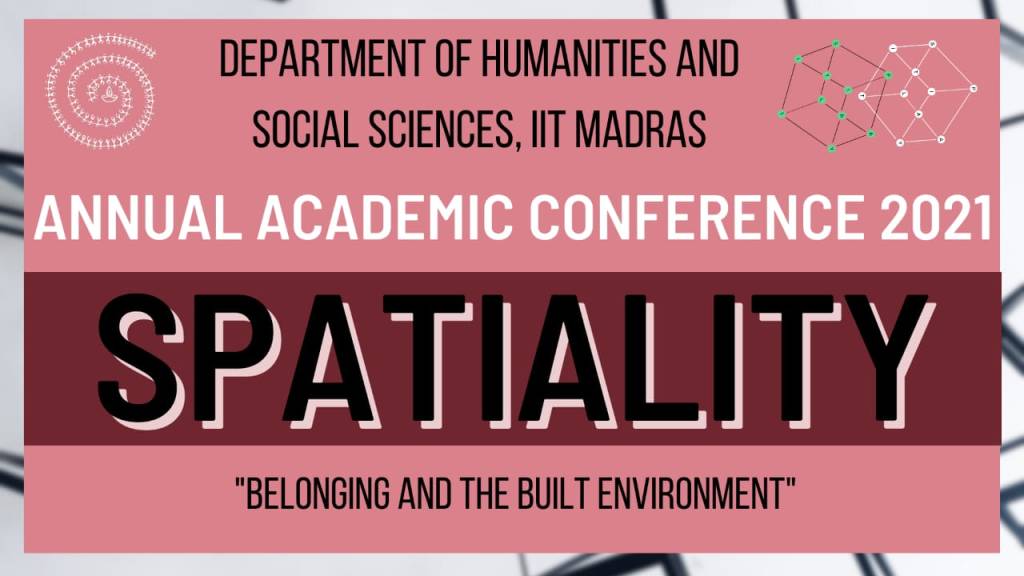
The second panel of the Annual Academic Conference series hosted by the Department of Humanities and Social Sciences was titled ‘Belonging and the Built Environment’. This panel consisted of 3 research scholars presenting their work on the creation and destruction of spaces during times of development and transition. It dealt with the various ways in which human life was remodelled because of these changes and how this in turn lead to an increase in diversity, but simultaneously added more classes to the already rigid class hierarchy. This panel was moderated by Prof. Prema Rajagopalan from the Department of Humanities and Social Sciences, IIT Madras.
The first presenter was Arundev VR from the Central University of Tamil Nadu. His research was centred around the novel ‘A Strangeness in my Mind’ by Orhan Pamuk. His paper was titled ‘Estranging Urban Sprawl: An analysis of the development of Istanbul and the life of the character Mevlut in the novel A Strangeness in My Mind’. It deals with the development of Urban dynamism in the city of Istanbul with specific focus on the life of a young migrant from Anatolia named Mevlut. The book captures the series of events that shape Mevlut’s life while simultaneously giving a tribute to the city. Upon keen observation, it is evident that Istanbul is not a mere location where the events unfold, but instead the city itself is portrayed as a character and this significantly shapes the plot of the book. Arundev’s work is based on the transformation of Istanbul from an ancient holy city to a modern capitalist city and the changes in spaces from rural to urban. These changes were a result of a symbiotic relationship between Mevlut and the city where they had a small impact on each other and grew together.
Additionally, his paper analyses alienation and estrangement of the character Mevlut as a result of the physical and cultural changes that the city undergoes. There is a complete change in physical as well as mental spaces. Arundev points out that this transformation of a modern capitalist city was accompanied by destruction of the past. Historic Ottoman buildings were demolished and replaced by modern workspaces. This gives out the idea of dehumanisation and disenchantment and paved the way for a more rationalised society. This urbanisation lead to the creation of distinct spaces in society, which are the global, the private and the meso level which is a middle ground that facilitates transition between the two. He also talks about cybernanthropes who are people overlooking the workings of this capitalist system. Overall, his paper explores the changes in physical and psychological spaces that take place due to the urbanisation of Istanbul.
Following this, Atriya Dey, pursuing MPhil in Developmental Studies with specialization in history from the Institute of Developmental Studies Kolkata presented his paper on ‘A Spatial Analysis of Markets and Infrastructure and the ‘Right to the city’ in a Smart City: A case study of Rajarhat New Town, Kolkata’. This paper is based on the Marx’s analysis of capitalism and its dynamic nature. This leads to capital accumulation which can be tackled by temptation dislocation of the capital on development of other spheres. This was proposed by David Harvey and termed a spatial peak. He put forward the point that despite expansion and urbanisation due to capital accumulation, there is always a connect to the old city. The social aspect of infrastructure is brought out the case of Rajarhat. He also touches upon the important role played by marginalised communities when they make use of gaps or spaces in infrastructure which the other sections of society haven’t used. These space making practices of the marginalised create modes of inhabitation in the city for them. This a one way in which people at the margins make claims to the city and the spaces it has to offer.
His paper then delves into the marketplace and how it is a space that allows interaction between all classes of people. It focuses on the impact that different groups of people have on the city and even street vendors have the ability to negotiate city spaces from the margins. The government hopes to transform the streets of Rajarhat by getting it cleaned and making it pedestrian friendly, but this may have adverse effects on some people whose livelihood requires the streets to remain the same. Thus, Atriya’s paper deals with these important concepts and how conversion to a smart city through development, capital accumulation and the marginalised communities have important roles to play in the management of spaces in a city.
The last presenter of the panel was Divya Malhotra, a doctoral scholar from the School of International Studies, Jawaharlal Nehru University, New Delhi, presented a paper on ‘Colour-coded Identity and struggle over land: Economics of displacement in Israel’. Divya’s paper analyses the distribution of spaces in Israel based on the notion of coloured identities and the impact it has on different communities. She goes over the history of Israel, the origins of the conflict and the concept of Aliyah (the return of people to the promised land). In 1947, the UNGA resolution 181 called for the division of the British ruled Palestine into a Jewish state and an Arab state. Despite this, the two communities were forced to live in a petite and explosive geography which only exacerbated the situation. Divya examines the concepts of spatiality that arose as a result of this toxic coexistence.
The paper brings up the spatial duality that was a consequence of the partition. There is a continuous and fluid Israel where it is possible to commute easily. On the other hand, there is a fragmented Palestine with obstacles to travel. There is also a hierarchy in access to public services, like healthcare, where the Jews are higher up in the priority order as compared to Arab Israelis. The UN Armistice Agreement divided Jerusalem into West (Israel’s control) and East Jerusalem (Jordan’s control), however after the Jordanian war East Jerusalem also came under the jurisdiction of Israel. This lead to the classification of Non-Jews. They were given the option to get a permanent residency status through a non-blue identity card or to undergo universal naturalisation and apply for Israeli citizenship (blue ID card). There was a second level of segregation based on religious affiliation and geography as well. She elaborates of the division of space in Jerusalem where all ethnicities are expected to coexist. Thus, to establish this the city is divided into four quarters. Overall, her paper deals with the restrictions to mobility and the division of space imposed by the Israeli government by issuing identity cards for all sections of society, therefore creating a hierarchy. Her research tries to come up with a better balance, with compatible visions from both sides, on the accommodation of the Arab community without Israel losing its fundamental characteristics as a Jewish democratic state.
All in all, this was an enriching panel that opened up new perspectives to the discussion on spatiality by taking into consideration various examples from the transformations occurring in the real world. It gives us new insights into discrimination and development, obstacles to expansion and the change in mindsets caused due to urbanisation. The papers dealt with predominantly political and economic issues, but highlighted the concept of spatiality that is inbuilt in all the scenarios presented.
Design by Conference Team
 Article 19