
— R Madhumitha
Introduction
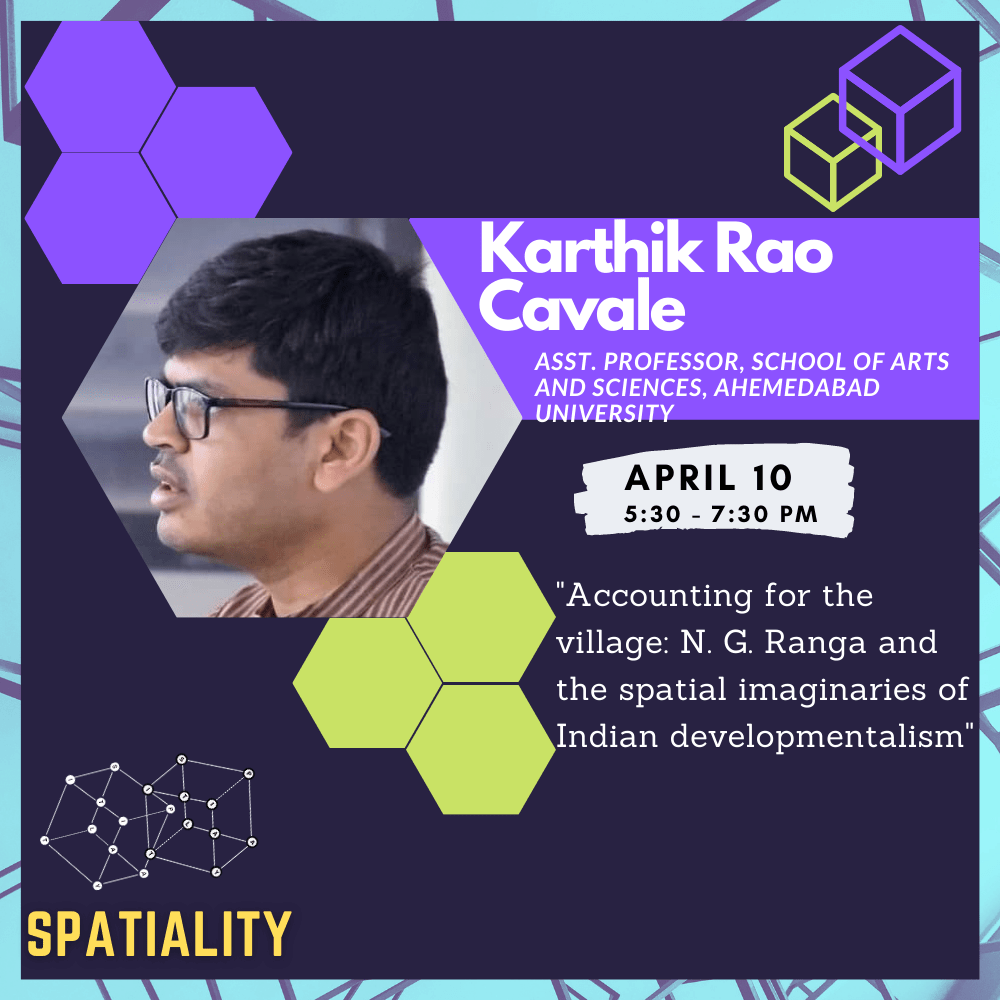
Karthik Rao Cavale is an Assistant Professor in the Division of Social Sciences in Ahmedabad University. He delivered the keynote lecture called ‘Accounting for the Village’.‘Accounting’ in this talk refers to a form of knowledge production, and broadly as how do you make sense of the village? Cavale examines the work of N G Ranga. A common feature of 19 th century colonial discourse on India had this impression of independent village communities, unlikely to survive the invasion of outside market forces. According to Marx, ‘The colonial regime is dragging the village from the sedentary village community into the national capitalist’. The central motif of the talk is the changing discourse of the 20 th century, spurred by the work of prominent economists like NG Ranga, and Gilbert Slater. community development projects. In the 1950s, villages would exist amidst the larger backdrop of a commodity community. This poses the central problem – if markets pose an existential threat to village communities, how can they exist in a market economy? Contrary to traditional exchange through customary agreements, agriculture is organized as commodity production. Then, how will the village community continue to exist and be the building blocks? The Indian Peasant, the ‘Kissan’ of political discourse is still an important figure of developmental discourse, but also an integral part of market systems?
Method

Cavale uses the theoretical framework with four units of analysis: These conceptions should be thought of as spatial imaginaries – what is the relation between underlying spatial practices and the changing spatial imaginaries? Is the peasant a market actor or someone who produces for himself? Cavale argues that the signifier and signified don’t have a one-to-one relation. If the first two form a discursive terrain, they are produced in relation to modes of knowledge production. How are truths produced? He says that these signifiers actually refer to a ‘referent’ and makes a theoretical departure from previous work. He aims to analyse ‘discourse’ in terms of: variation, selection and retention. How do variations come about in the dominant discourses, how do various social actors choose discourses to support their ideologies and how do these selected variations get retained as dominant? Cavale focuses on the first step – how does a variant get produced?
In the case of the ‘village’, the work of economists played an important role in generating a dominant variant. Economists developed new methods of knowledge production that served the demand of the anti-colonial political debate. They constructed the village community in economic discourse as an ahistorical object of study. By avoiding the historic trajectory of the villages, they are able to reconcile the village community and commodity production. Next, he speaks in detail about N G Ranga, Gilbert Slater and their contribution to the shifting discourses
N G Ranga, Gilbert Slater and shifting discourses
Most famous for being the founder of Swatantra Party, N G Ranga is a prominent politician and economist in India. He was born into a landowning peasant family, a wealthy family. A brilliant student, he was sent to Oxford where he was moved by the nationalist movement and chose to study a research degree under the guidance of Gilbert Slater. He came back to India and took on a teaching role in the Pachayappas college of Madras. Slater was the first professor of economics in Madras University. He found that most of the students were influenced by thinkers like Ranade and Naoroji. The common consensus of the 20th century was that the British rule was the cause of Indian poverty. Slater seemed to aim to neutralize this political effect by avoiding historicism and proposed a more grounded method of study. For his book, ‘Some South Indian Villages’, he conducted extensive fieldwork in a village in South Arcot district. This was the first systematic study of a village in a non-administrative context.
The village is taken as a given, the central unit of analysis. Collective action is based on the cultivation of cooperative instincts and not passive adherence to custom. Colonial discourse seeming progressive because they take a smaller share of the total produce. The nationalists will say this is a large sum of money. Ahistorical and empiricist shifted the question: How much are farmers actually earning. How much is being produced? They never asked about the cost of cultivation, Slater didn’t do this. the first person to do this was NG Ranga. Income became the measure of peasant well-being. Generated data on costs of cultivation. Now, peasants are fully integrated into the commodity economy. At the level of the imaginary, peasants are part of the economy. Evidence of surplus extraction. Village communities that are most cohesive, extraction is less. Village community autonomy is reimagined as non-exploitation. Thus, there is a shift from traditional Gandhian conceptions of autonomy as self-sufficiency to non-exploitation.
To conclude, the keynote lecture by Karthik Rao Cavale opens up avenues for a more rigorous method of understanding developmental discourse and was a most succinct and interesting lecture.

