
— Juanita Rose Thomas
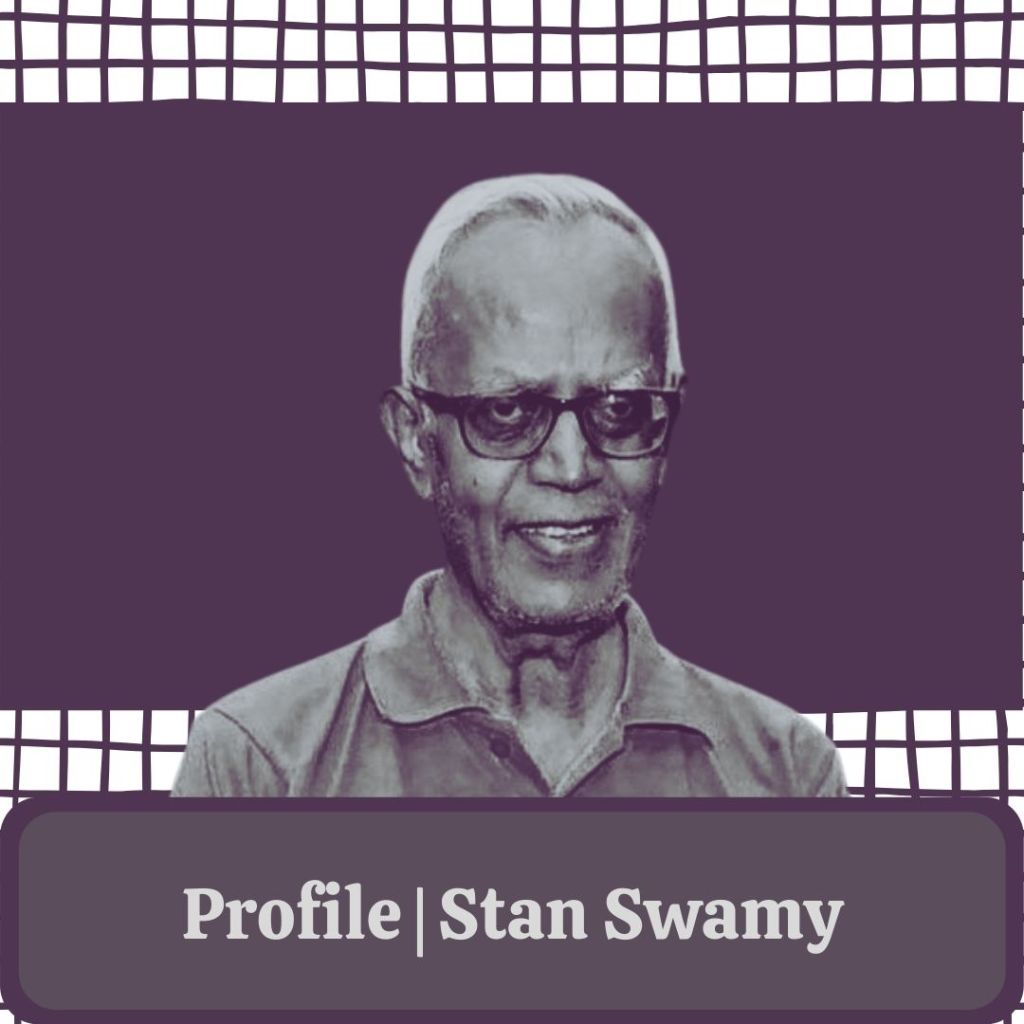
Stan Swamy was widely known as a Human Rights Activist. So, it was surprising for the country when he was arrested by the National Investigation Agency under Unlawful Activities Prevention Act (UAPA). “Human rights” and “terrorism“ are not words you often see together in a sentence or are they? In a democracy that pledges to protect each voice and opinion, Stan Swamy was convinced of his crippled possibilities and bleak future under the latest political scenarios. Nevertheless, he was continuing what he had always done – working for the tribals – in Bagaicha, Jharkhand till the minute of his arrest and fighting for democracy till the moment of his death.
Stanislaus Lourduswamy, popularly known as Stan Swamy, was born on 26 April 1937 in Trichy, Tamil Nadu. After his degree in Theology and Master’s degree in Sociology, he began working as the director of the Indian Social Institute in Bangalore. He worked closely among Adivasis and tribal communities in Eastern India, especially in Jharkhand and constantly questioned the government’s unwillingness to implement the fifth schedule of the constitution. When originally instituted, this schedule stipulates the formation of the Tribal Advisory Council, consisting solely of members from the Adivasi community, for the welfare and advancement of tribal areas in states. He also brought to the forefront the helplessness and desperation of the tribal communities that had their land taken from them in the name of dams, townships and industries. However, scandalous of all his work was his efforts to address the indiscriminate arrest of tribal youth by wrongly accusing them of being Naxals – a rather common story in tribal states like Jharkhand. No one would have guessed that Swamy would soon be part of those same stories until November 2018, when he was accused of conspiring, with many others, the Bhima Koregaon violence.
Bhima Koregaon violence
A small village in the Pune district of Maharashtra, Bhima Koregaon carries a lot of historical significance. The Bhima Koregaon battle dates back to 1818 when the British conquering India, part by part, reached Maharashtra which was then ruled by Peshwa Baji Rao II. Despite the latter possessing a superior army in number, the British made an unexpected success in the battle owing to their obstinacy and tactics. This was a great win for the Mahars of Maharashtra, who were an ethnic community in the state considered to be of lower caste and who composed a huge part of the company forces. This success, therefore, could not be studied solely under the lens of nationalism or divide and rule. It was, for them, a mark of the Dalit victory against the oppressing upper class under the Peshwa rule and is still considered by many Dalits as a point of their harmony and empowerment. With time, annual meetings commemorating the same came to be held with great enthusiasm by several Dalit groups.
Another key event marks the village Vadhu Badruk near Bhima Koregaon as significant due to its connection with Sambhaji Maharaj, the eldest son of Shivaji and the second Chhatrapati of the Maratha empire. Legend says that it was a member from the Mahar community who found the mutilated body of Sambhaji in a river and cremated it. There are memorials for both of them in the village, and this has long been a cause of tension between the Marathas and the Mahars as the former refuses to acknowledge this legend. Nevertheless, these conflicts have never gained much momentum till 2018, when the entire panchayath consisting of both the villages were thick with tension caused by the controversy around the cremation of the remains of Sambhaji Maharaj. The conflict between the Dalits and Marathas reached its peak point by 31 December 2017 and 1 January 2018. On 31 December 2017, a conference that included retired judges and other prominent people called the Elgar Parishad was held in Pune, Maharashtra, to celebrate the 200th anniversary of the battle of Bhima Koregaon. The following day witnessed violence in the annual celebratory meet, leading to the death of a 28-year-old and the injury of several others.
The art of deception
Initially, a First Information Report (FIR) was issued by the Maharashtra police against two members of a major Hindutva party for inciting the violence. However, the following days saw the police and the government actively pursuing the Elgar Parishad, the convenors associated with it as well as several mainstream activists for the same. From then on, Bhima Koregaon violence became yet another ticket on the hands of authorities to try their opponents without trial. Lack of sufficient evidence to succeed in the trial often meant that dissenters were connected with the Communist Party of India (Maoist) and booked under the UAPA. A number of human rights activists, including Varvara Rao, lawyer Sudha Bharadwaj, Arun Ferreira were arrested without enough evidence or using manipulated ones – as has been proven lately by forensic reports. Anand Teltumbde, Ambedkar’s grand-son-in-law, was arrested on the very occasion of Ambedkar’s birth anniversary for his alleged connection with Maoist groups. As soon as the case was handed over to the National Investigation Agency, more arrests were made based on seemingly far-stretched theories, including one plot for Prime Minister Narendra Modi’s assassination. The final act of brutality and bare enmity came in October 2020, when the 83-year-old priest and activist Stan Swamy was arrested for his connection with Elgar Parishad, which he, in reality, had never even attended. The Pune police had him as an accused, but the arrest was initially stopped by the High Court for lack of proper evidence until the unstoppable NIA stepped in. He was arrested on 8 October 2020, two days after he appeared in a youtube video expressing his concern and knowledge of an incoming arrest without sufficient grounds.
Stan Swamy died on 5 July 2021 while he was still in judicial custody. No, he did not win his long legal battles. No, he was unable to complete his mission of ensuring justice to the Adivasi community. No, he did not become a great hero for his deeds. Why does that even matter, when he, an 84-year-old man with Parkinson’s disease and various other ailments, was denied a straw to drink water (for the mighty NIA did not have a straw or sipper) or medical bail (for he wasn’t sick enough) or let’s just say, basic human dignity (for, he had irked the government)? A human rights activist who spent the prime years of his life fighting for justice fell prey to a hatred driven system that should have been nipped in the bud and has now grown enormously enough to instil fear in us. His fight for justice died in a hospital room on 5 July 2021 because no courts in India initially found his Covid-19 infection ‘deadly’ enough to be treated at a private hospital. No ‘great India Courts’ thought his appeals urgent enough to be heard unless already postponed two times in the very least. Two days after the court denied him proper hospitalization, he was directly put on the oxygen and then on the ventilator – never urgent enough.
The silence that had always shrouded the arrest and detention of Stan Swamy should not be allowed to last, for that will put out the last embers of our democracy. At a time when even the most trusted of institutions are forced into obedience, and the law of the country is manipulated to make the very process a punishment, the least one can do to honour the sacrifices of people like Swamy is to be another voice – a voice that need not origin from courage, but from desperation to live and die with dignity.
Further Reading
On the history and memory of the battle of Bhima Koregaon
Design by Rohit G
Edited by Lakshmi Priya & Madhumitha R

